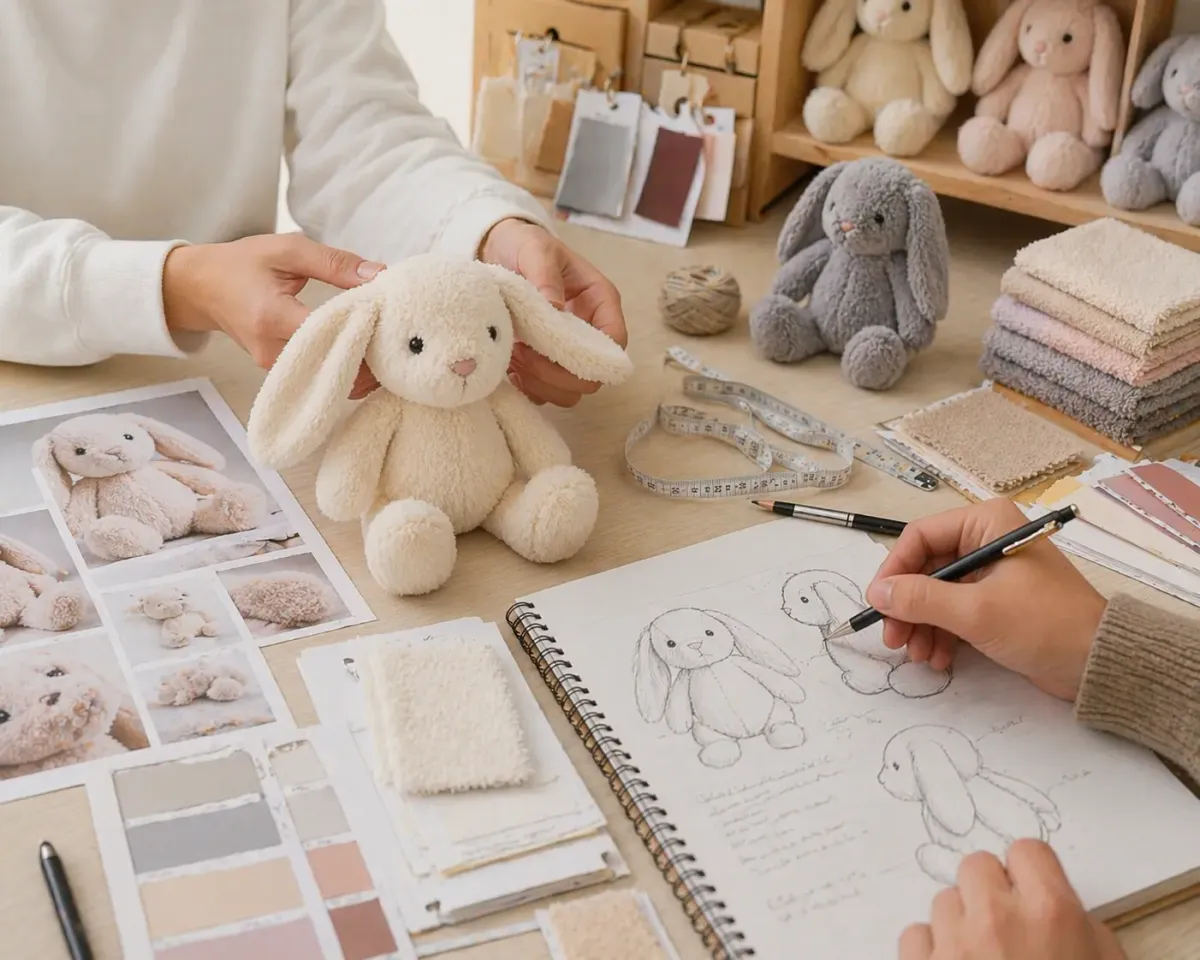
Plush is hand-sewn, so every missing measurement in a Custom Plush Toy RFQ becomes a judgment call on the factory floor. Each judgment call turns into a revised sample, a revised price, or both. That is why the RFQ, not the factory, decides how far apart the quotes land.
This guide is the 8-step process we walk buyers through before we price a plush toy. Budget 30 to 60 minutes. Done right, it removes weeks of sample churn, and the free RFQ template and tech-pack checklist at Step 7 make it faster to fill.
Key Takeaways
- The RFQ decides quote accuracy, not the factory. Market, age grade, dimensions with tolerances, quantities by phase, and delivery term must all be filled before unit price means anything.
- Sample and bulk are quoted separately. Prototype fee, revision rounds, MOQ per colourway and tier pricing each belong on their own line.
- Replace adjectives with numbers. Fabric GSM, pile height, fill density, stitch count and tolerance windows are what a sewing line can follow.
- Compliance is a line item with four owners. Name the market standard, who books the lab, who pays, and who holds the report.
- Compare landed cost, never the sticker price. Plush is volumetric; carton size and compression move the total more than the unit price.
- Canonical timelines: 5–7 days for a plush prototype after artwork approval, 30–45 days bulk after sample approval and material booking.
Prerequisites

Time: 30-60 min | Level: Intermediate
We built this process from the RFQs that reached a clean price without revision rounds. Every failed quote we have seen traced back to a missing input, not a difficult toy.
Minimum inputs:
- Artwork, target dimensions in cm, target market, intended age grade, intended use, target launch date, quantity tiers, packaging goal, delivery term, and approval owner.
Tech pack folder:
- Front, back, and side views.
- Close-ups of embroidery and trims.
- Reference sample photos labeled with names and measurements, not only colors or arrows.
- A draft BOM.
This packet lets a pattern engineer see the toy without guessing.
Primary method: Full tech pack plus RFQ sheet. For early concepts, use an email brief plus reference images. Warning: lower quote accuracy.
Team check: Sourcing owns the packet. Design confirms artwork. Compliance reviews age grading. Finance approves tiers.
⚠️ Safety First: Never guess child age grading. Do not treat "US/EU compliant" as a complete spec. Do not approve detachable components without review. Confirm the current requirement against the CPSC Toy Safety guidance and EU Directive 2009/48/EC. See our toy safety standards guide for how these map to a test package.
Custom Plush Toy RFQ: Smart 8-Step Guide From a Toy Factory
Write a plush RFQ factories can quote without guessing: specs in numbers, sample vs bulk tiers and compliance lines. Send us your sketch for a quote review.
Step 1: Lock the Commercial Boundaries Before You Write the RFQ
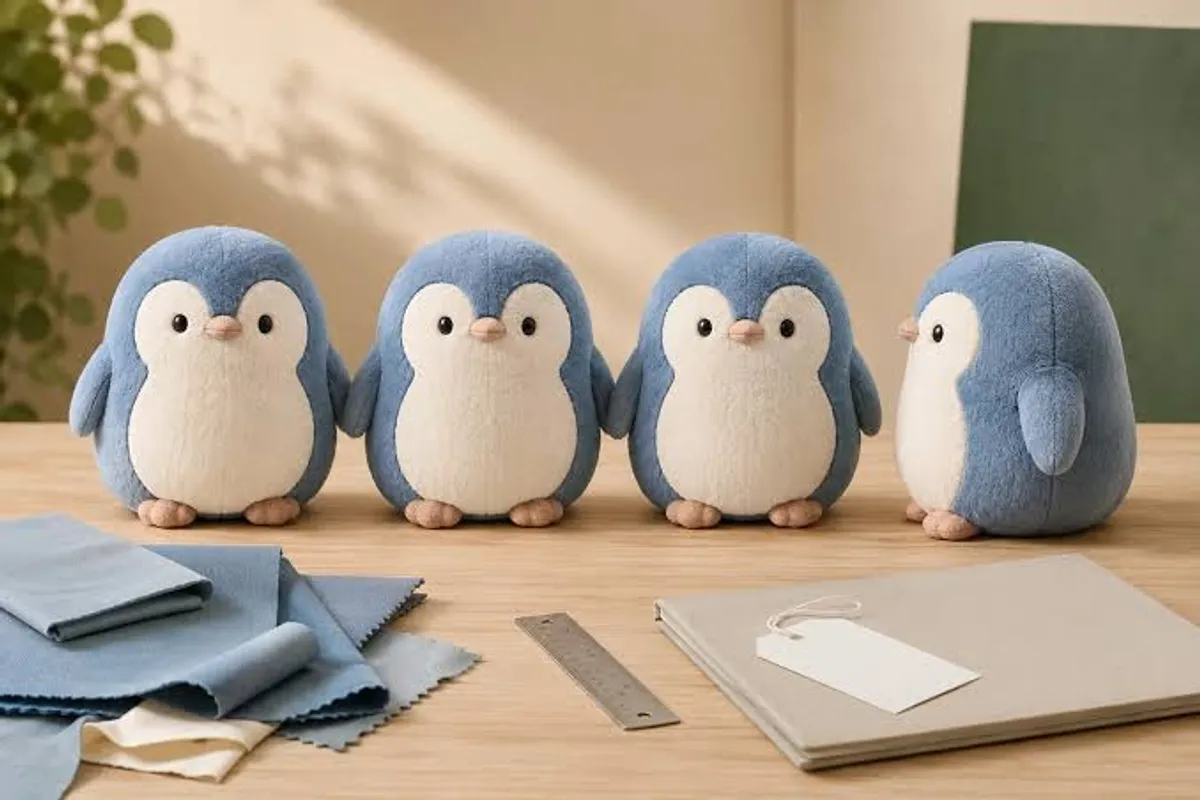
The cleanest RFQs we receive lock the commercial terms before anyone asks for a price. Define the destination country or region first, then the intended user and use, the launch window, and the delivery term. State whether this is a prototype, pilot run, or mass-production RFQ.
These inputs drive labeling, testing scope, packaging, and freight assumptions. Unit price only makes sense after they are fixed.
Use this mini checklist:
- Country and retail channel.
- Age grade and intended user.
- Quantity by phase: prototype, pilot, mass.
- Target arrival date and landed-cost basis.
A complete set reads like this: Market = US; Channel = Amazon FBA; Age grade = 3+; Quantity = 2,000 pilot, 10,000 mass; Arrival = June 15; Landed cost = DDP. Each line carries a value, and no line says TBD.
Packaging and labeling scope changes by channel. Amazon FBA needs an FNSKU label and e-commerce packaging, with the current requirements listed in Amazon's FNSKU help page. Retail shelves need shelf-ready boxes and barcodes. Promotional gifting often drops retail packaging and adds event labeling.
Verify by summarizing the project in one approval-ready sentence: "This is a 3+ plush for US Amazon FBA, arriving June 15, quoted DDP, at 2,000 pilot and 10,000 mass units." No TBD on market or use.
Related: how to find a toy manufacturer.
⚠️ Experience Warning: We received one RFQ with the launch date left blank. The factory assumed cheap sea freight, the shipment missed its retail window, and the first batch had to fly. Fill every field before you send the email.
Step 2: Assemble the RFQ Tech Pack
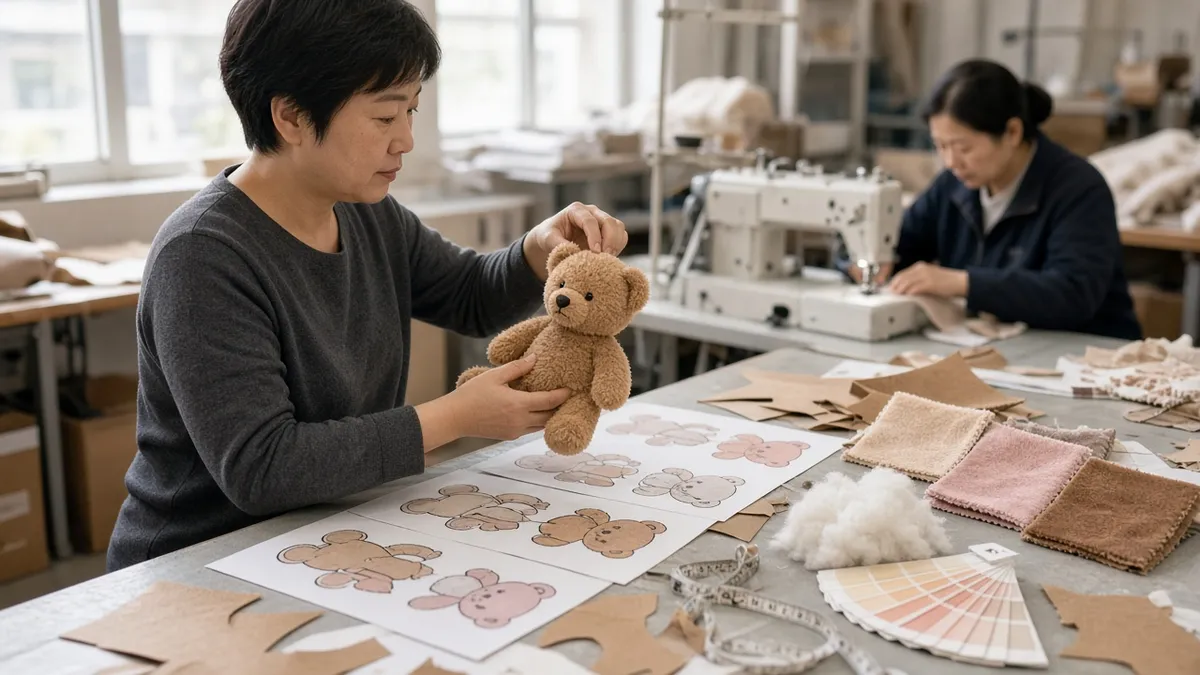
In our pattern room, we apply one test to every tech pack: could a second factory reproduce the shape from this file alone? If we cannot feel the shape balance and feature placement from the drawings, the pack is incomplete.
Start with front, back, side, and top views. Add finished dimensions in cm with tolerance ranges. Then the BOM: fabric GSM, stuffing density, trim and accessory list, and target compliance markets. Build the embroidery map, print map, and seam map. Note stuffing callouts and packaging notes. For artwork, ask for vector files when available.
Accept a layered raster backup. Add Pantone/PMS references and close-up callouts for details that affect labor. Hidden seams, weighted inserts, sound modules, jointed limbs, removable outfits, and mixed-material panels belong in a special-construction section.
Verification: hand the pack to a colleague. They should identify every external component without phoning the designer. Our toy production process and custom toy manufacturing guides cover how the pack becomes a sample.
Early-stage founders can use a simplified RFQ worksheet. Factories will price conservatively against it, and a full tech pack wins better quotes.
⚠️ Experience Warning: We once quoted a pack with no top view. The factory guessed the top gusset depth, the first sample arrived with a flat head, and the sample rounds restarted from the pattern.
Step 3: Replace Soft Words with Measurable Specs
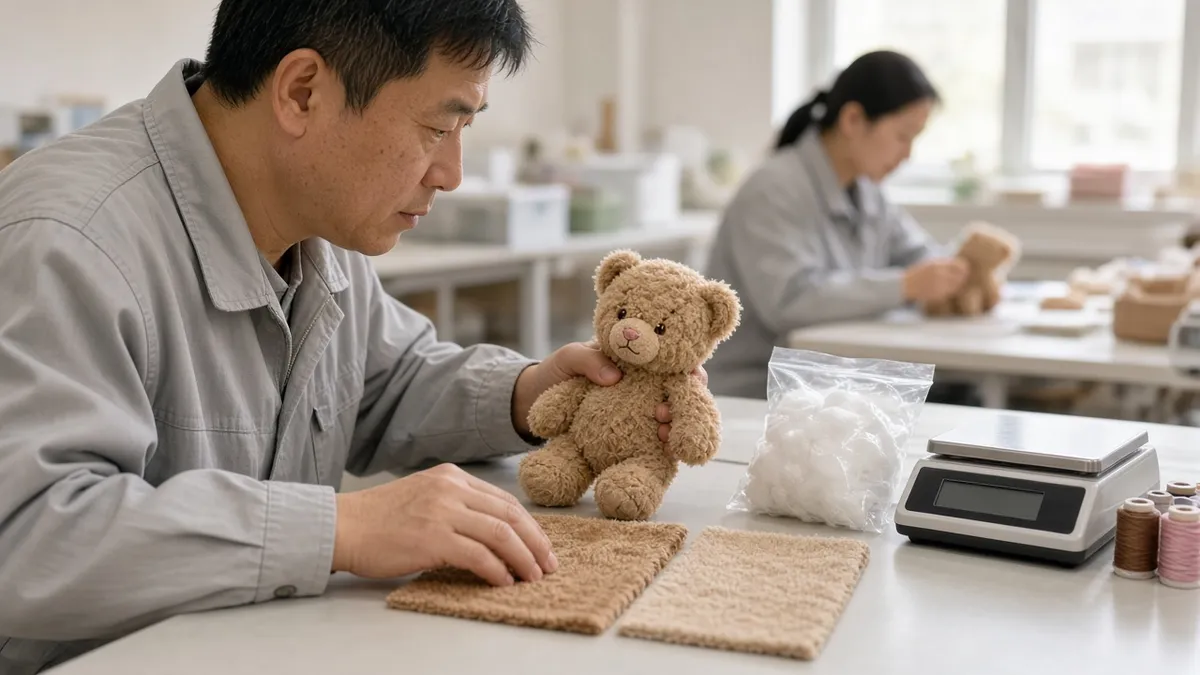
When an RFQ says "super soft plush" and "best stuffing", the quote answers the words rather than the toy. Sample revisions then close the gap at the buyer's cost. Measurable fields close it before the first quote.
As Eric Yang, Plush Stuffed Animals Toys Mascot Manufacturer notes, softness only becomes a specification once it is written as GSM, pile height and fill density — the three numbers a sewing line can actually work to.
Replace vague language with measurable fields. Lock fabric type, pile height, GSM, and color reference. Specify stuffing type, fill density, and target weight. Add embroidery thread, eye type, and trim material.
For fabric, list one primary option and one cost-down alternative. Do not let the supplier choose. Example: primary 2.5 mm pile, 320 GSM polyester velboa; cost-down 1.5 mm pile, 260 GSM. This prevents silent downgrades.
Specifying both options tightens quote accuracy and flags compliance risk early, especially on trims and eyes. See non-toxic toy materials and toy cost breakdown.
We perform a hands-on check on every first sample. Squeeze the plush body tightly: it must feel firm and solid, not lumpy. After the squeeze, the cover should recover fully within a few seconds; compare that recovery against the sealed approval sample, not a stopwatch.
Run a palm against the pile: smooth one way, rougher the other. The head can sit slightly firmer than the body, never harder.
Verification: Get three approvals before quoting: approved swatch, approved fill feel, and approved feature method.
On smaller sizes, switching exposed safety eyes to embroidery removes a small-parts question entirely and cuts assembly time.
Step 4: Translate Design Intent into Production Language
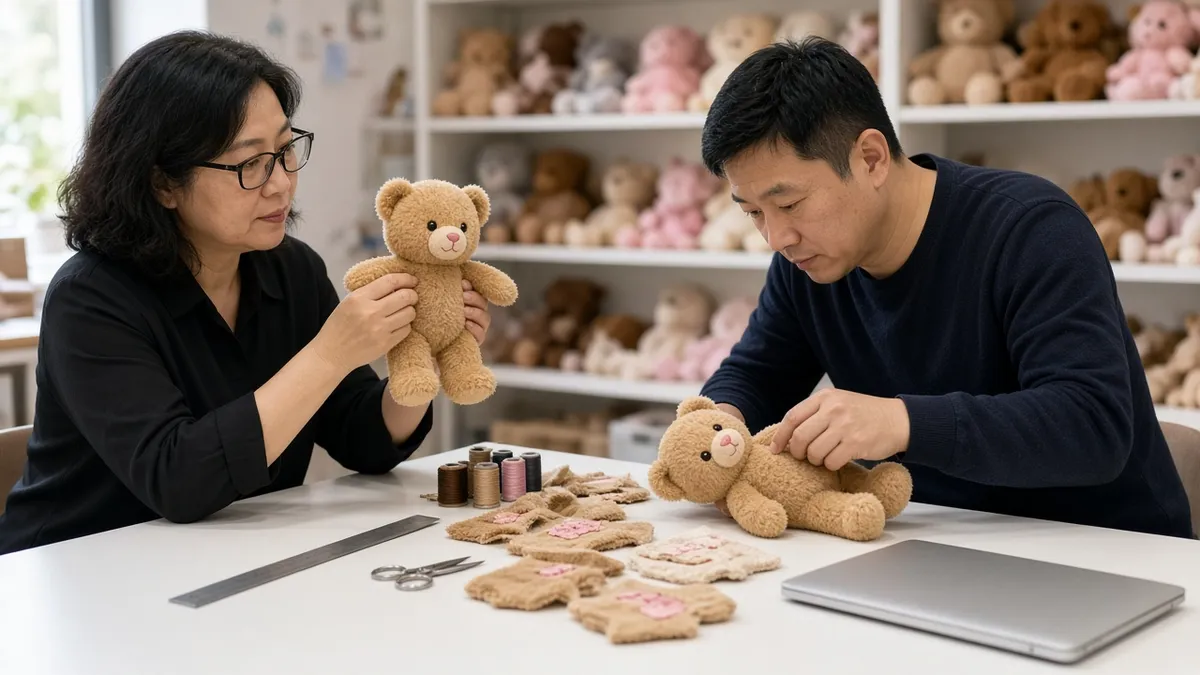
Design notes like "balanced symmetry" mean nothing on a sewing line. We convert sketches into hard numbers in our China sample room before any quote is prepared.
Write these lines into the RFQ:
- Seam allowance: 6 mm visible, 9 mm hidden.
- Stitch density: 10 to 12 stitches per inch on load-bearing seams.
- Decoration: appliqué for layered shapes, embroidery for fine detail. Name stitch count and layer count.
- Print area: 12 cm by 12 cm, measured from a named seam.
- Accessory attachment: bartack, lock stitch, or safety-eye locking washer.
- Tolerance: finished height ±1.0 cm, width ±0.8 cm, feature placement ±3 mm.
Make the quote table show embroidery stitch count, appliqué layers, print area, heat-transfer steps, and digitizing fee. Compare alternate decoration methods only when that table shows clear price and quality tradeoffs.
Write placement from a seam or edge. Do not write "logo on the left side." Write "logo center 35 mm from left side seam, 20 mm below neck seam."
At the sample stage, inspect symmetry at arm's length. One ear 4 mm low or eyes 2 mm off-center is a reject. Run a thumb along a seam. Clean alignment feels flat, not stepped. Misalignment looks like a wave or a step.
For bulk, agree the inspection plan before production starts. Our AQL 2.5 standards guide explains how the accept and reject levels map to cartons.
Make the supplier repeat the construction method and tolerance range in the quote or sample comments. Ask for it in writing.
A 4 mm seam where the spec said 6 mm is not a small difference. It changes how the seam holds under stuffing pressure. Tolerance lines exist because the default is the factory's habit, not your standard. The same logic runs through our toy quality control checks.
Step 5: Request a Line-Item Quote and Separate Sample from Bulk Quantities
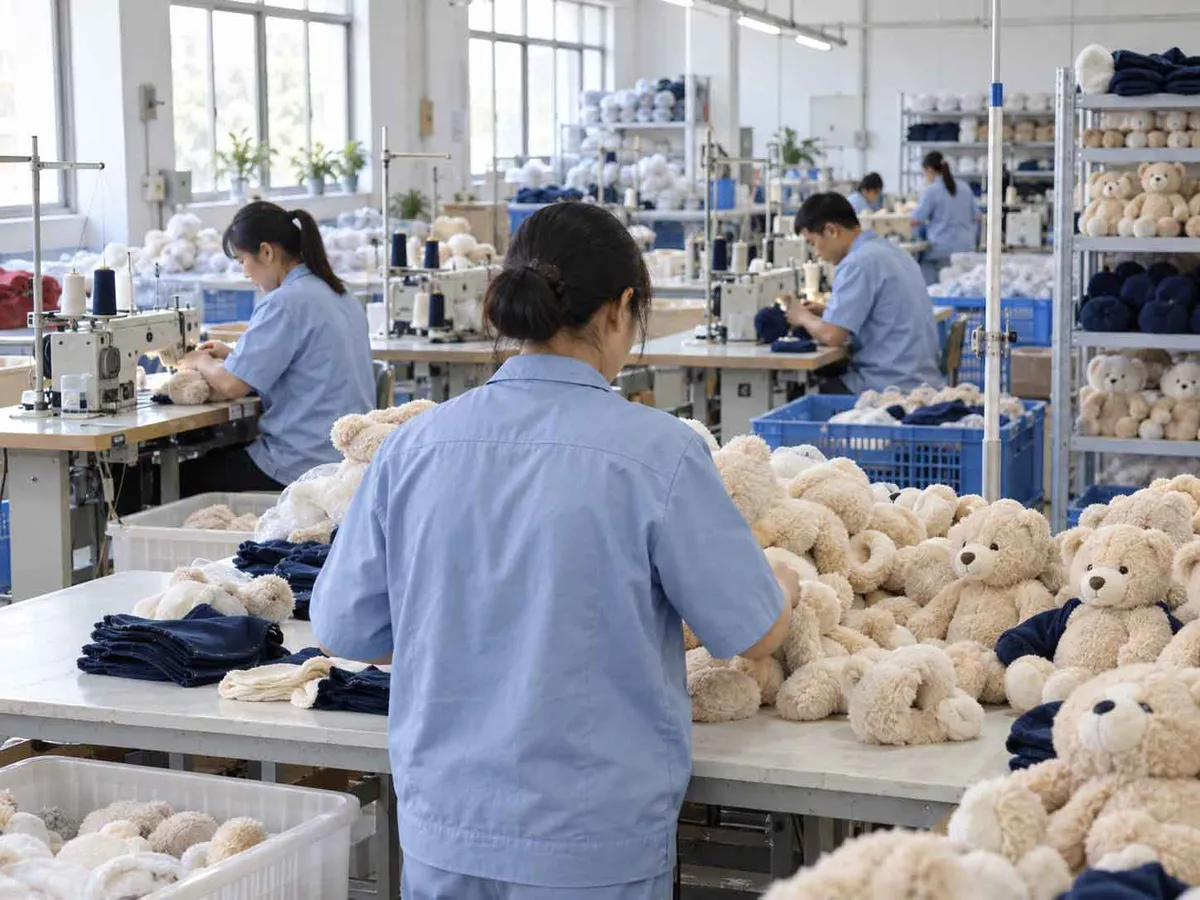
A quote that folds tooling into the unit price hides the MOQ logic. When the order doubles, the unit cost barely moves, and nobody can see why.
Ask for separate line items: prototype fee, included revision rounds, sample freight, embroidery digitizing, mold/tooling (if any), MOQ per design/color/size, and quantity-tier pricing for bulk.
Put sample quantities and mass-production quantities in separate tables. For each table, request lead times: sample lead time (typically 5-7 days after artwork approval), express shipping time (3-5 days), and bulk lead time (30-45 days after sample approval and material booking).
MOQ changes when fabric, trims, or colorways change. A new fabric may require a minimum dye lot. A new trim may have its own MOQ. A new colorway may require a minimum print run. Those minimums are why tier planning belongs at the start of the toy supply chain, not at order confirmation.
Verification: A trustworthy reply states: "Sample lead time is 5-7 days after artwork approval. Bulk lead time is 35 days after sample approval and material booking." If the answer omits dependencies, request a revision. See our MOQ guide for how tier pricing is usually structured.
⚠️ Experience Warning: A buyer once split a 1,000-unit order across two colourways and met a dye-lot surcharge that was never quoted. Ask before you split: "What is the MOQ per colorway, and what is the surcharge for splitting a dye lot?"
Step 6: Quote Compliance as a Separate Line Item
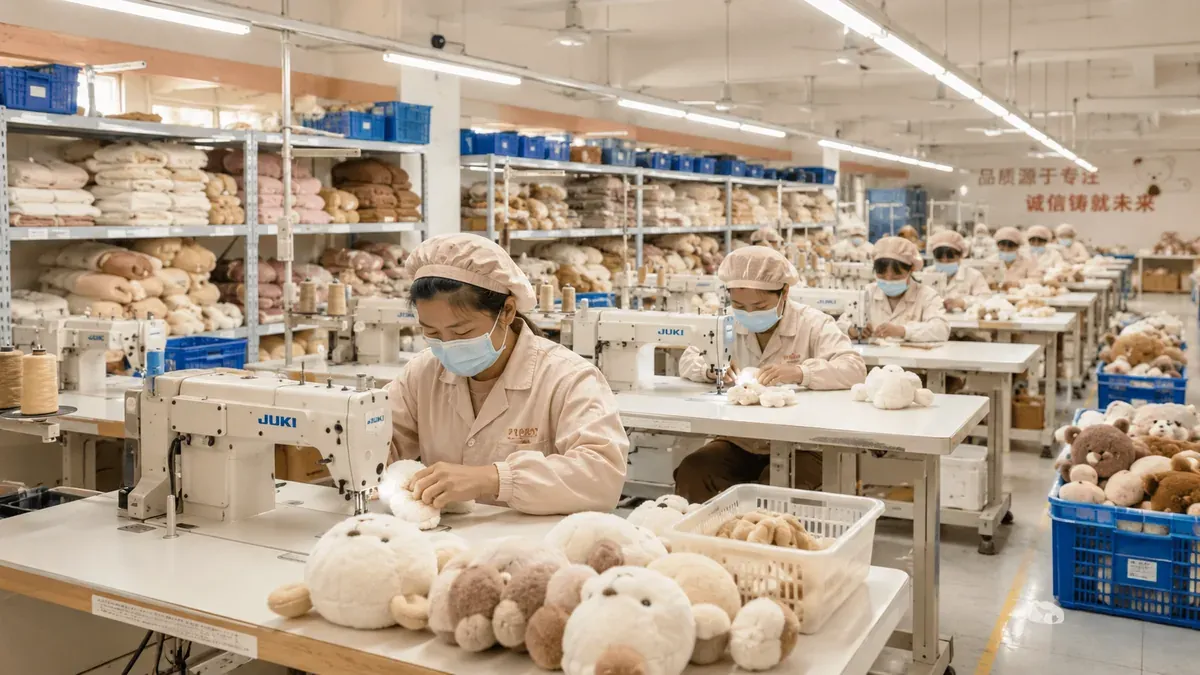
Compliance is risk control, not legal theater. What the RFQ must name depends on the product and the market. Where the toy is a children's product sold in the US, name ASTM F963 and CPSIA, and state that a Children's Product Certificate is required. For the EU, name EN71-1, EN71-2 and EN71-3 testing, plus a technical file kept for ten years.
CE marking is applied by the manufacturer or the importer of record. The RFQ should state who holds that role, because a factory does not "include" a CE mark by default. Tracking labels follow the same rule: they must identify the manufacturer, importer, and production run on the product and packaging, as the CPSC tracking-label guidance sets out.
Then ask the supplier to quote compliance work separately from the unit price: testing fees, documentation, labeling setup, tracking-label requirements, and retest assumptions after material changes.
Require the quote to state four owners: who books the lab, who pays, who receives full reports, and who handles importer or manufacturer paperwork. Ask for this in writing. A careful factory pauses to clarify assumptions instead of guessing.
Treat "free safety testing" as a question, not a benefit. Ask exactly who pays the lab fees, and demand legal ownership of the final test report.
Verification: The reply must list assumptions, exclusions, and cost basis: per SKU, per material family, or per submission round. If those are missing, send it back. Our CPSIA compliance for plush toys and EN71 compliance guides break down what belongs in each test package.
Change-control note: Any substitution of fabric, stuffing, accessory, or print method must be flagged before production. That change can affect compliance and cost. Buyers who accept "all certificates included" usually discover the retest question only after a material change, and the fee and delay land on the importer.
Step 7: Build the RFQ Email and One Comparison Sheet
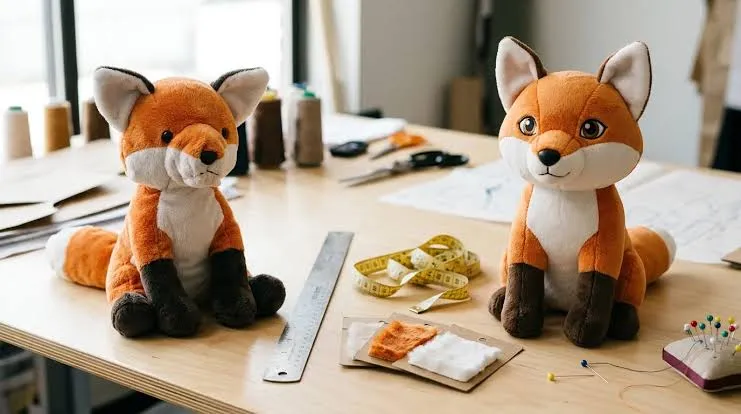
The send-out package decides quote quality. One fixed email body plus one attached quote sheet keeps replies comparable. The same structure runs through our toy sourcing guide.
Download the free Custom Plush Toy RFQ template and tech-pack checklist. Structure the email in four blocks: project summary, filled fields, mandatory instructions, attachments.
Fill every field: product name, market, age grade, dimensions, tolerance, fabric GSM, pile length, stuffing density, decoration method, packaging, quantity tiers, compliance scope, target Incoterm, sample timeline, bulk timeline, and approval notes.
Attach the quote sheet with those exact columns. Add this mandatory line: "List every assumption, exclusion, material substitution, revision limit, sample-fee refund term, and item not included in unit price." Serious factories reply with clarifying questions or structured attachments. A generic one-line reply is a warning sign. Send it back or drop the supplier.
Verification: Drop every supplier reply into the one comparison sheet. Each row must map to the same columns. Missing fields stay visible as gaps. Our custom plush manufacturer page shows the line items we price most often.
A quote can look cheaper per unit until freight and labels appear. The "not included" line is what keeps the comparison honest.
Step 8: Build a Landed-Cost Comparison Matrix
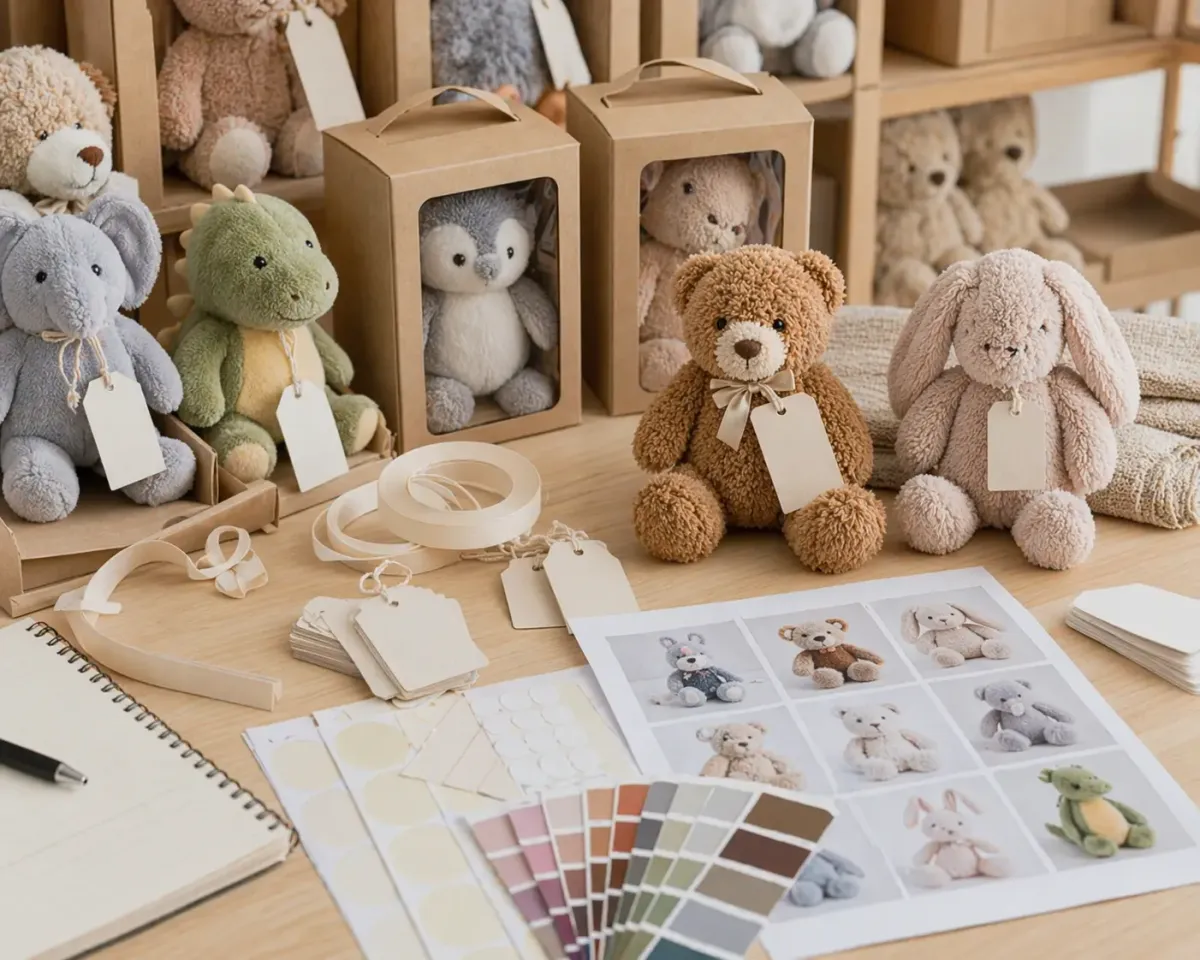
Quotes become comparable only after every reply sits in one sheet. Open a spreadsheet with one row per supplier:
| Supplier | Unit price (DDP) | Sample + testing | Carton and freight | Notes |
|---|---|---|---|---|
| Factory A | ||||
| Factory B | ||||
| Factory C |
Convert every column to landed cost before you compare rows. Never rank suppliers by EXW or FOB sticker price alone.
Plush is volumetric. Carton size, compression or vacuum packing, and the final fulfillment destination change total cost more than most buyers expect. Ask each factory for carton dimensions, units per carton, and gross weight.
For Amazon FBA, add barcode, polybag, and carton compliance to the matrix. Our USA plush fulfillment guide covers the prep.
Now screen red flags. Reject very low pricing with no breakdown and no exclusions. Reject "testing included" with no scope. Reject refusal to video-audit the factory.
Also reject vague sample terms, silent substitutions, and answers with no clarifying questions. A quote that feels too smooth is a warning. Our plush toy supplier red flags list covers the patterns we see most.
Verification: Choose the supplier with the clearest scope, controllable risk, and best total commercial fit. Do not choose the lowest ex-factory price.
⚠️ Experience Warning: We have seen a quote with no freight assumptions win a comparison and lose it at the port. The difference sat in dimensional weight once carton compression failed.
Troubleshooting
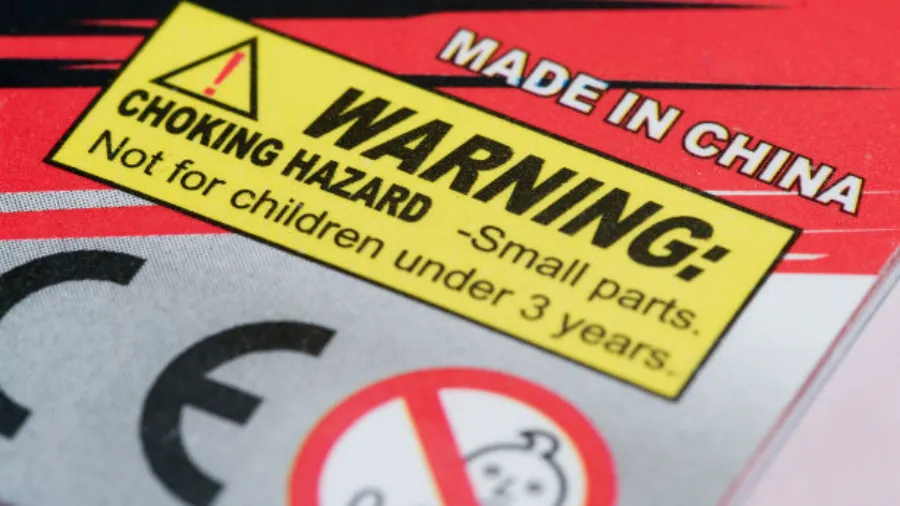
We have watched the same four RFQ failures stall real orders. Here is how we close each one before quotes go out.
Blurry Artwork and Missing Views
Buyers send one front view. Factories guess the back, then quote a different toy. Require three-view art, cm dimensions, and a component list. Then read the reply: a real quote cites your measurements. A weak one says "similar to a photo." "Can I send an RFQ without a final design?" Yes, if you label it concept-stage and accept a wider range.
Mixed Sample and Bulk Quantities
One table for prototype, pilot, and mass production hides MOQ logic. Split it into three. Ask: "What is the MOQ per colorway, and the surcharge for splitting a dye lot?"
"Testing Is Free" or "All Certificates Included"
That usually means a reused report or lab fees buried in unit price. Ask for lab scope, payer, report owner, and retest rules. "Can an old test report cover a new plush?" No. New material or a new factory means a new submission. "Who handles compliance paperwork?" The importer of record, unless the factory accepts it in writing.
Low Quote, Vague Scope, Reused Photos
A quote far cheaper than the field, with no exclusions, is a warning. Force assumptions, exclusions, substitutions, and freight basis into writing. If photos look reused or the factory refuses a line tour, ask for a video audit, recent production proof, and an inspection path.
"How long should a reply take?" Serious factories answer in 2 to 3 days. A one-line reply with no questions is a red flag, however fast it arrives. The toy sourcing risks checklist covers the rest.
💡 Diagnostic: Squeeze the sample. Thin pile or a solvent smell means bulk will not match your swatch.
🛡️ Prevention: Get tolerance in writing: finished height ±1.0 cm.
Q&A: What Our Sourcing Team Gets Asked Most
Q: Top 3 fatal fabric mistakes? A: Naming "soft plush" without GSM or pile height. Skipping the cost-down option. Omitting the swatch-to-bulk standard.
Q: How should buyers state tolerances? A: In numbers. "±1.0 cm finished height," not "close enough."
Q: How do you block bait-and-switch? A: Seal an approved swatch, test bulk against it, and write the rejection clause into the PO.
Bottom line: Failure is rarely bad luck. It is an unresolved assumption at the RFQ stage.
People Also Ask About Custom Plush Toy RFQ
-
How many factories should I send my custom plush toy RFQ to?
Send it to three to five factories. That range gives you enough spread to spot an outlier without drowning in replies. Fewer than three and you cannot tell a fair price from a lucky one; more than six wastes review time. Serious factories reply in two to three days.
-
Do I need a full tech pack to get accurate plush quotes?
No, but quote accuracy drops sharply without one. A concept-stage RFQ with a sketch and a brief still gets quoted, with wide ranges and more sample revisions. A full tech pack with dimensions, GSM, fill density and decoration maps brings quotes onto the same basis. Label a concept-stage send clearly and accept the wider spread.
-
What is the biggest reason plush quotes come back inaccurate?
Vague specs. Words like "super soft" and "best stuffing" are not specifications, so each factory prices its own assumption. Quote against GSM, pile height, fill density and measured decoration placement, and the replies converge.
-
How do I compare plush quotes that use different delivery terms?
Convert every quote to landed cost first. Plush is bulky, so carton size, compression and units per carton move the total more than the unit price. Ask for carton dimensions and gross weight, then put every supplier into one matrix.
-
Can I use an old test report to cover a new plush order?
No. A new material, trim or factory means a new submission. Ask four questions in writing: who books the lab, who pays, who owns the report, and what triggers a retest. The CPSC Toy Safety guidance covers the US baseline.
Conclusion
You have the exact system we use daily. Download the RFQ template, complete the checklist, and send it to your factories today. This process eliminates factory guesswork. It secures accurate pricing for your brand.
Download the RFQ template above, fill it in, and send it to your shortlisted manufacturers. If you want a second set of eyes on a reply, contact LeelineToys for quote review or factory-direct manufacturing support.
Disclosure: LeelineToys is a manufacturer. We share the same SOPs we run on our own floor. This guide provides operational advice straight from our factory floor. It does not replace formal legal counsel. Verify all safety regulations with a certified testing lab before you pay for any production tooling.
Do the work once, and you get better quotes, fewer sample revisions, tighter margins, and far less sourcing risk.