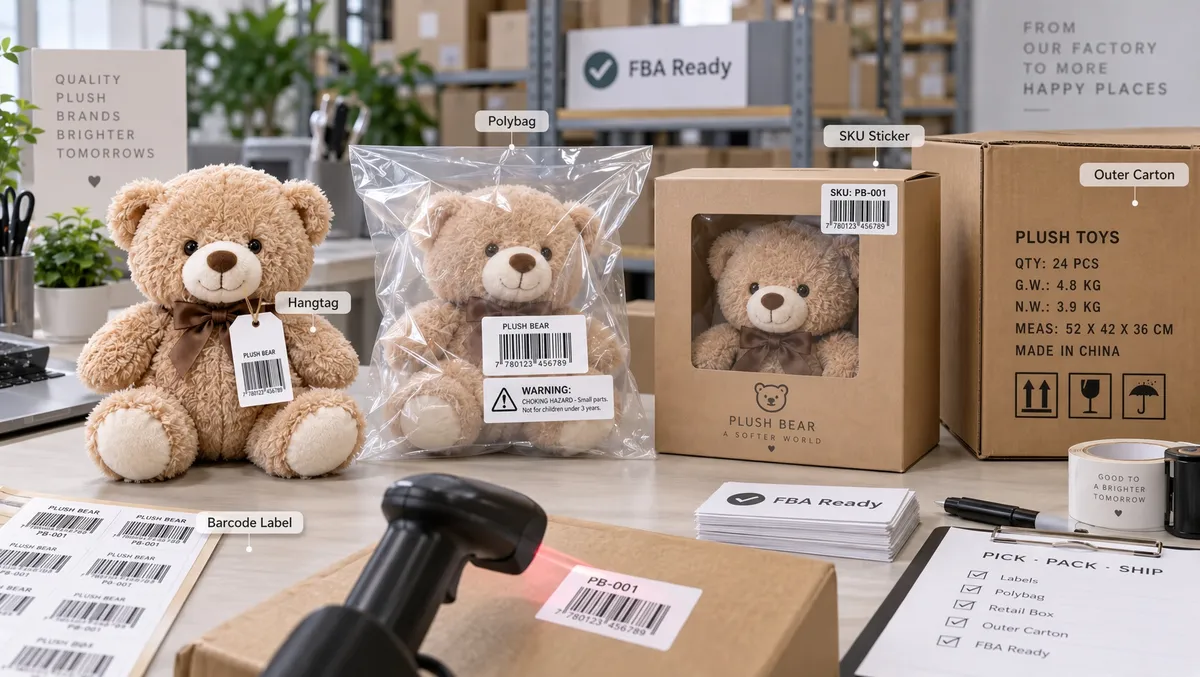

A 12-inch plush can pass sewing inspection and still be rejected at FBA — the bag lacked a suffocation warning, and the barcode sat under a seam. We rebagged the entire lot. This is why Amazon FBA plush packaging decides whether your inventory arrives clean or gets rejected.
Our toy packaging design guide covers the format choices we audit. Below are the 8 FBA plush requirements our factory checks on every order — from a real compression teardown to the SOP we run before freight handoff. As a custom plush manufacturer, we run them on the floor, not just on paper.
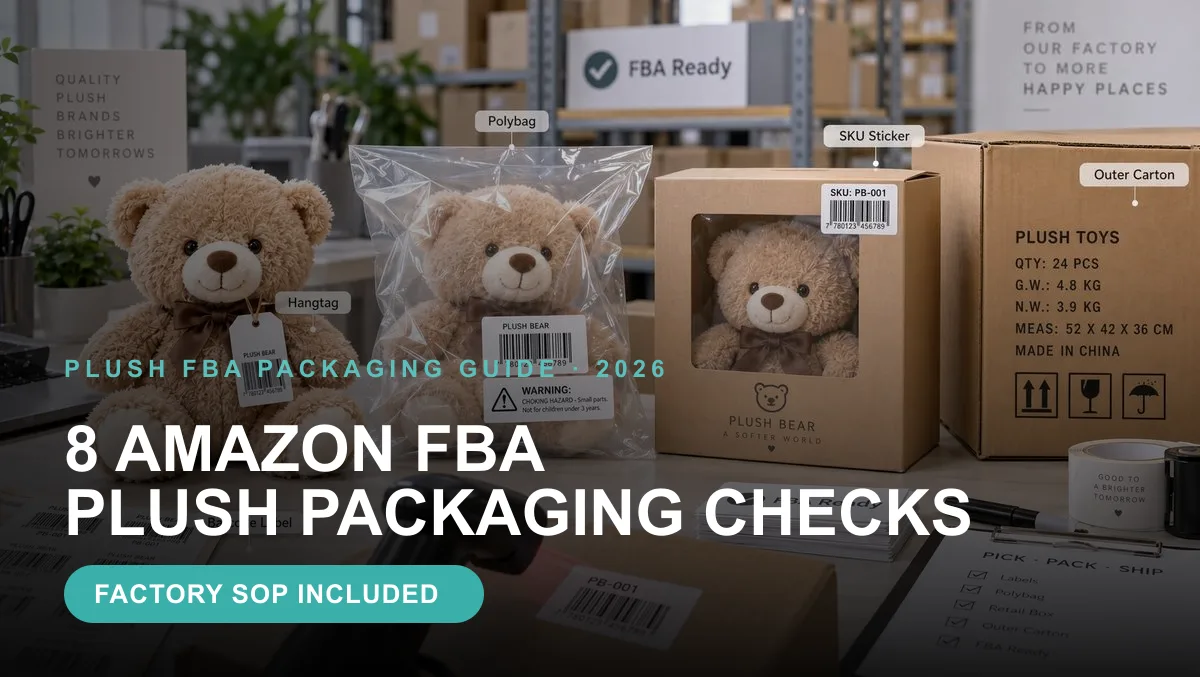
Key Takeaways
- Seal the whole unit. Amazon requires a sealed, transparent poly bag that fully encloses every plush — no exposed fabric, no open-face box.
- 1.5 mil LDPE is the floor. Thin film tears in transit, and a weak heat seal fails even on thick film. Thickness and seal strength both have to pass.
- Warn at a 5-inch opening. Measure the bag opening, not the flat bag, and print a legible suffocation warning at 5 inches or wider.
- Keep the FNSKU scannable. Apply it to the bag's smooth face, back it with rigid card if needed, and scan-test before sealing.
- Bag to packed size. More than 3 inches of film tail inflates dimensional weight, freight and FBA fees.
- Compression needs proof. Approve vacuum compression only if the plush rebounds to 85%+ in the 48-hour rebound test.
- Grade the carton and inspect last. Use ECT-32 single-wall minimum, then catch bag and label defects at pre-shipment inspection.
Amazon FBA Plush Packaging – 8 Requirements From a Plush Factory
Bag, label, compress and carton plush toys the right way. This Amazon FBA plush packaging guide adds a full factory SOP.
1. Fully Enclose Every Plush in a Sealed, Transparent Poly Bag
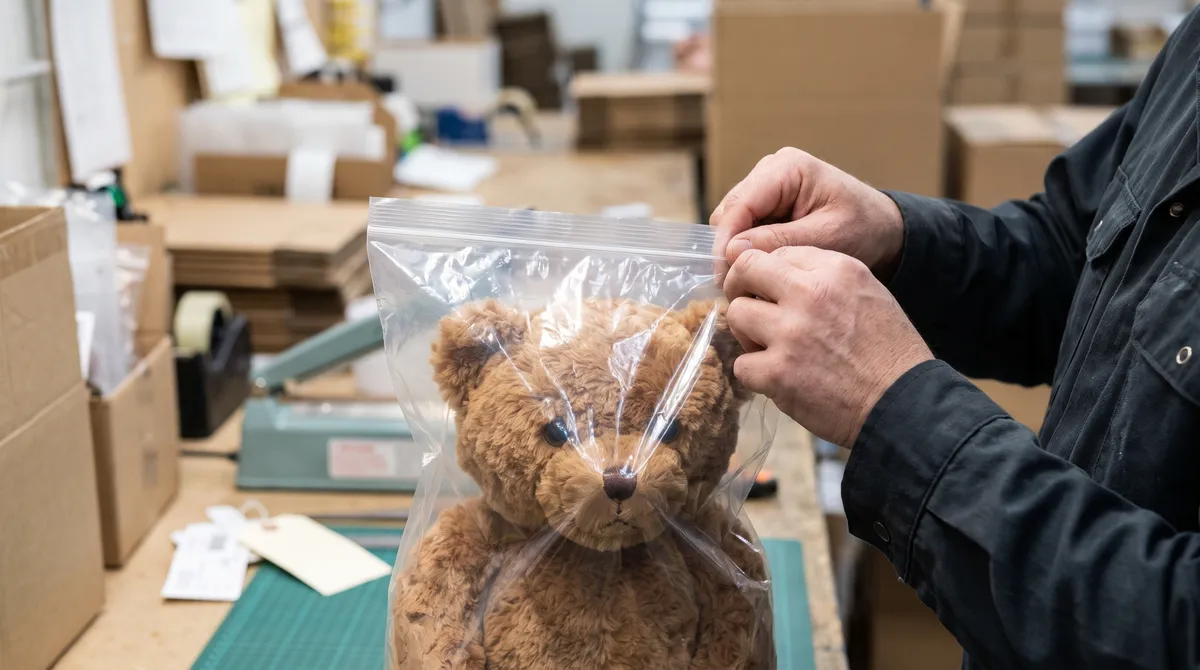
At the bagging station, a 14-inch bear failed my line check: its left paw sat outside the poly bag and rested against the open carton wall. Amazon’s FBA packaging guidelines require every plush unit to sit inside a sealed, transparent poly bag or shrink wrap.
No exposed fabric, open-face gift box, or partly covered plush. This is the baseline for Amazon FBA plush packaging. Brands often assume retail presentation is enough. They ship an open display box that still shows fabric.
That exposed surface collects dust, scuffs against cartons, and triggers receiving flags, prep fees, or refusal before inventory hits the shelf. The rule is simple: bag the whole unit. Our unit-prep checkpoint verifies bag fit, film clarity, and full enclosure before labeling. I reject any unit where a paw, tag, or seam pokes through the seal.
✅ Verdict: A sealed clear bag protects your plush from warehouse dust and scuffing. Check the full enclosure at the bagging station, not after freight.
2. Use Poly Bags That Meet the Minimum Thickness Spec
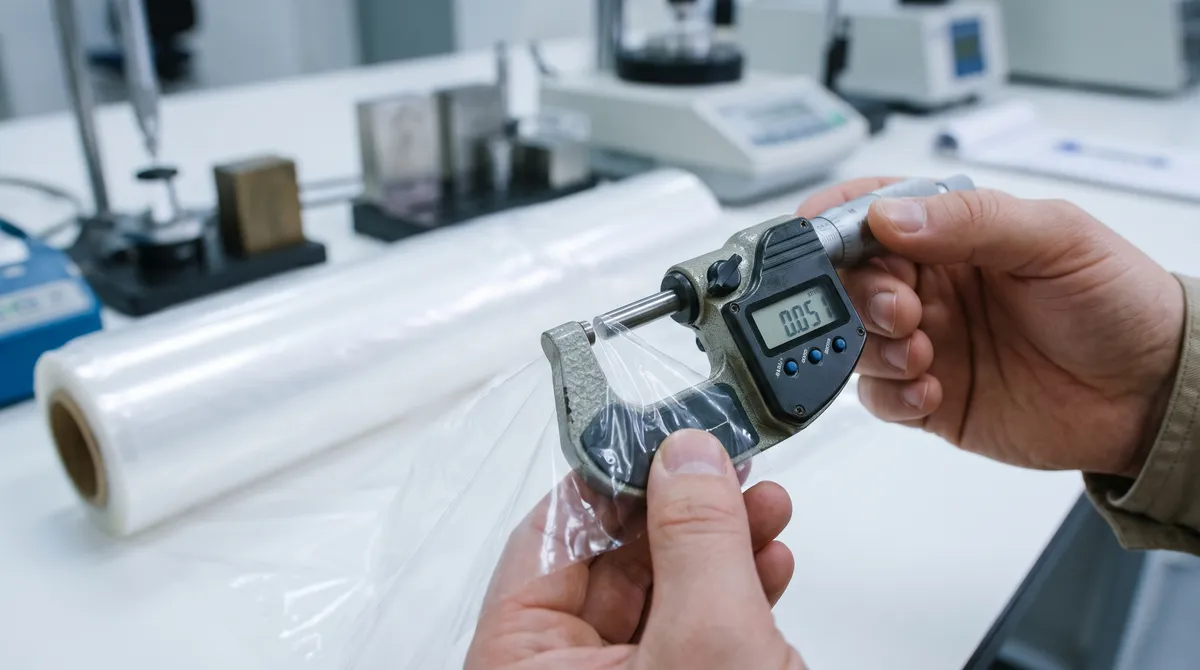
A client once saved $0.02 per unit by switching to a 1.2 mil bag, and the film tore during case packing — the shipment was rejected at FBA receiving. For US FBA plush prep, our working spec is at least 1.5 mil LDPE, per Amazon packaging requirements. Cross-border rules can vary, so check the destination marketplace before you print the BOM.
The common mistake is buying thin film that rips during container loading. Glossy film also fails: it looks premium but scans poorly and creases easily, causing barcode read errors.
As Custom Packaging & Printing specialist Susan Jeeli points out, a poly bag usually fails at the heat seal before it fails at the film — so buyers should treat seal integrity as a spec item, not an afterthought.
We check every incoming film roll’s thickness with a calibrated digital micrometer. Our approved-bag BOM locks the exact film spec per SKU. For seal strength, we pull three sealed bags per lot and run an ASTM F88 heat-seal peel test.
Every bag must hold at least 3.0 lb/in of peel force before we approve bulk runs. This lab step prevents torn bags during ocean transit and cuts rebagging costs. For how this fits the wider line, see our toy quality control process.
✅ Verdict: A 1.5 mil bag with a weak seal fails faster than a 1.2 mil bag with a strong seal — so 1.5 mil is the floor, not the goal. Thickness and seal strength both have to clear spec.
💡 Pro Tip: Buy 1.5 mil LDPE minimum, and pass a seal pull test before bulk production.
3. Add a Suffocation Warning When the Bag Opening Is 5 Inches or Larger
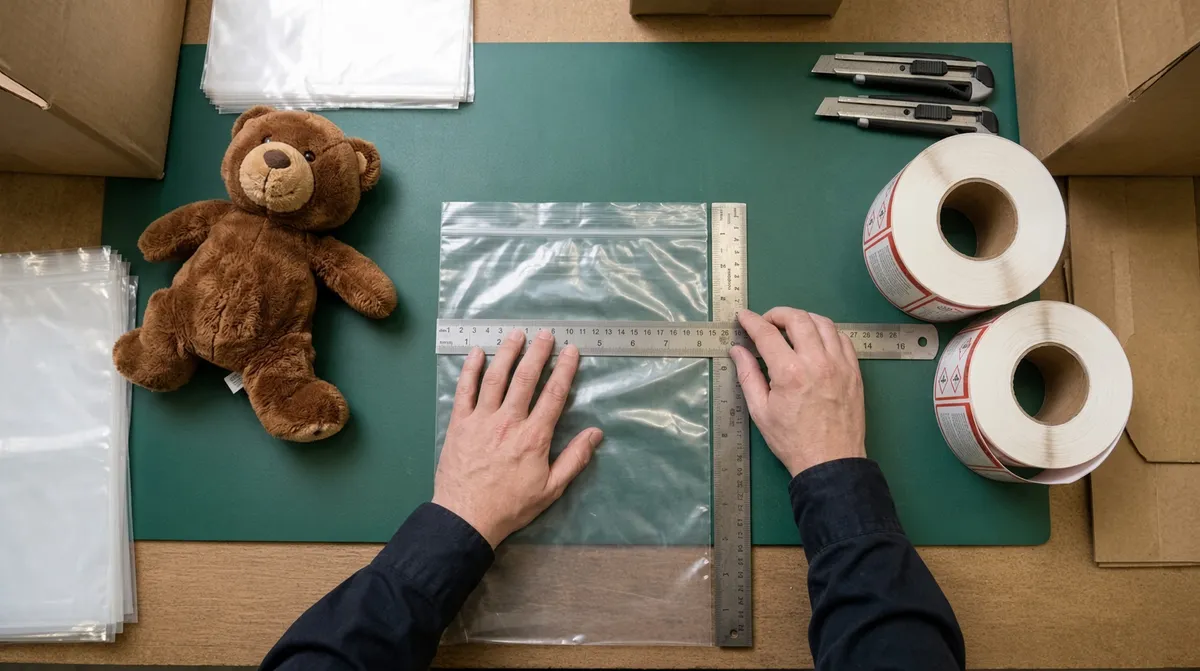
Most factories measure the bag flat. Amazon measures the opening. The check starts at 5 inches: any poly bag with a 5-inch or wider opening needs a suffocation warning.
That warning is a packaging rule from Amazon’s prep policy and US state plastic-bag laws — not a CPSIA toy-safety requirement; see our toy safety standards guide for what CPSIA covers. Print it in a legible font size, with larger text as the bag grows. Confirm the exact minimum point size and wording for your destination before you print.
For large plush bags, use a label. Printed film costs more on short runs, and labels let you match language by market. Canada, for example, often needs bilingual English and French handling.
Common failures: a missing warning, one buried under a fold, print too faint on clear film, or a warning forgotten after a bag spec change. A faint gray print can wash out under warehouse lights. We measure the opening with a ruler at bagging, not on a spec sheet.
Our pack-out sheet locks warning placement and language to each SKU and destination. It flags bag spec changes before PO release, so no one is relabeling at the last minute. For market rules, see our Canada plush toy labeling compliance guide and CPSIA compliance for plush toys.
✅ Verdict: Measure the opening, not the flat bag. A 4.9-inch opening skips the warning; a 5.1-inch opening needs it.
4. Keep the FNSKU Scannable After Bagging and Cover Any Conflicting Barcode
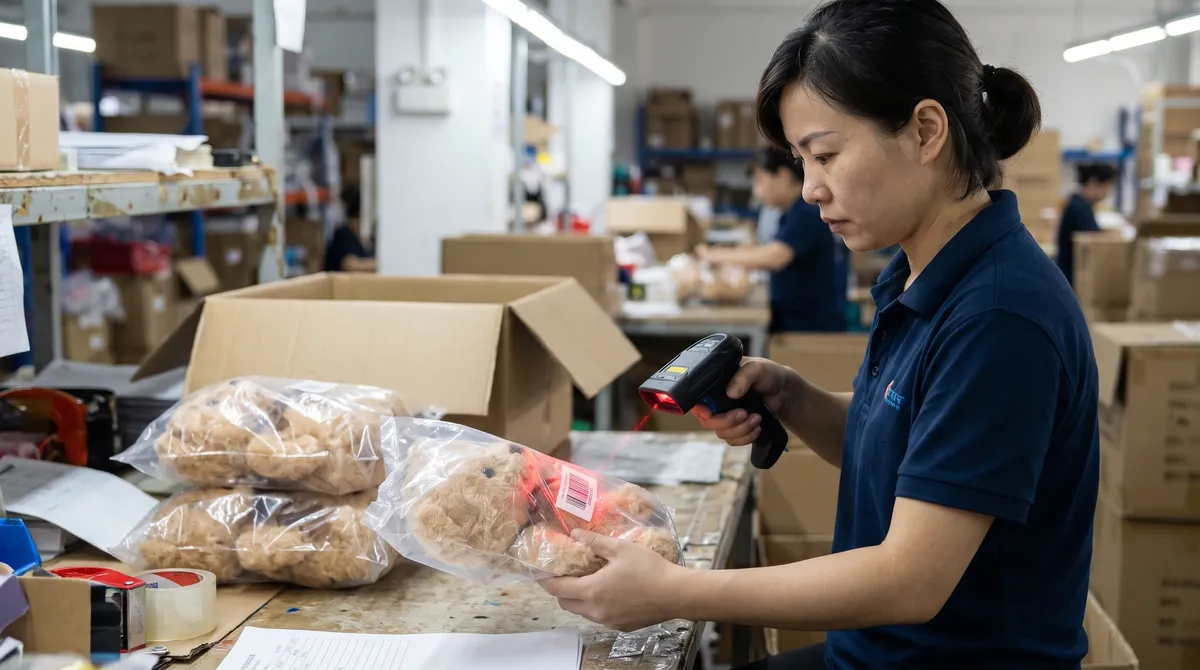
A client’s 8-inch plush once failed my scan test because the FNSKU sat over a bag wrinkle. Amazon requires one scannable FNSKU per unit, and any conflicting barcode must be covered. Soft packaging makes this harder than hardgoods.
Poly bags crease, bend, and reflect light. Glossy film mirrors light. A seam creates a dead zone.
Common mistakes:
- Apply the label over a wrinkle, across a seam, or on reflective film.
- Leave the retail UPC visible inside a clear bag.
The scanner reads the wrong code, so receiving rejects the carton.
We apply the FNSKU as a flat outer label on the bag’s smooth face. If the surface is uneven, we insert a rigid card backing behind the label.
We scan-test each SKU type with a Zebra DS2208 handheld scanner before case packing, then our inspectors re-scan 10 bagged units per carton from 6 and 12 inches away. We run this under bright LED ceiling lights to mimic Amazon warehouses. If glossy film reflects light and blocks the scan, we stop the line immediately.
For the sell-side setup that pairs with this, see our Amazon selling guide, toy branding strategy, and Amazon toy brand case study.
✅ Verdict: A retail UPC showing through a clear bag can get the carton rejected at receiving. Cover every UPC with an opaque label and scan-test before sealing.
5. Limit Poly Bag Overhang to 3 Inches Beyond the Plush
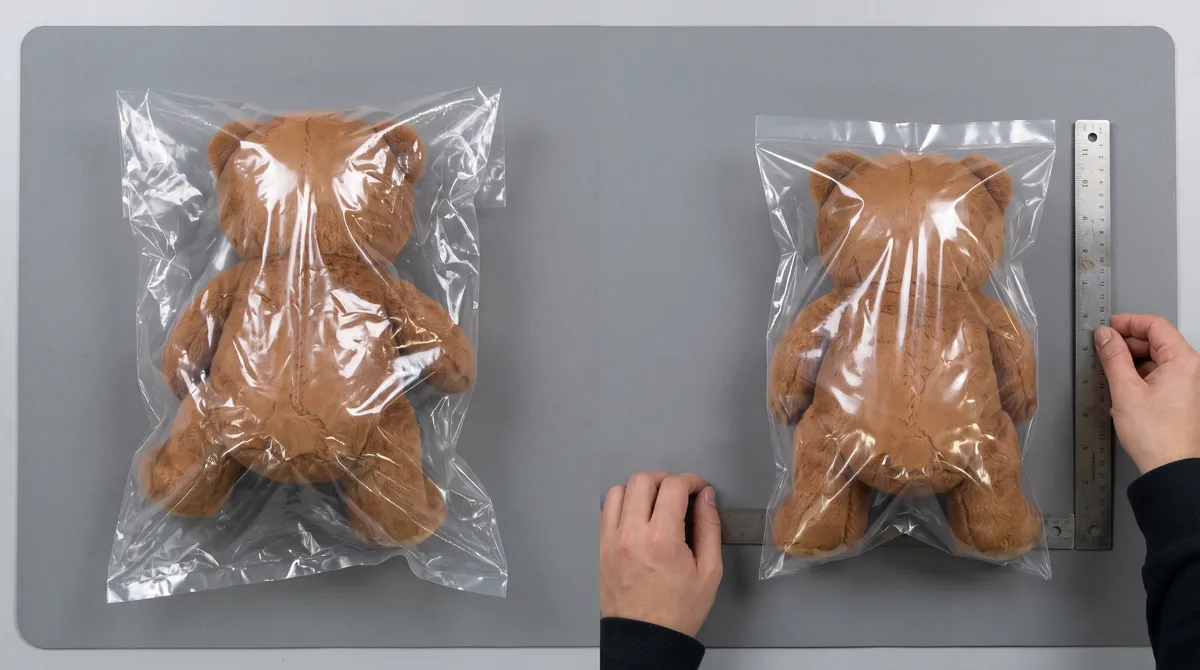
For Amazon FBA plush packaging, Amazon measures the bag, not the plush. Keep the film tail to 3 inches or less beyond the product. Excess plastic changes measured package dimensions on softlines. Trapped air adds length, width, and height, so dimensional weight rises even when the toy’s mass does not.
The common mistake is buying one oversized poly bag for several plush SKUs. That creates film tails, traps air, and makes each unit look larger. Your freight quote and FBA fees follow that larger cube.
We size bags by finished packed dimensions, not naked plush size. We measure the bagged unit, check the 3-inch overhang, and log the packed cube before quoting.
On a 12-inch bear, trimming the bag tail cut about 1.5 inches from measured length. Toy mass stayed the same, but the volumetric charge changed. For the full method, see our retail packaging and volumetric optimization and toy cost breakdown guides.
✅ Verdict: Bag to packed size, not plush size. A 3-inch tail is the limit. Trim, then quote freight.
6. Use Vacuum Compression Only When the Plush Passes a 24-Hour Rebound Test
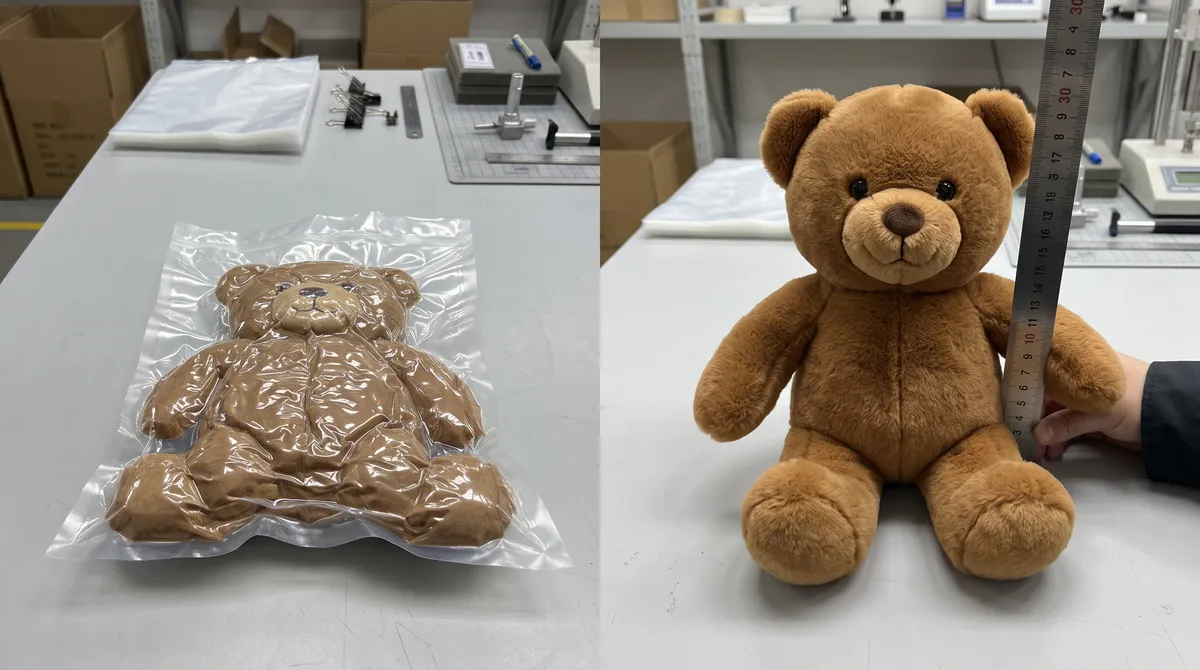
A vacuum bag can cut a plush’s packed volume by more than half. But if the plush does not bounce back, you have shipped a wrinkled defect. Amazon measures the packaged unit it receives, not your intent. Use vacuum compression only when the fabric recovers cleanly.
Many suppliers over-compress plush to cut shipping costs. Our packaging engineer warns against flat-packing long-pile plush: heavy vacuum pressure crushes the fibers and warps embroidered eyes, and even high-grade PP cotton can lose its loft under a long transit hold. Low freight bills mean nothing when buyers open a flat, lumpy toy.
We run a compression-hold and rebound test on every compression SKU. Each unit is held under load to approximate the planned transit window, then measured for rebound at 48 hours. Here is our 12-inch plush teardown:
- Before compression: 12" L × 8" W × 6" H (0.33 cu ft)
- After vacuum: 10" L × 6" W × 4" H (0.14 cu ft)
- 48-hour rebound: PP cotton recovered to 98% of original height. No wrinkles. Embroidery intact.
- Amazon size tier: stays in Large standard — 10×6×4 is too tall for Small standard — but the smaller cube lowers the billable dimensional weight.
- FBA fee impact: the saving comes from lower dimensional weight within the same tier, not a tier downgrade. Confirm the exact figure against the current Amazon fee schedule for your destination.
We only approve compression if rebound hits 85% or better by 48 hours. Otherwise, we bag normally. Full protocol: our custom plush toy fulfillment in the USA guide.
💡 Pro Tip: Test rebound against the real transit hold before you quote FBA savings. Measure recovery, then approve compression.
7. Build Master Cartons That Stay Within Amazon Limits and Survive Ocean-to-FBA Transit
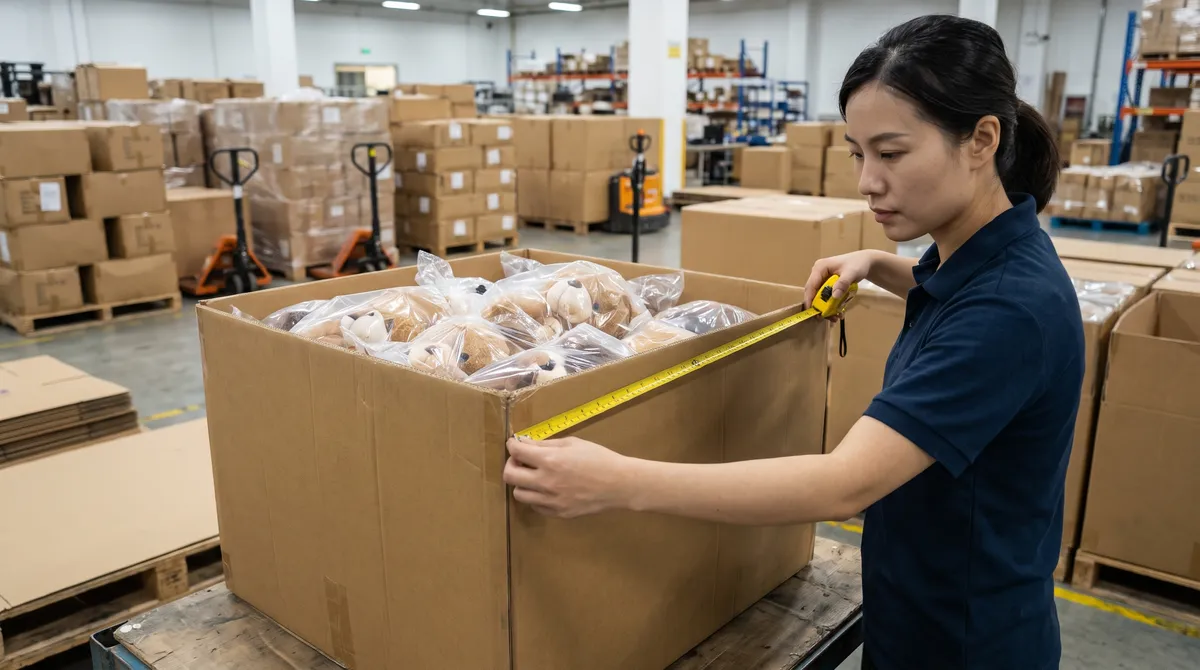
Your units can pass every bag check and still fail at the carton.
Amazon requires rigid, six-sided corrugated cartons that stay inside finished box limits: in the US, no side longer than 25 inches and no box over 50 lb for standard parcels. Case packs must be sensible, and outer labels must read at arm’s length.
For Amazon FBA plush packaging, I spec ECT-32 single-wall board (200-lb Mullen) as the minimum, and step up to ECT-48 double-wall (275-lb Mullen) for heavy or high-stack orders. Soft goods need that edge-crush strength, not the cheapest sheet on the quote.
The common mistake is buying cartons at the lowest unit price. Plush swells, sidewalls bow out, and labels wrinkle. A carton can measure wider at FBA arrival than on our factory floor once the plush expands in transit.
Our packaging engineer pairs carton board grade with case-pack count and void fill. Before sealing, we run an ISTA 3A style shake and compression check on sample boxes.
This check stops soft plush toys from bulging the sidewalls during sea freight. Labels sit away from seams and tape so scanners read them clean. See our toy supply chain management and import toys from China guides for the full flow.
✅ Verdict: Grade up before you stuff more in. A bulged carton that measures over limit is a rejection, not a saving.
8. Run a Pre-Shipment Packaging Inspection Before the Truck Leaves the Factory
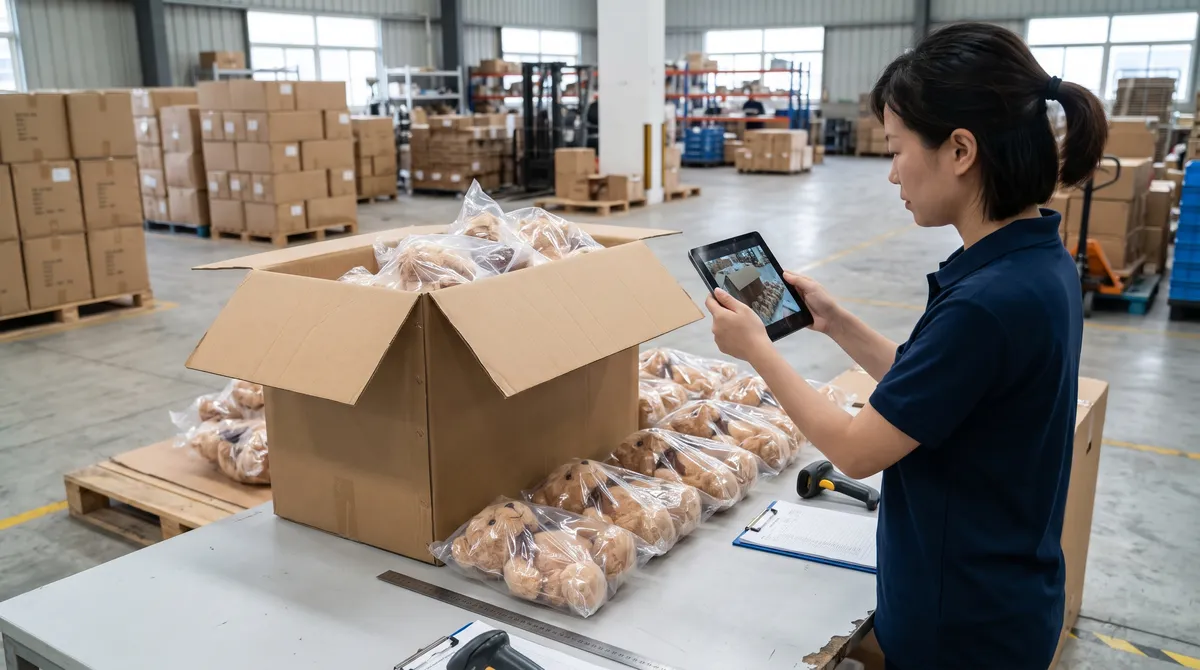
Amazon doesn’t care that your supplier “usually gets it right.” It cares that every unit and carton arriving at the FC is compliant. Pre-shipment inspection is your last control gate, and it makes compliance measurable, documentable, and repeatable.
Most sellers inspect product appearance and skip the packaging defects that actually trigger rejections:
- Oversized bag protrusion
- Unreadable FNSKU through glossy film
- Missing warnings
- Mixed-SKU cartons
I run a packaging inspection on every order. Across our recent FBA plush shipments, the same four defects keep recurring, so the table below maps each one to the control point that catches it before freight handoff.
| Packaging defect | Control point that catches it |
|---|---|
| Bag overhang over 3 in | Bag sizing + pre-shipment measurement |
| Unreadable FNSKU through glossy film | Per-carton scan audit |
| Missing or buried suffocation warning | Pack-out sheet + pre-shipment check |
| Mixed-SKU carton | Carton and label audit before handoff |
We inspect finished lots to ANSI/ASQ Z1.4 General Level II, using the common AQL tiers — 0 for critical defects, 2.5 for major, and 4.0 for minor. Missing warnings and unreadable FNSKU barcodes count as major.
We archive timestamped photos of every inspected carton — bag seals, labels, and carton marks — before the truck arrives. That archive settles disputes and documents compliance. See our plush factory audit checklist for the full protocol.
✅ Verdict: Inspection is where compliance becomes measurable. Run a pre-shipment check to catch bag and label defects before freight pickup.
How to Build an FBA-Ready Custom Plush Retail Packaging SOP?
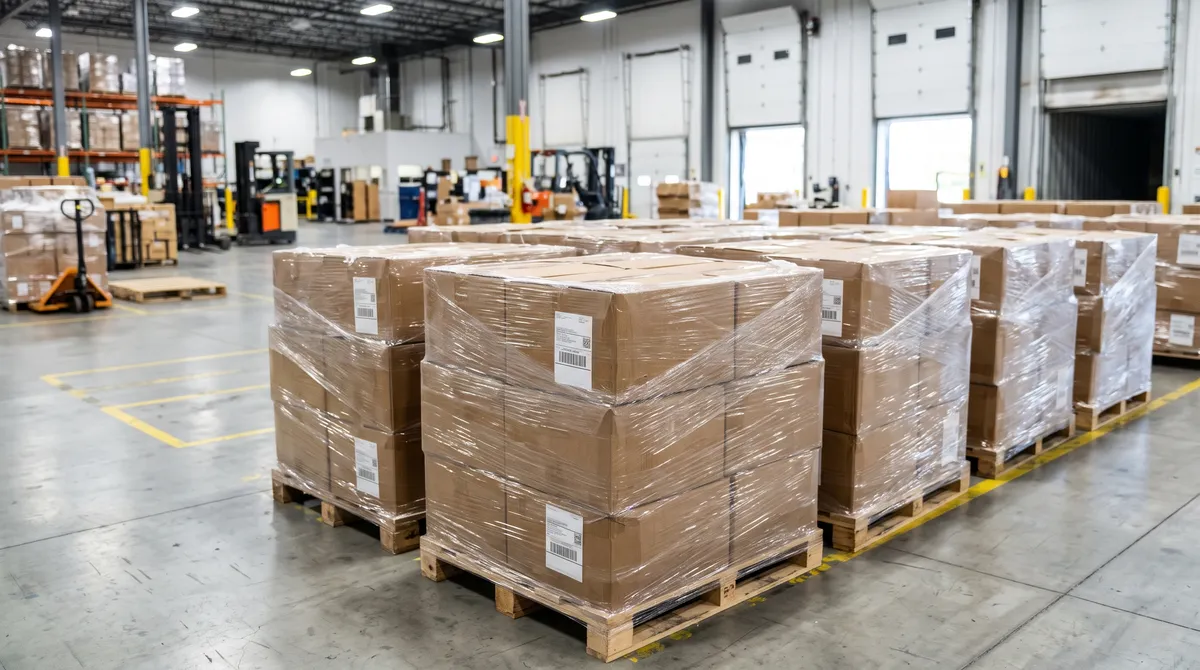
Our factory built this SOP from recent US and Canada FBA plush orders. Our head of QA and packaging engineer reviewed every teardown and inspection log. Every step aligns with Amazon FBA prep rules and the destination market’s packaging and toy-safety rules.
We ran every SKU through bagging, scan, carton, and freight handoff. Use it with the 8 checks above. The lesson we keep relearning: thickness and seal strength both have to pass — a strong seal on thin film still fails. A client’s units once failed scan audits because the FNSKU wrapped a curved seam.
Custom plush retail packaging comes down to fit, cost, and scan reliability. Match your format to Amazon’s FBA packaging requirements. The build behind it runs through our custom toy manufacturing line. Then use this table.
| Attribute | Poly bag | Retail box |
|---|---|---|
| Cost | Low | Higher |
| Dimensional efficiency | High; soft cube | Lower; rigid cube |
| Brand presentation | Low | High |
| Barcode handling | Flat label works | Box or bag label |
| Damage exposure | Medium; film tears | Low if board is strong |
| Outer poly still needed | Yes, always sealed | Yes, if windows or open box |
Package design: toy product packaging. Compare formats in our types of toy packaging guide. ODM support: toy ODM/OEM.
Packing SOP: BOM Approval to Freight Handoff
- Approve packaging BOM: Lock bag spec, warning text, FNSKU placement, box type, and carton grade.
- Verify LDPE thickness: Measure each incoming roll — 1.5 mil minimum — with a calibrated micrometer.
- Compression hold and rebound test: Decide compress-vs-standard before bagging. Approve only if rebound hits 85% or better at 48 hours after the transit-hold.
- Bag and seal check: Fully enclose plush. Keep overhang under 3 inches. Seal flat, with a clean seam and no wrinkles.
- Heat-seal pull test: Pull three bags per lot and require 3.0 lb/in peel strength minimum.
- FNSKU scan audit: Scan 10 units per carton at 6 and 12 inches. Cover old UPCs.
- Select master carton grade: Use ECT-32 single-wall, or ECT-48 double-wall for heavy loads. Shake-test each case.
- Place outer labels: Keep labels off seams and tape. Confirm arm’s-length scan.
- Archive photos: Timestamp bag seals, labels, and carton marks.
- Hand off to freight: Match carton count, label data, and PO before the truck leaves.
You now have a sealed, scannable unit, a graded carton, and a photo archive. Next step: request an FBA-ready plush quote from our team.
Packaging rules checked against Amazon Seller Central on November 20, 2026.
Disclosure: This guide reflects our own factory’s plush packaging process. We manufacture custom plush for Amazon FBA sellers; no third-party vendor paid for inclusion.
People Also Ask About Amazon FBA Plush Packaging
-
Do plush toys need to be poly bagged for Amazon FBA?
Yes. Amazon FBA plush packaging requires a sealed, transparent poly bag or shrink wrap that fully encloses each unit.
Rule: no exposed fabric. Risk: open display boxes collect dust and trigger prep fees or rejection. Best practice: seal the whole plush at the bagging station, then check for pokes before labeling.
-
How thick should the poly bag be?
Use at least 1.5 mil LDPE for US FBA plush prep. Rule: our BOM locks 1.5 mil minimum. Risk: 1.2 mil film tore during case packing and got a client’s shipment rejected.
Best practice: measure every roll with a micrometer, then pass a 3.0 lb/in heat-seal pull test. Check the destination marketplace before you print the BOM. Our toy sourcing guide covers spec control.
-
When is a suffocation warning required?
You need one when the bag opening is 5 inches or larger. Rule: measure the opening, not the flat bag. Risk: a missing warning buried under a fold gets units rejected at receiving.
Best practice: lock warning placement and language on the pack-out sheet. Use a label on short runs, and confirm wording by market.
-
Can I vacuum-pack plush for Amazon FBA?
Yes, but only if the plush passes a 48-hour rebound test. Rule: approve compression only at 85% recovery or better. Risk: over-compression wrinkles fabric and distorts embroidery, so a freight saving becomes a defect. Best practice: run the teardown first and compare packed cube and FBA fee before you quote.
-
Can I use a retail box instead of a poly bag?
Yes, but the box still needs an outer sealed poly bag if it has windows or an open face. Rule: Amazon measures the package it receives. Risk: a rigid box raises cube and dimensional fees. Best practice: validate box strength and the FNSKU scan path, then compare landed cost against a bag.
-
How should multi-piece plush sets be labeled for FBA?
Bag the whole set as one saleable unit, keep the parts from separating, and label it so the FNSKU scans on the outer pack. If the set can be split or the pieces are sold separately, mark it “Sold as set” so receiving does not break it into single units.
Rule: one scannable FNSKU per saleable unit. Risk: loose parts in a mixed carton trigger a mixed-SKU rejection. Best practice: seal the set as one bagged unit and confirm the labeling on your prep sheet before the run.
Want a second set of eyes? If you want LeelineToys to review a current plush pack-out, send bag specs, flat dimensions, and carton details through our contact page.
We run the same checks on our floor. Building a new FBA plush line? See our Amazon FBA toy manufacturer page.