
I've seen founders bleed cash because a single lab report on Toy Safety Standards bounced. Failed EN71 tests, customs holds, frantic Amazon document requests: they usually stem from weak scoping and patchy paperwork, not one missing test.
This article merges my factory-floor QC checklist, a raw interview with our Lead Quality Engineer, and anonymized audit patterns into a usable compliance framework. Think of it as your pre-shipment fire drill.
No theory. Just the processes that stopped our clients' rework costs.
Professional Toy Safety Standards Guide: Classification, Testing & Shipment Readiness
Understand toy safety regulations and testing requirements – discover how to ensure product safety and meet global compliance standards.
1. Start With the Right Scope: Toy, Children's Product, or Accessory?
The costliest mistake? Scoping wrong.
I've seen a $50k shipment seized: the label said "14+," but cartoon packaging screamed preschool. That slip triggered a CPC, tracking labels, and 6 weeks of rework.
Nail these definitions first:
- ASTM F963 – U.S. toy safety standard (under‑14).
- CPSIA – requires third‑party testing, tracking labels, and a CPC for children's products (under‑12).
- CPC – Children's Product Certificate, a legal compliance document.
- Tracking label – permanent label with manufacture date, batch, and company info.
- EN 71 – EU toy safety standard.
- CE mark – declares EU safety compliance (backed by a DoC).
- Technical file – design dossier, risk assessment, test reports (kept 10 years).
- ISO 8124 – international toy safety standard.
ASTM rules cover toys for kids under 14. But the CPSIA law targets kids under 12.
You must get a lab certificate for these younger kids. The laws look closely at your package marketing. The catch: classification depends on marketing, not just the physical item.
Amazon flagged a client's wooden puzzle last month. The product listing called it the best gift for a two-year-old kid.
The client paid $3,200 for extra lead tests. The mistake cost them six extra weeks of work. If your packaging, listing, or reviews point to under‑12, you're in CPSIA territory.
Author's take: I never ask if it's a toy. I ask: who does your packaging say this is for? Under‑12? You need a CPC.
The U.S. uses ASTM F963-23 as the base toy law. You must follow this rule for new production runs.
We enforce this exact rule on factory floors. You can add local rules after you meet this standard. Layer market‑specific requirements on top only after you classify correctly.
2. Use the U.S. Checklist: ASTM F963-23, CPSIA, CPC, and Tracking Labels
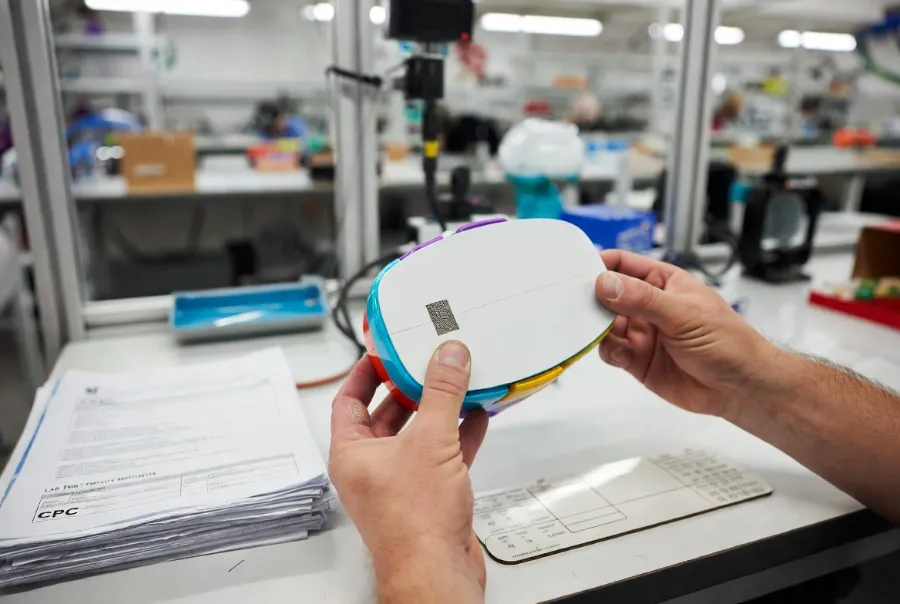
U.S. compliance isn't an acronym swamp. It's a 30-minute pre‑shipment checklist. Here's the stack.
First, the standard. ASTM F963‑23 is the current CPSC‑accepted toy safety baseline for toys made on or after April 20, 2024. If your product targets children under 12, CPSIA requires third‑party lab testing and a CPC.
Not all ASTM F963 clauses need a lab. Sharp‑point, small‑part, lead, and phthalate provisions require a CPSC‑accepted lab.
Labeling, instructions, visual checks, and manufacturing‑process rules only need documented compliance. I've seen clients waste $2,000 testing "toy warnings" in a lab when a PDF printout would suffice.
Your CPC always needs these seven fields in English. Missing one can cause a customs hold.
- Product identification (name, SKU).
- Citation of each CPSC regulation (ASTM F963‑23, 16 CFR Part 1303, etc.).
- Importer or U.S. manufacturer name.
- Contact info for the person holding test records.
- Date and place of manufacture.
- Date and place of testing.
- The CPSC‑accepted lab's name and contact.
Tracking labels go on product and packaging when practicable, with permanent print (screened, etched, or laser-engraved, not stickers). I require the manufacturer name, production date, location, and a unique batch or lot number.
You can mix samples to save money on chemical tests. We group up to five items made of the exact same plastic.
This trick cuts testing costs by 30 percent. But you must only mix parts for chemical checks.
Never composite for mechanical hazards. Mixing small parts or rattle‑test samples invalidates the results.
We always audit the testing labs first. You must check the lab scope before you ship.
A bad lab license ruins your whole shipping container. Top retail brands use our method to stop bad goods. Verify the scope covers your test method (e.g., CPSC-CH-E1001) to avoid a compliance gap.
3. Build the EU File: EN 71, CE Marking, DoC, and Record Retention
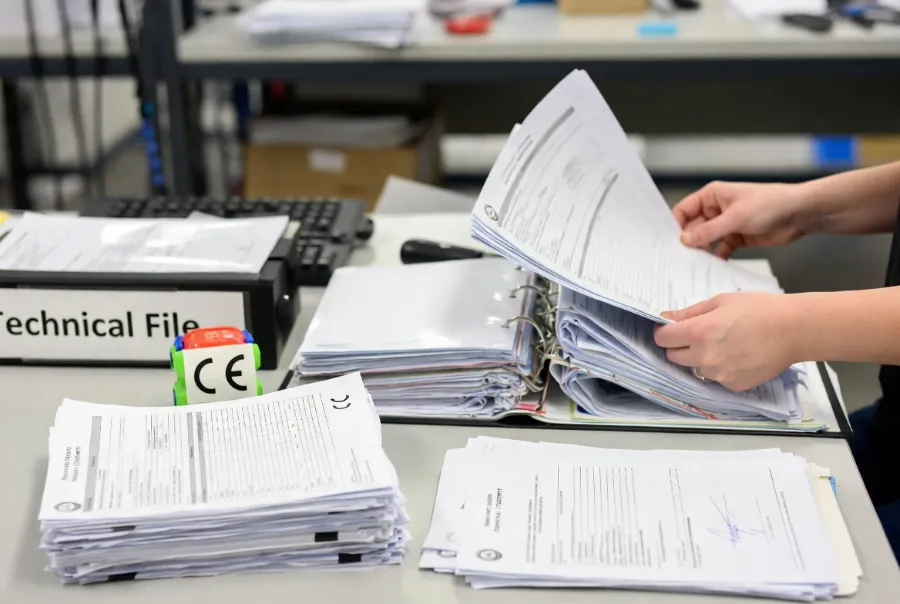
The CE mark holds huge legal weight in Europe. You sign this mark to prove you tested the toy.
EU officials demand a full file of test data. The mark means nothing without this technical file. The EU path is a paperwork trail:
- Safety Assessment: Test to EN 71 (mechanical, flammability, chemical, including EN 71‑3:2019+A2:2024).
- Conformity Assessment: Self-declare via Module A. A notified body is rarely needed.
- Technical Documentation: The dossier. Design specs, bill of materials, risk assessment, and test reports. Keep for 10 years after the last sale.
- EU Declaration of Conformity (DoC): A one-page legal statement listing the toy, standards, and manufacturer's signature.
- CE Marking: Affix only after signing the DoC. This is your conformity claim, not an EU approval badge.
- Traceability: Name and address of manufacturer and importer, plus a batch number, on the product or packaging.
- Warnings & Instructions: In the destination country's official languages.
A French authority rejected one of our toy shipments. The small parts warning only used English text.
French customs block boxes with no French words. You must print rules in the exact local language.
The mental shift U.S. teams need:
| U.S. CPC | EU DoC & Technical File |
|---|---|
| Single certificate listing CPSC regulations and lab details | A short written declaration plus a deep technical file |
| Lab report from a CPSC-accepted lab | Report from any ISO 17025 lab; no pre-approval |
| Filed with CPSC if requested | Not filed; kept by manufacturer or importer |
| Strict tracking label requirements | Traceability via importer/manufacturer ID on product |
If an EU authority calls, you must hand over that file within days.
2026 Update: Regulation (EU) 2025/2509 applies August 1, 2030. Continue using the current EN 71 / Directive workflow. Structure your document control now—risk assessments, chemical inventories, digital signatures—so you glide into the new Reg.
🧠 Expert Take: Treat the technical file as your manufacturing bible. If you can't produce it within 24 hours of an EU authority's request, your shipment is dead.
4. Map Other Markets Fast: ISO 8124, Canada, Australia, and China Export Checks
| Market | Primary Requirement | What Actually Matters |
|---|---|---|
| International | ISO 8124 series | Technical baseline only. No country accepts it as a standalone law. Align testing here, then layer local rules. |
| Canada | CCPSA + Toys Regulations (SOR/2011-17) | U.S. test reports often work if they meet Canadian lead, phthalate, and small‑part limits. You still must file a General Certificate of Conformity. |
| Australia | Mandatory toy safety standard (Consumer Protection Notice No. 14) | References AS/NZS ISO 8124, plus bans on specific hazards (e.g., lead, phthalates, small parts for under‑3s). |
| China | GB 6675.1‑2014 (current) | GB 6675.1‑2025 was published November 2025. Enforcement date: November 1, 2026. Export now under the 2014 version. Do not assume the revision is live yet. |
I've seen a container seized on arrival because a client ignored Australia's bath‑toy ban under Consumer Protection Notice No. 14. The fine ate 40% of that shipment's profit. Don't make that mistake.
Canada demands a General Certificate of Conformity for every children's product, even when U.S. lab reports look similar. The lead and migration limits differ; check them.
Australia's mandatory standard covers all toys sold to consumers—not just under‑3 items—if a specific hazard regulation applies. A non‑compliant plush keychain can get destroyed at customs.
China's GB 6675.1‑2025 tightens phthalate limits and mechanical requirements, but enforcement doesn't start until November 1, 2026. For now, ship under the current GB 6675.1‑2014. We already run pre‑check tests against the draft so clients don't scramble later.
Our Floor‑Factory Tip: Use ISO 8124 as your cross‑market tech baseline, then layer country‑specific add‑ons: Canada's GCC, Australia's hazard bans, China's GB limits. Our import‑from‑China team tracks these shifts daily. Grab the full EN71 cheat sheet if you ship to Europe.
5. Catch the Hidden Failures Labs Miss Before Shipment
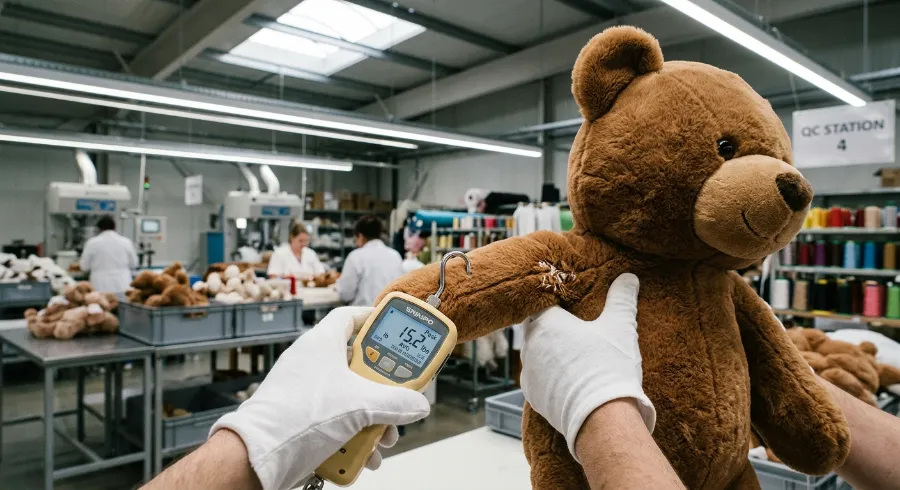
Our lead quality engineer tested a finished plush bear. The toy easily passed the official lab test.
But she tore the seam with just eight pounds of force. Lab tests do not always catch weak factory sewing.
Thread tension was inconsistent on the Juki 8700. These failures don't show on test reports. Below is an anonymized three‑region audit snapshot of real catches made just before shipment.
| Issue Found | Likely Root Cause | Containment Action | Permanent Corrective Action |
|---|---|---|---|
| Plush eye detaches at 4.6 lbs | Low stitch tension on Juki 8700 | 100% torque recheck on line | Monthly tension gauge calibration |
| Battery door opens with 2.5 N pull (limit 5 N) | Screw boss too thick, preventing full thread engagement | Remold entire lot | Added go/no‑go gauge at molding |
| Magnet flies out after 1.2 m drop | Adhesive under‑cured | Halted shipment, re‑glued, 100% retest | Switched to UV‑cured adhesive; 24‑h cure verification |
I use lab reports as a baseline. These floor‑level catches stop the failures generic ASTM checklists never see.
🧠 Expert Take: Ask your factory for seam‑tension data for three consecutive production lots. Inconsistent numbers reveal machine calibration drift weeks before a lab would catch it.
6. Run a 10-Step Toy Certification Workflow From Prototype to Port
Chaos bleeds money. Design sends late art, a lab misses a test, and QC approves a batch with swapped material. The fix is a rigid operating process my team lives by.
Bookmark two official tools first. The CPSC Regulatory Robot triages early U.S. requirements.
The CPSC Lab Search finds accepted testing labs. Both are starting points, not legal advice.
- Classify Product & Age Grade. A puzzle called a "best gift for a 2-year-old" is a children's product needing a CPC. Misclassification here causes costly rework.
- Freeze the Bill of Materials. I demand safety data sheets for every adhesive, ink, and textile. One undocumented foam swap cost a client six weeks of phthalate retesting.
- Conduct a Hazard Review. Check the frozen BOM against ASTM F963 and EN 71. Identify small parts, sharp edges, and magnets.
- Scope the Lab Package Tightly. Map each hazard to a specific test method. Do not ask for "full ASTM F963"; you will pay for unused tests. Call ISO 17025 labs to confirm turnaround times.
- Submit Pilot Samples. Send five identical units from pilot production. A 3D-printed sample does not match injection-molded chemistry.
- Review Artwork and Warnings. Verify every warning matches the age grade and destination language. A French authority rejected our shipment for an English-only small parts warning.
- Draft Certificates Before Mass Production. Draft the CPC or EU DoC only after final lab reports land. One typo in the importer's address causes a customs hold.
- Lock Mass-Production Controls. No material substitutions without re-testing. We run three inline checks per shift: material verification, assembly integrity, and print adhesion.
- Pre-Shipment Inspection. I pull random samples and test pull force on seams. The lab report says the design is safe; I verify the factory built it that way.
- Shipment Release Gate. No load leaves without a valid lab report, signed certificate, and passed inspection. I once held a truck for two days because a tracking code did not match the CPC.
Where Teams Waste Money
Most overruns are self-inflicted wounds. Late age-grade changes forced new molds and full chemical rescreening. Undocumented material substitutions caused heavy-metal failures and remolding of 5,000 units.
Duplicate chemistry work happens when teams test lead, phthalates, and heavy metals separately. Composite one sample for all screens to save 30%. Poor lab scoping orders tests for unused clauses.
🧠 Expert Take: Call your lab after step three. Describe the product, age grade, and target markets. Demand a written quote with specific test methods and prices. This call kills scope creep before you cut a purchase order.
- Jerry Cheung, Plush & Toy Manufacturing
The Inline QC Factory Sheet: Run-With-You Compliance

I use this exact sheet on every production run. It checks attachments, seams, labels, packaging traceability, and shipment documentation.
We built this guide from real factory work. It helps you run your product lines better.
But this text is not legal advice. You must check your exact toy with a legal expert.
1. Incoming Materials & BOM Lock
- Freeze the BOM. Require safety data sheets for all adhesives, inks, and textiles.
- Cross-check material specs against the approved sample.
- Verify supplier certificates for stuffing, paint, and pellets.
- Flag any material swap instantly. A foam change can force a full phthalate retest.
2. Pre-Production Sample Approval
- Inspect first-off samples for size, color, label placement, and attachment methods.
- Approve age-grade warnings matching final art. Mislabeling here is costly.
- Document every deviation and obtain written approval.
3. Inline Mechanical Checks & Composite Note
- Torque test small parts to 0.5 N·m minimum.
- Tension test seams with a calibrated pull gauge.
- Check battery door withstands 5 N pull without opening.
- Run a sharp-edge review with a sharp-edge tester.
- Drop test from 1.5 m onto concrete. Photograph before and after.
- Compress soft toys to detect internal wire hazards.
- Pull attachments (eyes, buttons) to 15 lbs or more.
- Use go/no-go gauges for small parts. Do not rely solely on lab reports.
You cannot group parts for drop or pull tests. Physical tests need single, whole items.
Group testing ruins the data for physical strength. Always test physical stress on one complete toy.
4. Document Review: CPC, Tracking Labels & EU File
- Verify the Children's Product Certificate includes all seven fields: product ID, each citation, importer name, contact, manufacture date/place, test date/place, lab details.
- Ensure tracking label is permanent (laser-etched) and displays the batch number.
- For EU, confirm the DoC is signed and technical file retrieval within 24 hours.
- Cross-check lab report standards match your age grade.
5. Packaging & Carton Traceability
- Match carton labels to product labeling: same age grade, warnings, country of origin.
- Verify batch numbers on packaging and product are identical.
- Check all required language warnings (e.g., French for France).
- Ensure barcodes and SKUs match the purchase order.
6. Final Pre-Shipment Signoff
- Pull random samples and repeat key mechanical tests.
- Confirm all lab reports, signed CPC/DoC, and inspection records accompany the shipment.
- Release gate: no load leaves without valid reports and passed inspection. I have held trucks until paperwork aligned.
Physical Stress Tests You Must Run
- Torque: Twist attached parts to 0.5 N·m for 10 seconds. No detachment.
- Tension: Pull seams at 15 lbs. Photograph the joint.
- Drop: Ten drops from 1.5 m. Check for magnet release or small parts.
- Compression: Apply 6 kg load on plush; no wire protrusion.
- Seam pull: Steady force to 20 lbs. Watch for thread elongation.
- Battery access: Pull door; must not open under 5 N.
- Sharp-edge: Use tester. Any burr fails.
- Attachment security: Pull eyes, snaps, buttons to failure. Record break force.
Utility Assets: Your Compliance Kit
- BOM template to lock materials and SDSs.
- CPC field checklist (all seven fields).
- EU DoC & technical‑file checklist for fast retrieval.
- 2026 updates box: Track ASTM F963‑23, GB 6675.1‑2025, EU Regulation 2025/2509.
- Free compliance assessment: Contact us to review your product scope and test package.
We test toys to keep kids safe. Contact our team to review your factory process today. Catch physical risks before you ship your boxes.
People Also Ask About Toy Safety Standards
1. Does every ASTM F963 section need third-party lab testing?
No. Only specific provisions—like lead, phthalates, small parts, and sharp points—require testing at a CPSC‑accepted lab.
Labeling, instructions, and visual checks only need documented compliance. In our factory, we've saved clients thousands by scoping tests tightly.
One team wasted $2,000 sending toy warning copy to a lab. A simple in‑house PDF review met the standard.
2. Can I reduce lab cost with composite testing?
Yes, but only for qualifying chemical screens. I've combined up to five SKUs of the same material to cut phthalate testing costs by 30%.
However, composite testing fails for mechanical, physical, or small‑parts safety work. Mixing torque, drop, or seam‑pull samples turns a pass/fail test into a guess. Reserve composites for chemistry only.
3. What exactly must appear on a CPC and on tracking labels?
A CPC must list seven fields in English: product ID, each cited CPSC regulation, importer name, contact for test records, manufacture date/place, test date/place, and the lab's name/contact. Tracking labels go on product and packaging when practicable with permanent marking (laser‑etched, not stickers).
I've seen a shipment held because the lot code was printed on a removable sticker instead of engraved. Always include manufacturer, date, location, and batch number.
4. Does CE marking mean the EU approved my toy, and how long do I keep the file?
No. CE is your own declaration of conformity, not an approval mark.
You sign a DoC and back it with a technical file of design specs, risk assessments, and test reports. Keep that file for 10 years after the last toy is placed on the market.
I've seen a client's container seized because they couldn't produce the file within 48 hours. Treat it as your manufacturing bible.
This guide shares our factory‑floor methods, not legal advice. Request your free compliance review.