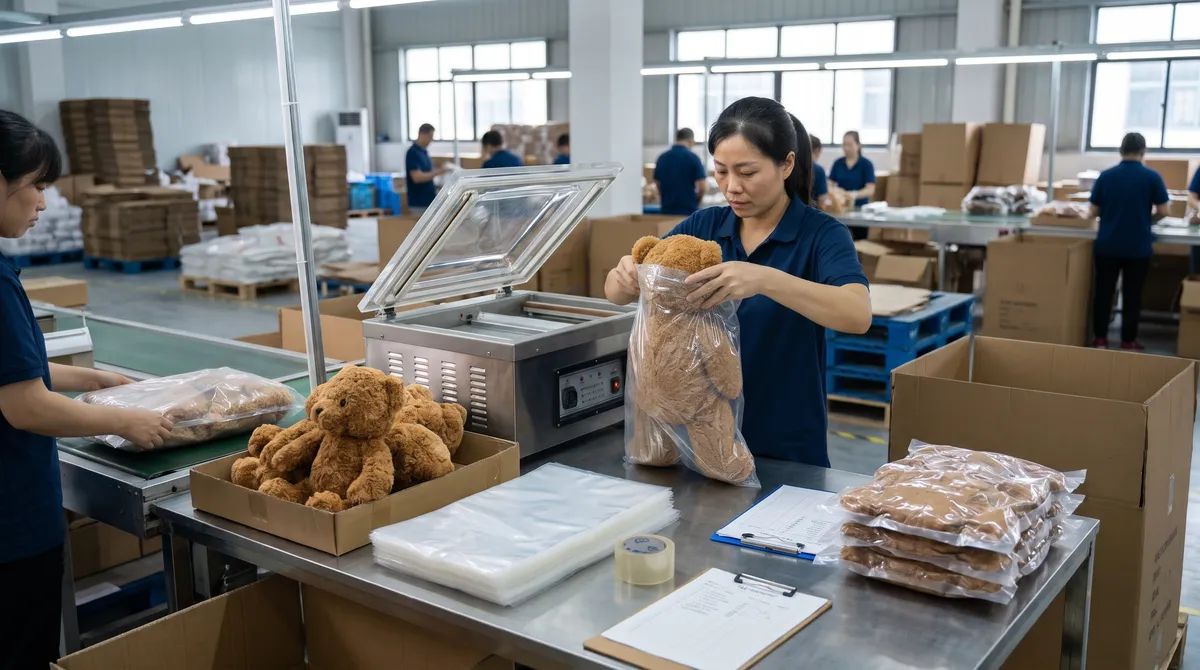

A plush toy is mostly air. That air inflates CBM, and on ocean and air freight you pay for volume, not softness. Vacuum packing plush toys cuts that billable cube, but over-compression flattens the pile, twists seams, and triggers QC claims and bad reviews.
These seven rules come from an internal transit simulation we run before we approve any compression SKU. It is a controlled bench test built to mirror an ocean voyage, not a logged customer shipment.
We compress three plush builds at 60% in 120-micron PA/PE bags, hold them 45 days in a humidity-controlled chamber, and measure rebound at 24 and 48 hours. Use the rules to pressure-test any supplier's packing spec, ours included.
Key Takeaways
- Screen SKUs before you compress. Wire armatures, sound modules, and rigid inserts should never go under vacuum; weighted plush needs its own spec.
- Match fill to rebound, not just price. In our 48-hour test, PP cotton recovered to 93% while recycled polyester hit 83% and failed the 85% gate.
- Start at 55–65% compression, then prove it. Chasing 80–90% to save cartons distorts faces and slows loft recovery.
- Spec 100–150 micron PA/PE film. PA adds puncture and oxygen resistance; PE adds the seal and the moisture barrier.
- Wrap every hard part. Unprotected eyes and noses drive most film punctures; add 2mm EPE foam sleeves.
- Demand a 45-day transit simulation. Anything under 85% rebound at 48 hours fails.
- Put the ROI on net landed cost. On a typical 5,000-unit order the net saving is about $0.19 per toy after bag and labor, mainly on inbound freight, not FBA fees.
Vacuum Packing Plush Toys: Tested 7 Rules
Save on freight the right way. See how vacuum packing plush toys cuts CBM, what bags and labor really cost, and the true net saving.
Rule 1: Disqualify Plush SKUs That Should Never Be Vacuum Packed
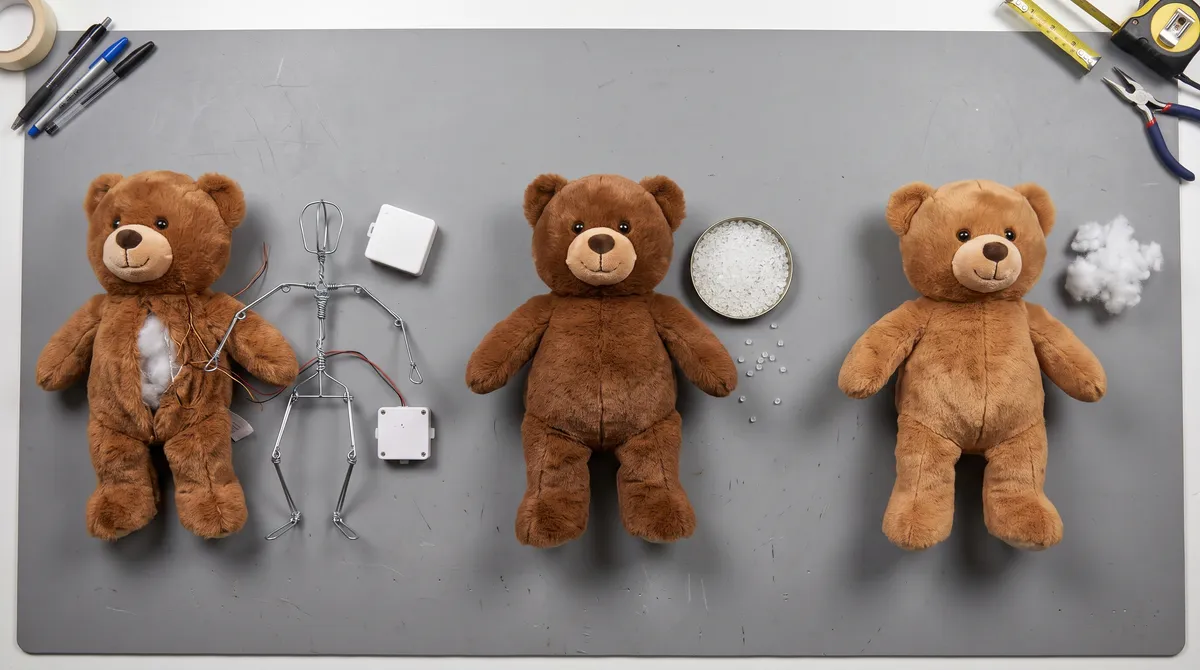
A cheap freight quote means nothing if compression crushes a plush that should never be packed. Before we price a carton, we screen every SKU against a red/yellow/green matrix.
Red flags:
- Wire armatures
- Sound modules
- Rigid inserts
- Collector-grade long pile
- Oversized molded noses
- Fragile presentation pieces
Yellow: weighted plush. It moves to special handling with its own packaging spec. Green: plain sewn plush, soft fill, no hard parts.
We often see buyers approve vacuum packing from a quotation spreadsheet. No engineering review, no sample test. The photo shows a soft shell, so they assume all plush behaves the same. It does not.
A 6mm wire frame can punch through a bear's chest after weeks under compression in storage. Hard safety parts and armatures create stress risers the moment vacuum pressure folds the fabric against them.
The defect shows up as a torn seam and a sharp wire tip, not as a clean break. Catching it starts with the same screening covered in our plush toy supplier red flags guide.
✅ Verdict: We require SKU-level sign-off from engineering and QC before we lock packaging. Our pre-production packability review runs compression, a 48-hour recovery check, and a drop test. Failed SKUs ship air-filled. Read the custom plush manufacturing process before you approve vacuum packing plush toys.
💡 Pro Tip: Screen every SKU before you book freight.
Rule 2: Match Fill and Fabric to Recovery Performance, Not Just Unit Cost
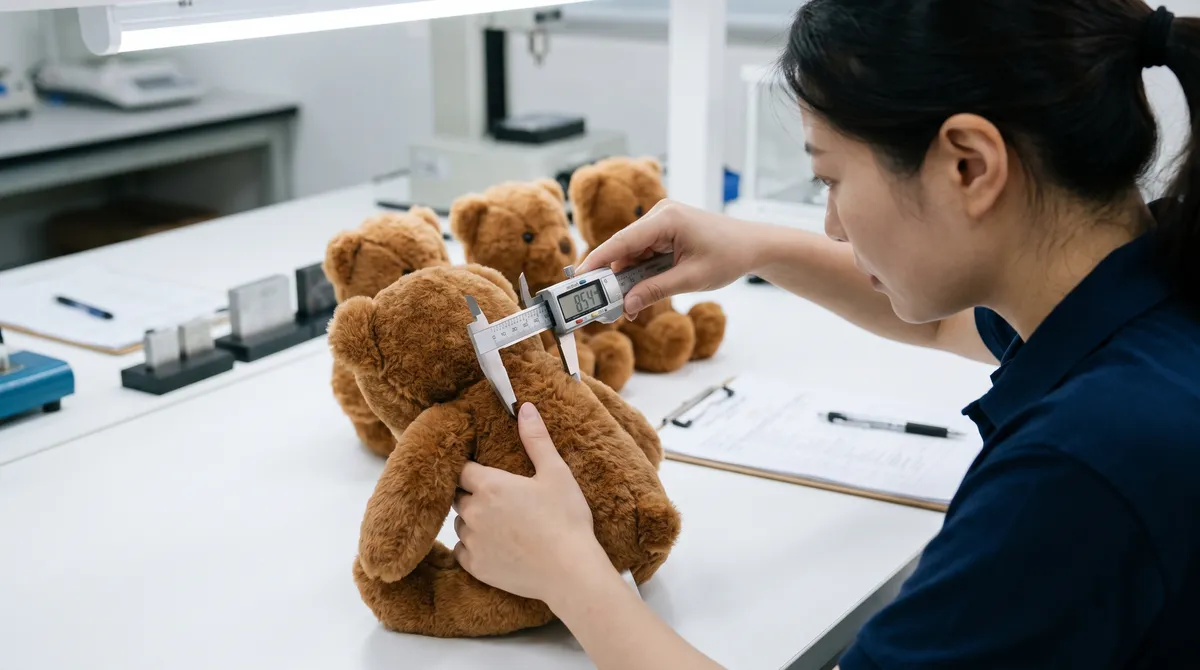
Plush recovery depends on your exact fill fiber and outer shell fabric. Procurement teams downgrade fill for cost or sustainability claims without checking rebound memory. The warehouse sees the bill after transit: flat bears, creased minky, thin long pile, and photos that kill the listing.
We ran three constructions through a 48-hour compression rig, measuring caliper height at the chest before packing and again at 24 and 48 hours after release. The weighted build is the Yellow-route SKU from Rule 1, tested on its own special-handling spec.
| Construction | Start | 24h height | 48h height | 24h rebound | 48h rebound |
|---|---|---|---|---|---|
| 3D hollow conjugated PP cotton | 42mm | 35mm | 39mm | 83% | 93% |
| Recycled polyester fill | 42mm | 30mm | 35mm | 71% | 83% |
| Weighted PE-pellet plush | 42mm | 34mm | 37mm | 81% | 88% |
All heights are caliper readings at the chest, in mm. Rebound = recovered height ÷ original height, measured 24 and 48 hours after release from vacuum.
Recycled polyester is cheaper per kilo, but it recovers slower and lands under our 85% gate. Weighted PE-pellet plush depends on shell choice; see the weighted stuffed animal guide.
Custom Plush OEM/ODM Specialist Emma Jin puts it plainly: the fill that saves a few cents per unit is usually the one that comes back flat, so buyers should lock rebound data — not just fiber price — before approving a construction.
Outer fabric changes how a plush fails under vacuum pressure. We tested velboa, minky, and 15mm long-pile fur on our bench. Velboa and minky held sharp crease lines along every fold point.
Long-pile fur looked fine at first, but it turned flat and thin after one wash. We screen non-toxic toy materials against rebound spec, not just unit cost.
✅ Verdict: Fill savings return as refunds. We approve a construction only after it clears the 48-hour rebound gate on a signed report.
💡 Pro Tip: Ask for 24-hour and 48-hour rebound data before you approve a fill downgrade.
Rule 3: Lock the Compression Ratio Before Bulk Production
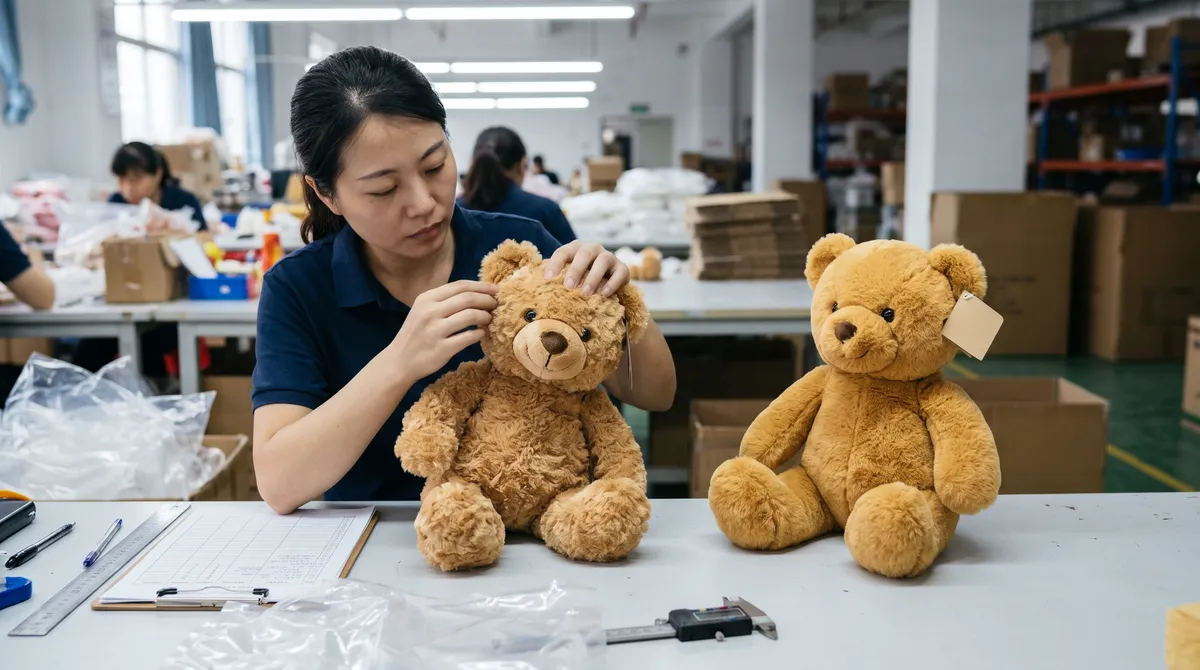
Treat your compression ratio as a fixed SKU spec, not a quick shipping tweak. For vacuum packing plush toys, set your opening benchmark at 55% to 65% volume reduction. Then tune it to each plush's geometry. Facial embroidery, ear shape, fill density, and hard safety parts all shift the safe window.
The mistake is chasing 80% to 90% because the carton looks efficient on paper. On the floor, that ratio shows up later as distorted faces, bent safety parts, crushed piles, and slow loft recovery after a long voyage. Buyers see the flat toy in photos. Sell-through drops.
We lock the ratio during sample approval. We measure the original dimensions, vacuum the sample to the target ratio, and photograph the compressed orientation. Then we reopen it and log rebound at 15 minutes, 24 hours, and 48 hours against a golden sample. We sign off only when the rebound curve clears the SKU spec.
✅ Verdict: We reject any target that wins on freight math but fails the 48-hour rebound check. A 40cm bear compressed to 85% came back about 12% flatter, and that gate protects listing photos.
💡 Pro Tip: Set a 55% to 65% starting window, then prove rebound before bulk production. Review the toy production process before you sign off.
Rule 4: Upgrade the Bag Spec Before You Upgrade the Freight Plan
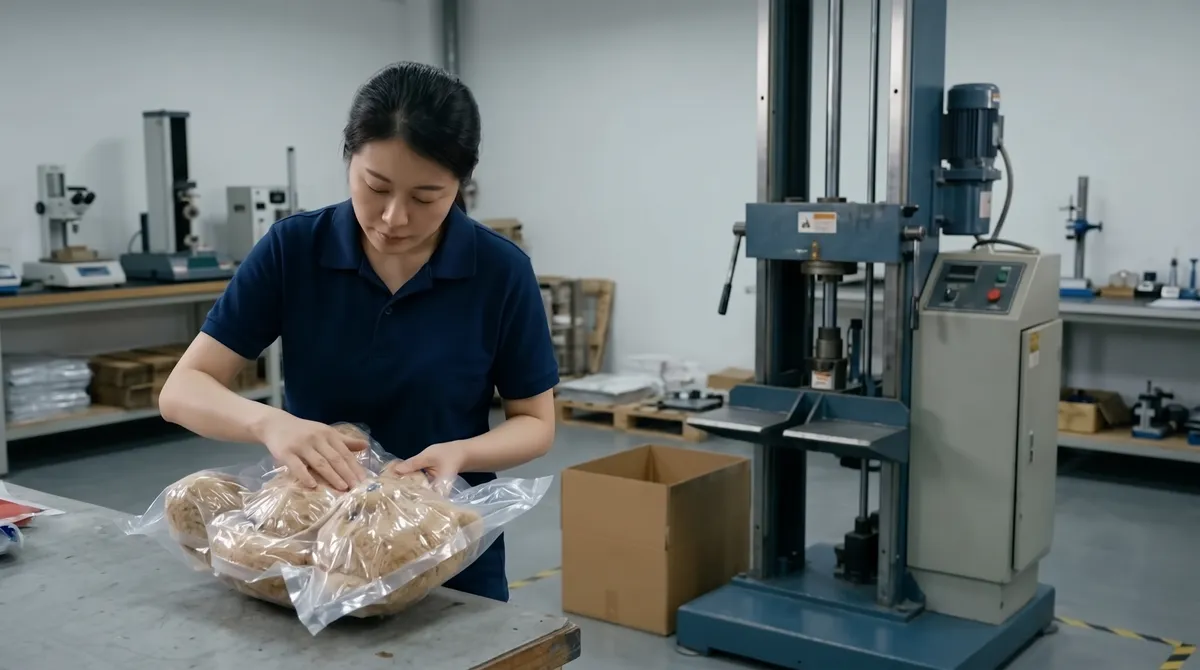
Upgrading freight first is backwards. We have seen a 40HQ of plush arrive with pinhole leaks from 60-micron consumer bags. The buyer blamed the plush. The failure was the bag spec.
For export plush, we specify PA/PE co-extruded film at 100 to 150 microns. The nylon (PA) layer adds oxygen barrier and puncture resistance; the PE layer adds sealability, flexibility, and the moisture barrier.
Go thicker for SKUs with hard eyes, molded noses, or sharp tag hardware. Thin bags save pennies but cost you refunds when stacked cartons rub and slow leaks appear weeks later. This sits inside the wider toy product packaging spec.
We define the bag matrix by SKU class: when to add inner sleeves or face shields, and how to orient valves or seams off stress points. We test every bag spec against an ISTA 3A parcel-drop sequence, where drop height is graded by package weight rather than a fixed figure, plus an ASTM D642 stack test.
The PA layer blocks sharp edges from poking pinholes through the film. Our 120-micron PA/PE bag passed the full drop sequence and stack test with zero air leaks. A thin 60-micron consumer bag split open in the same drop sequence.
✅ Verdict: We reject any export bag under 100 micron. Thin bags fail our drop and stack tests far more often than 120-micron PA/PE. Lock the bag spec before you renegotiate freight. See types of toy packaging for the full spec.
💡 Pro Tip: Ask your supplier for the micron rating and co-extrusion structure on every bag before you approve a carton.
Rule 5: Protect Faces, Safety Eyes, Tags, and Trim Before You Pull Vacuum
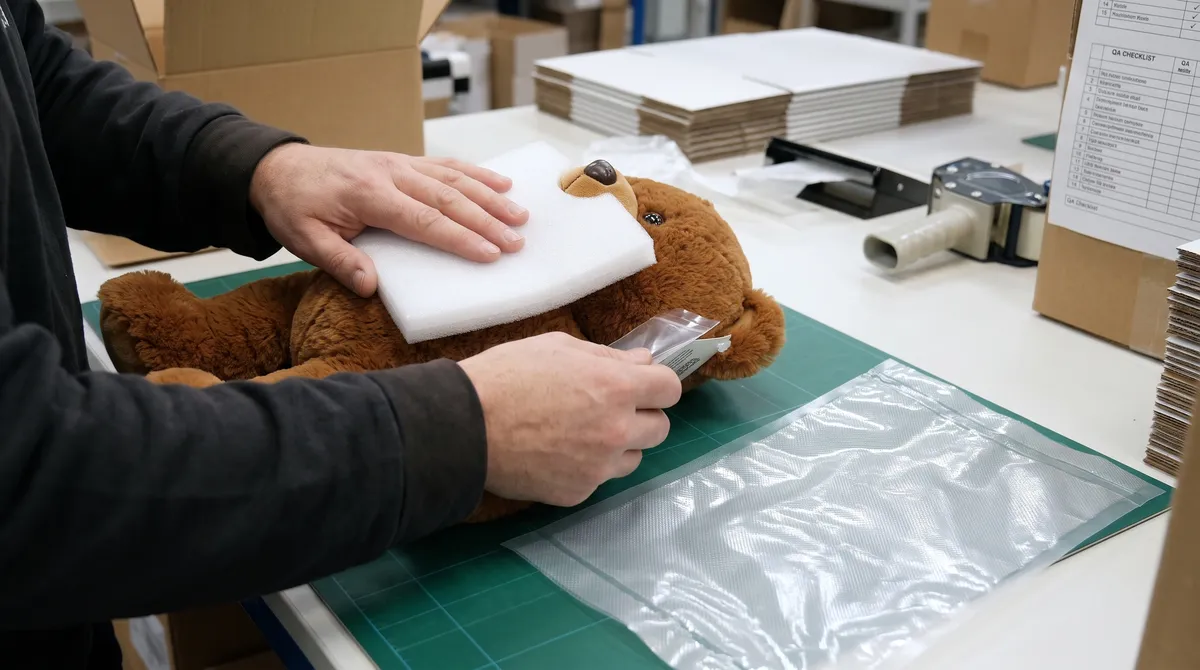
Hard accessories puncture bags at the worst pressure points. Safety eyes, plastic noses, hangtag edges, ribbons, and molded trim create stress risers. The face and pile fail where they fold against a seam.
Our floor teams see one common mistake: compressing with exposed hard parts. Loose hangtags inside the bag act like blades. Placing the face against a bag seam leaves a permanent crease. Sticking a barcode label on a wrinkled panel makes it unreadable at receiving and fails GS1 barcode standards.
Unprotected plastic eyes and noses accounted for 34% of all film punctures we logged in a recent audit. After we added 2mm EPE foam sleeves over every hard face part, the share of punctures traced to hard parts fell to 4% within two weeks.
Our protection sequence: inner sleeve or tissue wrap on every hard part, face-up orientation, hangtag isolation in a separate pouch, and barcode placement on a flat, unwrinkled panel. See our toy quality control gates and Amazon selling guide. Small parts must also meet ASTM F963.
✅ Verdict: We never vacuum a plush with exposed hard trim. One puncture turns a carton into a moisture risk and a potential return.
💡 Pro Tip: Wrap every hard part and isolate tags before you pull vacuum.
Rule 6: Run a 45-Day Ocean-Transit Rebound Test Before You Approve Mass Packing
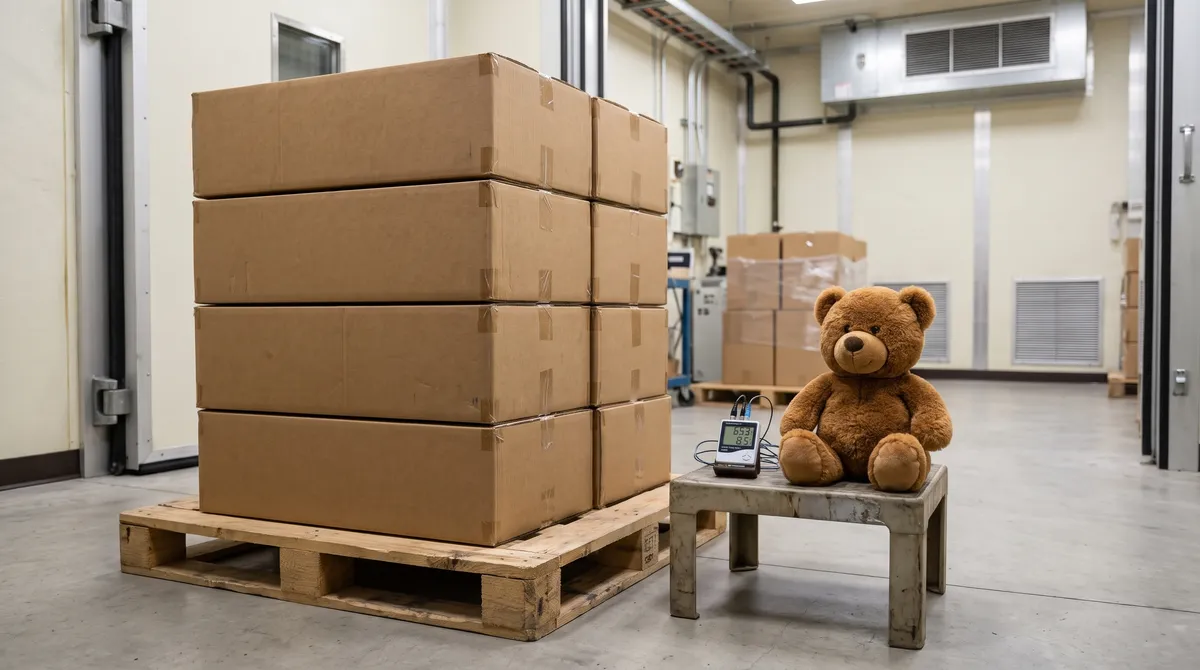
A 48-hour tabletop test proves a plush survives your bench. It does not prove it survives 45 days in a container. So we built a closer proxy.
We compressed three plush builds to 60% for 45 days in 120-micron PA/PE bags. We stacked four master cartons high and held chamber humidity between 68% and 74% to mirror a Pacific Ocean voyage. A four-carton stack is a proxy, not a full 40HQ floor load — the bottom of a loaded container carries far more weight, so treat these numbers as a floor, not a ceiling.
One uncompressed golden sample sat beside the stack as our control.
| Construction | Control | 45-day height | 24h rebound | 48h rebound |
|---|---|---|---|---|
| 3D hollow conjugated PP | 42mm | 30mm | 79% | 91% |
| Recycled polyester | 42mm | 25mm | 68% | 80% |
| Weighted PE-pellet | 42mm | 29mm | 77% | 85% |
Heights are caliper readings at the chest, in mm, measured 48 hours after release. Rebound = recovered height ÷ control height.
The common mistake is approving vacuum packing plush toys after a short demo. No stacked load. No humidity note. No photo log. No pass/fail threshold for face, limbs, and pile. That gap is where refunds live.
Every test we run logs the golden sample ID, compression date, bag spec, stack condition, reopening steps, caliper points, rebound timetable, and visual defect checklist. We add a desiccant sachet and record weight gain as a moisture proxy. That log is the evidence a plush factory audit checklist should ask for.
✅ Verdict: Anything under 85% rebound at 48 hours fails. Recycled polyester never cleared that gate over a 45-day hold, even when it looked acceptable after a short tabletop test.
💡 Pro Tip: Never approve mass packing from a short demo. Demand a 45-day simulation with a stacked load.
Rule 7: Prove the Savings With CBM, Landed Cost, and Throughput Math
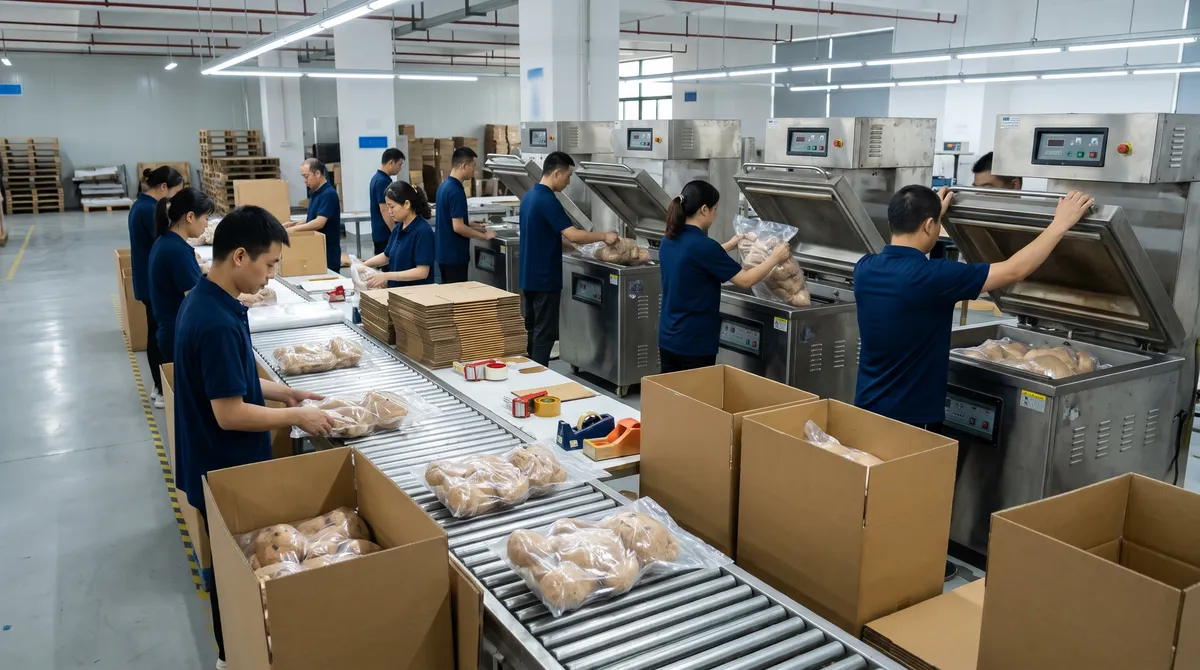
Finance will not approve a packaging program from a photo of a smaller carton. They need rows and columns.
A typical 5,000-unit plush order measures about 15 CBM air-filled. Vacuum packed, the same order ships at 6 CBM, which also changes units per carton from 20 to 50. At a $180 per CBM LCL sea freight rate, shipping drops from $2,700 to $1,080.
That trims gross freight by $1,620, or $0.32 per toy. Subtract your extra PA/PE bag cost ($0.08 per toy) and extra packing labor ($0.05 per toy), and the net saving is about $0.19 per toy. Always build your final budget on net landed cost, not gross freight math. Start the model with the toy cost breakdown.
Air express couriers like DHL and FedEx bill soft toys by dimensional weight, not scale weight. Carriers divide carton volume by 5,000 (cm³/kg) or 139 (in³/lb) to set your chargeable weight. Vacuum packing shrinks your carton cube directly and slashes that billed DIM weight. See our retail packaging and volumetric optimization notes.
One caveat on FBA fees. Amazon charges fulfillment on the dimensions of the packed unit it receives, so if plush enters the fulfillment center already compressed and stays that way to the customer, the FBA fee may not drop — and a flattened toy can read as a defect on arrival.
The reliable saving is on inbound freight (CBM and DIM weight). Confirm in your fee calculator whether re-inflating before FBA labeling still leaves a net gain. For the full prep sequence, see our Amazon FBA plush packaging guide.
The CBM drop is only half the model. Do not quote best-case CBM and hide bag cost, extra hand labor, slower throughput, added QC photo time, recovery insert cards, or return risk if rebound fails. On our line, vacuum packing drops the pack rate from 340 to 260 units per hour. That tradeoff is real.
✅ Verdict: Run vacuum pack, standard polybag, and retail box on one sheet. Net bag and labor cost against freight savings, then add return risk.
💡 Pro Tip: Build the ROI sheet before booking freight.
How to Vacuum Pack Plush Toys: A Step-by-Step Factory SOP
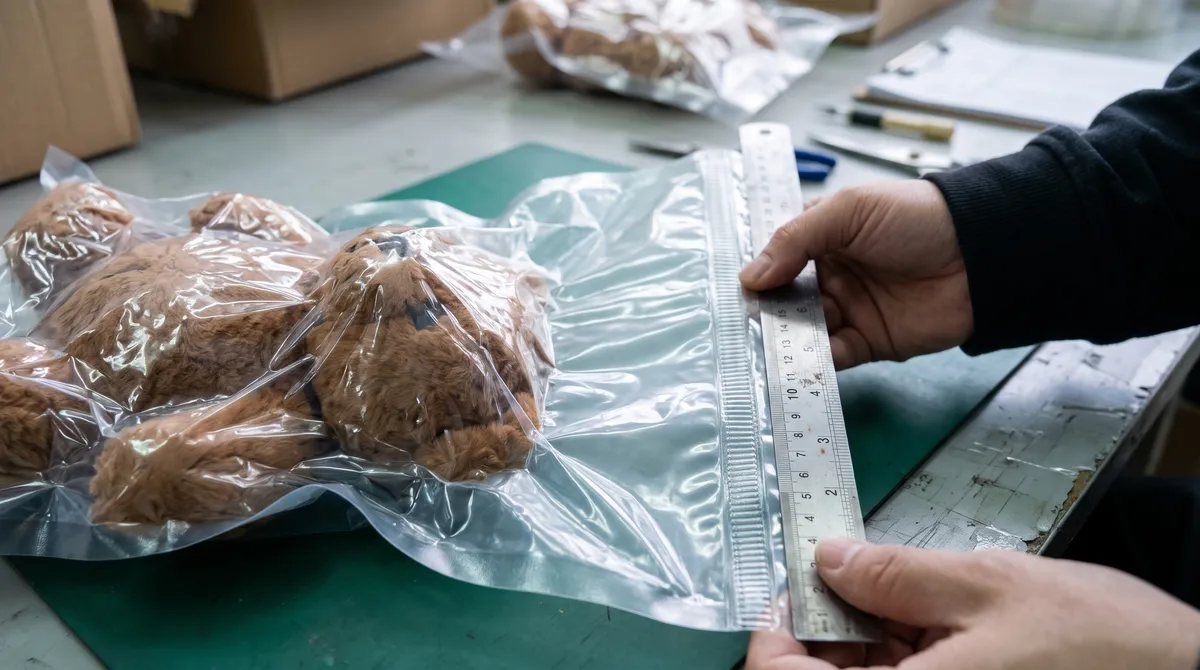
This protocol comes from our own floor, where we run it on every vacuum-packed export order and in the 45-day simulation above. Hand this sequence to sourcing, QC, and packaging.
Step 1: Pre-Check and Moisture Control
- Check dryness and cleanliness. Reject damp plush.
- Log humidity risk. Apply a "Keep dry — desiccant inside" warning label to the master carton.
- Place desiccant. Use 1-2 sachets per bag.
- Output: Dry plush with a logged moisture risk.
Step 2: Protect Hard Parts and Load the Bag
- Wrap safety eyes, noses, and hangtags in an inner sleeve.
- Load face-up. Keep seams off the bag edge.
- Isolate hangtags in a separate pouch.
- Output: No exposed hard parts.
Step 3: Pull Vacuum and Seal
- Pull vacuum to the 55-65% ratio from Rule 3.
- Set the heat-seal bar to 140°C–160°C with a 1.5-second dwell time for 120-micron PA/PE film. Log the exact machine settings on each batch record.
- Cool the seal before stacking. Do not stack hot bags.
- Output: A sealed bag with a flat seal.
Step 4: Load Cartons and Run Seal-Integrity QA
- Load cartons flat. Keep the carton fit snug.
- Seal integrity runs two tiers. Seal leaks are a critical defect with zero tolerance; the sampling plan (AQL 1.5) governs major defects like seal wrinkles, peel strength, and barcode readability. Confirm the sampling standard against ISO 2859-1.
- Inspect the AQL sample for: leaker rate, seal wrinkles, peel strength, barcode readability, suffocation warning placement, and carton fit.
- For FBA: confirm polybag label visibility and scannability against Amazon FBA polybag requirements.
- Output: A carton that passes QA.
💡 Pro Tip: We reject any seal wrinkle over 3mm. A wrinkle that size is a weak point that leaks under normal handling, so we sign off only at zero leakers on the inspection sample.
Next step: Confirm CPSIA for plush toys for the US and CE marking for the EU before retail, then lock the bag and carton spec from Rule 4. Request a compression sample, rebound test, or freight-saving calculation at our contact page.
People Also Ask About Vacuum Packing Plush Toys
-
Does vacuum packing damage plush toys?
It can if you over-compress or pack hard parts poorly. In our floor tests, soft PP-cotton plush recovered at 93% after 48 hours at 60% compression, clearing our 85% gate. Plush with wire, sound modules, or exposed safety eyes failed more often. We screen every SKU first, wrap hard trim, and run a 48-hour rebound check.
-
How long can plush stay compressed during ocean transit?
Plan for 45 days, not a 48-hour test. We compressed three builds at 60% for 45 days with a four-carton stack and 68% to 74% humidity. PP-cotton held 91% rebound at 48 hours and passed. Recycled polyester hit 80% and failed our 85% gate. Add desiccant, log moisture, and do not approve mass packing from a short demo.
-
What compression ratio is safe for PP-cotton plush?
Start at 55% to 65% volume reduction for PP-cotton plush. Our 3D hollow conjugated PP cotton held 93% rebound at 48 hours after a 48-hour compression test, and 91% after our 45-day transit simulation. Chasing 80% or 90% can save cartons, but it may distort faces and slow loft recovery. Lock the ratio on a golden sample.
-
What bag thickness should I spec for plush with hard safety eyes?
Use 100 to 150 micron PA/PE co-extruded film for export plush with hard safety eyes. In our drop and stack tests, a 120-micron bag passed the full drop sequence and a 48-hour stack, while a 60-micron bag split in the same sequence. Add an inner sleeve over eyes and noses.
-
How much can flat-packed plush save on shipping, and is it FBA-friendly?
On a typical 5,000-unit order, vacuum packing cut 15 CBM to 6 CBM and freight from $2,700 to $1,080 at $180 per CBM. That trimmed gross freight by $1,620, or $0.32 per unit, about $0.19 net after extra bag and labor cost.
The saving lands mainly on inbound freight; confirm FBA fulfillment fees separately, and only ship compressed if labels scan and the plush clears the 85% rebound gate.
This FAQ is based on our factory process and simulation data, not paid endorsements.