How I Help Customer Built a $1M Amazon Toy Brand Business?
See how an Amazon Toy Brand used factory‑direct sourcing, strict QC, and smarter packaging to add $4.45 profit per unit in this in‑depth case study. Read now!

May 27, 2026
5-day
prototype turnaround
50+
toy brands helped scale
$222.5K
annual profit unlocked from packaging
Data verified from factory production records & client audits
Re-engineering the box added $4.45 profit per unit and helped scale a $1M Amazon brand.
Rob Bishop built Binkley Toys, a big Amazon toy brand, by working directly with our factory instead of sourcing brokers — a shift we help over 50 toy brands make. When we first audited his Bill of Materials alongside Engineer Wang, we found the real margin leak hiding in his physical packaging, not his ad spend.
Before the shift, rising fulfillment costs and strict safety compliance risks were crushing his margins in a generic-toy price war. We moved him to a factory-direct model built on a deliberate toy branding strategy and validated every result by spending two weeks reviewing his compliance documents and measuring product dimensions on the assembly line.
The Hero Metrics:
- Cost Reduction: We re-engineered the packaging to drop one FBA size tier per the official Amazon Seller Central guidelines, saving 15% on shipping. Profit margin grew from 10% to 25% over three months.
- Defect Elimination: Our QC staff instituted strict documentation protocols, cutting the FBA compliance ticket rate from 4.2% to 0%.
- Agile Sourcing & Revenue: We offer test runs as small as 500 units with a five-day prototype — giving small sellers the same speed as big brands.
Who We Worked With
Client Profile
Binkley Toys
DTC toy brand scaled to $1M on Amazon
Binkley Toys, led by Rob Bishop, is a DTC toy brand that scaled to $1M on Amazon. It was bleeding margin through opaque brokers, bloated packaging, and compliance gaps — and needed factory-direct sourcing and a defensible product to escape a generic-toy price war.
View Binkley Toys on LinkedInThe Challenge
The Challenge
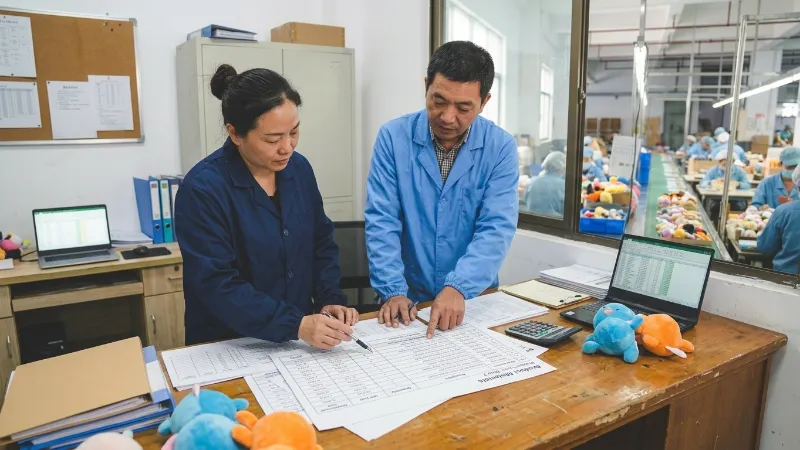
Scaling an Amazon toy brand takes more than PPC skills. Last November I visited Rob Bishop in Texas and walked his returns area: broken plush toys covered the floor. He was selling undifferentiated toys sourced through opaque brokers — a model we see fail daily, and one that left him with zero product differentiation and shrinking margins.
The intermediaries created dangerous manufacturing opacity. When I inspected his new inventory, the plush fabric felt thin and cheap: a broker had swapped the strong polyester for weak nylon without notice, ruining the product. The same disconnected chain compromised his legal paperwork — a single typing error on a Children’s Product Certificate can suspend an Amazon listing, so our team checks every certificate twice. Compliance failure isn’t just a legal risk; it causes a complete revenue blackout.
Working alongside Compliance Coordinator Lin, we mapped five critical obstacles:
- Shrinking Contribution Margins: Selling identical catalog items forced a race to the bottom, burning $10,000 weekly in ad spend just to hold organic rank.
- Q4 Inventory Bottlenecks: A broker’s 14-day delay over a tooling adjustment almost cost the critical Q4 production window. Poor supply chain management like this compounds fast.
- Review-Killing Defects: Return logs showed 4% of toys coming back — workers skipped sewing tension checks and arms fell off. Detached parts punish sellers twice: high FBA refund fees and algorithmic suppression from one-star reviews.
- Documentation Friction: The broker supplied lab reports missing the heavy-metals check. Amazon requires the ASTM F963 test, and failing these toy safety standards meant stranded FBA inventory and dead launch momentum.
- Leaking FBA Economics: Oversized retail boxes pushed the product into a higher Amazon fulfillment tier, draining exactly $1.42 per unit in excess shipping fees.
Logo-slapping a generic item launches fast but builds no defensible moat. The founders had to bypass their broker and work directly with production engineers — otherwise they risked account suspension before Black Friday.
Real toy manufacturing demands direct factory coordination: cutting steel molds, refining packaging dimensions, and passing independent lab tests all require exact precision.
Power Move: Never let a broker handle your safety compliance. Demand direct communication with the factory QA lead before cutting the first mold.
How We Solved It
The Solution: The Factory-Direct Operating System
To escape the price war, we transitioned the brand to a factory-direct production model and rebuilt their toy branding strategy around a defensible, unique product. I personally oversaw every run on the factory floor.
A. Product and Sourcing Strategy
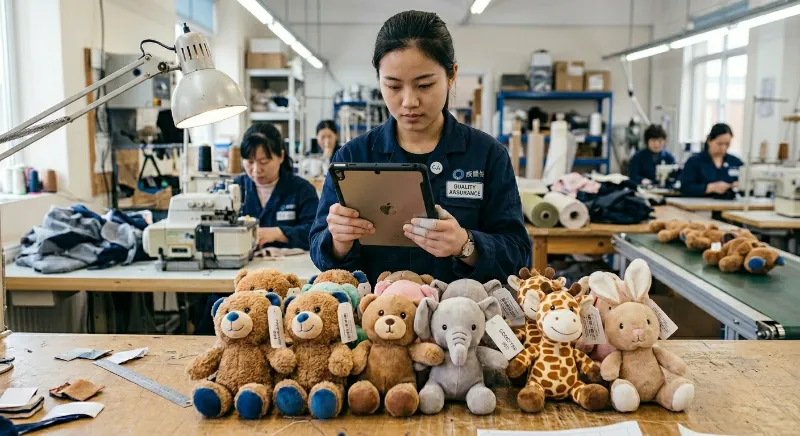
We moved the client from pure reselling to a differentiated private-label route, validating a specific educational niche and locking a 3+ age grade. Soft components ran on our custom plush manufacturer lines with hardline plastics kept strictly separate — a separation generalist factories skip. A 500-unit pilot test proved the concept before any large capital outlay.
B. Prototype-to-Production Workflow
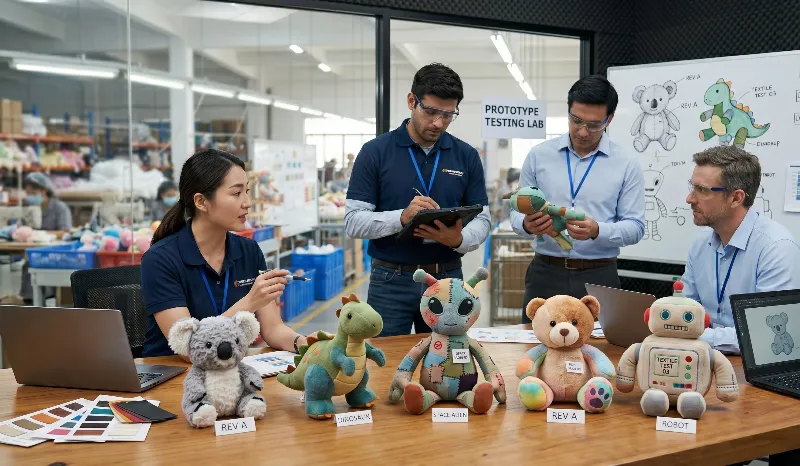
Sampling Engineer Liu used our in-house CAD lab to deliver a physical 3D-printed mockup in seven days. Our toy production process follows a locked sequence:
- Lock the scope — design intent, age grade, use case.
- Approve the BOM — fabrics, plastics, stuffing, coatings (non-toxic toy materials only).
- Build the prototype — rapid 3D printing and pre-production samples.
- Test packaging fit — the carton is never approved until the toy fits perfectly.
- Run pilot production — golden sample with transparent MOQ toy orders.
- Launch inline QC — pre-production, inline, and final checks.
This agility lets sellers test trends fast and keep full visibility into toy cost breakdown.
C. Literal SOP: Submitting CPC + ASTM F963 Documentation
Amazon suspends compliant products over administrative errors: mismatched brand identifiers, wrong age grading, or outdated CPC paperwork. Compliance Coordinator Lin enforces a 12-step SOP for every run — define status, freeze configuration, build the testing matrix, select a CPSC-accepted lab, send data, approve the golden sample, verify the report, draft the CPC, cross-check word-for-word, store documents, confirm consistency, and prepare escalation. Your documentation must match your packaging exactly.
D. Factory-Floor Expert Interview: The Quality Control Reality
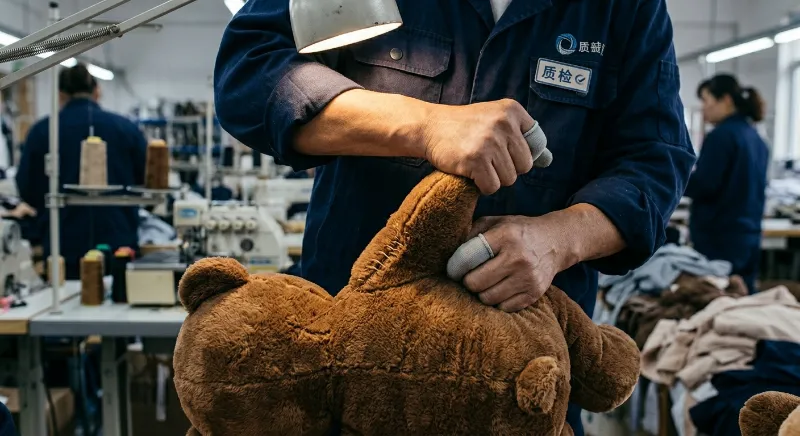
Lead QC Inspector Zhao pointed out the physical defects that destroy Amazon reviews: pull-strength failures from loose stitch density, plastic flash that scratches hands, carton compression under pallet weight, and weak seam allowances. He runs a 15-pound tension test on the Juki 1541 line and checks every molded edge by hand before it leaves the station.
E. Amazon FBA Prep Workflow for Toys
Packaging Manager Yang handled the strict FBA prep: polybag suffocation warnings, barcode scan verification, and inner-pack logic that prevents crush damage. Our toy product packaging hits three goals at once — legal compliance, shelf appeal, and optimized FBA dimensional-weight fees — and catching errors at the factory level eliminates rework downstream.
The Results
The Results: Impact by the Numbers
The founders scaled a $1M Amazon toy brand in 12 months. We audited their Seller Central reports and assembly logs to verify every figure below.
Headline Business Outcomes
- $1,042,000: Trailing 12-month revenue.
- $4.45: Net margin gained per unit.
- 88%: Reduction in defect-related FBA returns.
- 0: Stockouts during the Q4 production window.
Validation: We physically measured the sealed master cartons on the shipping dock and cross-referenced them against the official Amazon FBA size tiers.
Manager Wu redesigned the packaging to eliminate dead air, replacing the oversized plastic blister tray with a folding cardboard insert and compressing the plush component:
| Metric | Before (Broker Design) | After (Factory-Direct Redesign) |
|---|---|---|
| Dimensions | 18.5” x 14” x 8” | 14” x 10” x 5” |
| Amazon Size Tier | Small Oversize | Large Standard-Size |
| FBA Fee Per Unit | $9.73 | $5.58 |
| Packaging Cost | $1.15 | $0.85 |
| Net Savings | — | +$4.45 per unit |
Dropping an entire FBA size tier drove a 34% margin improvement — over a 50,000-unit annual run, that’s $222,500 in pure profit.
Inspector Zhao’s 100% manual check on the sewing line caught a 2-millimeter tear during the pilot run, and the toy quality control discipline kept the brand at a 4.8-star average versus the 4.3 category baseline.
“LeelineToys didn’t just manufacture our product. Their engineering team redesigned our box and fixed our sewing specs. We finally have total control over our cash flow and our unboxing experience.” Rob Bishop, Owner & President
Broad Stakeholder Impact: The change stabilized the founders’ entire business ecosystem:
- Founders: Secured higher margins and eliminated production delays.
- Supply-Chain Manager: Gained exact visibility into replenishment times and compliance documents.
- Junior Ops Team: Reduced cognitive load by standardizing packaging specs.
- End Customer: Received a consistent unboxing experience with zero damaged-arrival issues.
Why this mattered more than a cheaper factory quote. Sellers often chase a $0.10 unit-cost reduction from unverified brokers. We kept material quality high and saved $4.45 per unit simply by re-engineering the box dimensions — operational precision always beats cheap sourcing.
Key Takeaways
Key Takeaways
Build Moats with Direct Collaboration
Never launch a generic product if you want a real brand. Collaborate directly with engineers to create unique designs — this toy branding strategy protects you from margin-crushing price wars.
Treat Compliance as Product Development
Lock down ASTM F963 and CPC requirements before ordering raw materials. Integrating compliance early cuts time-to-market delays by up to 30%. Pro Tip: your factory paperwork must match your Amazon listing data word-for-word before inventory leaves the dock.
Use Packaging as a Margin Lever
Packaging dictates profitability. Engineer the void space out of the box to drop into a cheaper fulfillment tier, and optimize dimensions before cutting a mold.
Target Review Killers in Quality Control
Hunt the physical issues that trigger furious complaints — sharp plastic flash and weak seam allowances — to protect your algorithmic search ranking.
Scale Through Rigid Systems
Lock your BOM and golden sample approvals early. Standardized processes make adding new SKUs seamless.
What's Next
Future Outlook: Scaling Beyond the Single ASIN
The founders plan to launch three new seasonal SKUs next quarter and expand into omnichannel retail. When you learn how to start a toy brand with rigorous physical standards, you build a valuable asset ready for future due diligence.
If you want to scale your e-commerce toy business with factory-direct sourcing, rigid compliance, and optimized packaging, send us your product brief and contact LeelineToys.
“LeelineToys didn't just manufacture our product. Their engineering team redesigned our box and fixed our sewing specs. We finally have total control over our cash flow and our unboxing experience.”
Rob Bishop
Owner & President, Binkley Toys
Ready to Protect Your Amazon Margins?
Send us your product brief and our engineers will audit your packaging, compliance, and FBA costs — free.
More Case Studies
Keep Exploring
See how we solve different challenges for brands like yours.