

Short answer: Ten European wooden toy companies are profiled below. Nine still make their toys in Europe:
- Jeujura — French construction sets and chalets, made in the Jura
- HABA — German blocks, games and baby toys from Bad Rodach
- Ostheimer — hand-carved Waldorf figures from Zell unter Aichelberg
- Selecta — German baby and motor-skill brand; current production site not disclosed
- GRIMM'S — rainbow stackers and open-ended blocks, Germany and Bosnia
- goki — one of Germany's largest wooden toy groups, with German, Romanian and Chinese plants
- ABAfactory — Czech pull-along toys and vehicles, made in Czechia
- Erzi — German play food and role-play toys from the Ore Mountains
- BAJO — Polish stacking toys and modular train sets
- Grapat — Spanish loose parts and peg dolls
The comparison table below gives each one's country, founding year and production status.
goki, GRIMM'S and Ostheimer also produce outside their home country, and Selecta does not disclose its current production site. Check the country-of-origin label per SKU.
Most European makers are small-batch and heritage-focused. If you need private-label wooden toys at 300–1,000 units, a European maker is rarely the right fit.
LeelineToys is not affiliated with any brand listed here. All trademarks belong to their owners. Official-site links are provided so you can verify each claim yourself.
How to read this list
Not every company called a "European wooden toy manufacturer" still manufactures in Europe. This guide separates four cases:
- Still making in Europe — the company owns and runs production on European soil.
- Partly made in Europe — a European manufacturer that also produces abroad; check the country-of-origin label per SKU.
- Production not disclosed — a European brand that does not publish a current production site; confirm the country of origin per SKU.
- European brands that produce in Asia — design-led brands that are not counted as European manufacturers and are not profiled here.
Every entry below gives the same facts in the same order: country, founding year, production site, product focus, OEM status, MOQ where one is published, certification and official website. Where a maker does not publish an MOQ, the entry says so; no number has been estimated. We also do not publish third-party prices: they change by volume, configuration and year.
Last verified: 24 October 2026. We re-check official company pages and production statements every six months.
Quick comparison
| Brand | Country | Founded | Made in Europe? | Type |
|---|---|---|---|---|
| Jeujura | France | 1911 | Yes | Heritage maker |
| HABA | Germany | 1938 | Yes — wooden toys | German toy manufacturer |
| Ostheimer | Germany | 1939 | Yes — some ranges abroad | Heritage maker |
| Selecta | Germany | 1968 | Not disclosed | Brand (Schmidt Spiele) |
| GRIMM'S | Germany | 1978 | Partly — Germany and Bosnia | Heritage maker |
| goki | Germany | 1981 | Partly — Germany, Romania and China | Manufacturer + brands |
| ABAfactory | Czechia | 1991 | Yes | Manufacturer |
| Erzi | Germany | 1991 | Yes | Manufacturer |
| BAJO | Poland | 1993 | Yes | Manufacturer |
| Grapat | Spain | 2015 | Yes | Workshop |
European wooden toy makers and brands
Jeujura — France (est. 1911)
Jeujura was founded in 1911 by Henri Liégeon in Champagnole, in the French Jura, and moved production to Saint-Germain-en-Montagne in 1980, where the workshop and head office remain. It is one of the last French wooden-toy makers with continuous production in France, now run by the fourth generation of the family.
The range covers wooden construction sets, chalets, board games, tables and outdoor games. The strength is provenance and a genuinely French factory; the constraint is scale, with around 45–50 employees and a catalogue aimed at retail rather than private label.
- Production: Saint-Germain-en-Montagne, France.
- OEM and MOQ: no private-label programme is published on its site; MOQ not published — ask directly.
- Certification and products: CE / EN 71 — ask for the current test report per SKU; construction sets, chalets, board games and outdoor games.
- Official site: jeujura.fr.
For the manufacturing comparison, see CNC vs handmade wood toys and the wooden toy manufacturing process.
Best for: retailers that want French-made construction toys with a heritage story. Not for: private-label volume.
HABA — Germany (est. 1938)
HABA (Habermaass) was founded in 1938 in Bad Rodach, Bavaria, as a factory for fine wooden products, and Bad Rodach has been its headquarters and production site ever since. The company kept wooden-toy manufacturing in Germany while sourcing some other product lines abroad.
After a 2023 insolvency and restructuring, HABA remains family-owned and retained the Bad Rodach plant; the Eisleben furniture site was sold in 2024. The range covers blocks, board games, baby and role-play toys. For a buyer, it is a German manufacturer with a broad catalogue, but the restructuring makes continuity checks worth doing before a multi-year programme.
- Production: Bad Rodach, Germany.
- OEM and MOQ: no private-label programme for wooden toys is published on its site; MOQ not published — ask directly.
- Certification and products: CE / EN 71 — ask for the current test report per SKU; blocks, board games, baby and role-play toys.
- Official site: haba-play.com.
HABA is also a useful benchmark for the educational side of the category; see types of educational toys.
Best for: retailers that want a broad German toy brand with games and baby lines. Not for: buyers looking for a wooden-only factory or low-MOQ private label.
Ostheimer — Germany (est. 1939)
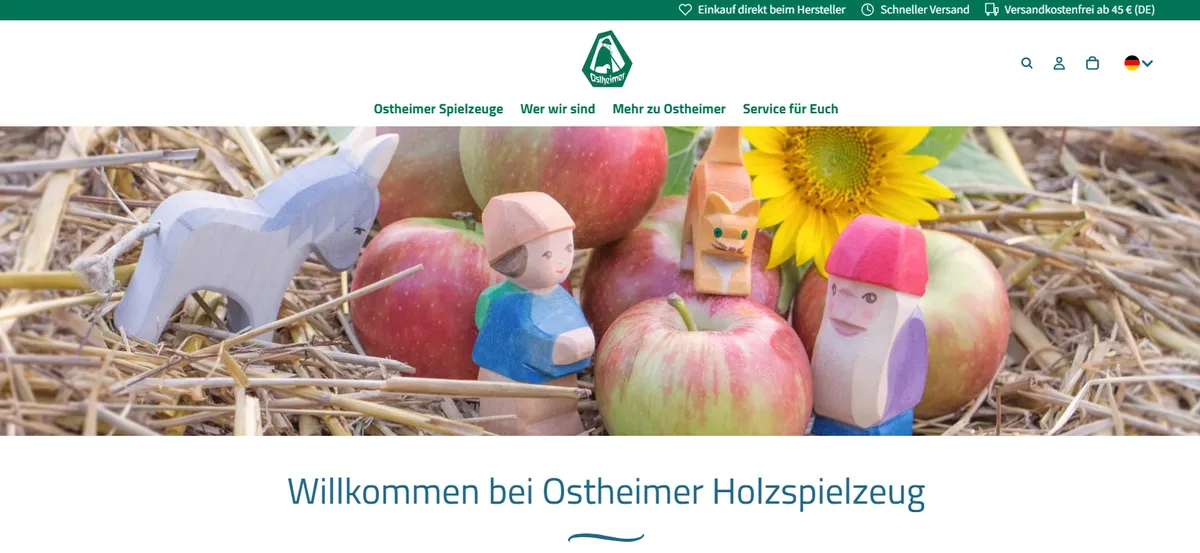
Ostheimer (Margarete Ostheimer GmbH) dates its history to 1939 and works from Zell unter Aichelberg, Germany. The figures are hand-carved and hand-painted with natural oils in a deliberately simple, Waldorf-inspired style, and the range covers farm and wild animals, people, knights and seasonal scenes.
The company states that most production is in Germany, with some ranges made in Poland and Bosnia. If origin is part of your marketing, ask for the origin of the specific figure rather than the brand as a whole.
- Production: Zell unter Aichelberg, Germany; some ranges in Poland and Bosnia.
- OEM and MOQ: no OEM or private-label programme is published on its site; MOQ not published.
- Certification and products: CE / EN 71 — ask for the current test report per SKU; hand-carved figures and animals.
- Official site: ostheimer.de.
The hand-carved approach is the opposite end of the market from painted plastic figures; see wooden vs plastic toys for the retail trade-offs.
Best for: Waldorf and natural-material retailers, and gift shops selling hand-finished figures. Not for: buyers who need uniform finishes at volume.
Selecta — Germany (est. 1968)
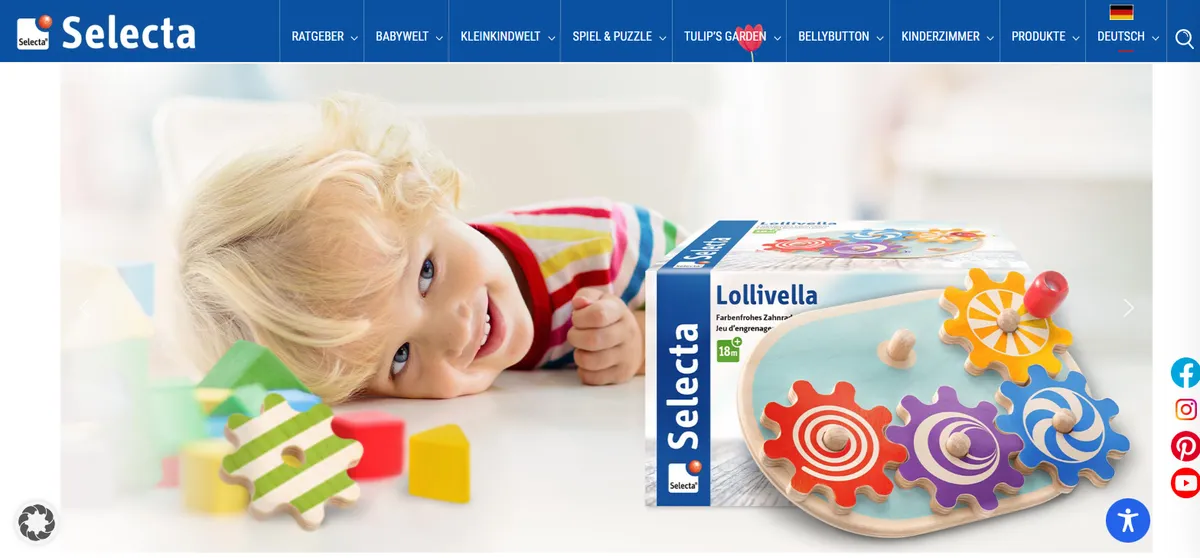
Selecta was founded in 1968 near Wasserburg am Inn and focuses on baby and motor-skill toys: rattles, sorting games, stacking pieces and mobiles. Since 2017 it has been a brand of Schmidt Spiele GmbH, and its current site no longer states a production location.
Selecta filed for insolvency in 2017 and was taken over by Schmidt Spiele the same year. The current site describes Selecta as a Schmidt Spiele brand; local reporting says the former Edling factory was later sold and demolished. Confirm the current production site, country of origin and certificate status per SKU before you rely on a German-made claim.
- Production: not disclosed — confirm the country of origin per SKU.
- OEM and MOQ: no OEM or private-label programme is published on its site; MOQ not published.
- Certification and products: CE / EN 71 — ask for the current test report per SKU; baby and motor-skill toys.
- Official site: selecta-spielzeug.de.
Best for: baby and motor-skill ranges (confirm current production origin). Not for: private label or custom design.
GRIMM'S — Germany (est. 1978)

GRIMM'S Spiel und Holz Design is a family-owned German company working from Hochdorf. Its own FAQ states that production runs in Germany and Bosnia, which makes it a European maker with a cross-border supply chain rather than a single-site factory.
The range is built around open-ended play: rainbow arches, building blocks, balls, rings and loose parts in a fixed colour palette. The wood is FSC-certified alder, lime, beech and maple from European forests, finished with water-based stains and plant oils. For a material-level comparison of the species involved, see wooden toy materials.
- Production: Hochdorf, Germany, and Bosnia.
- OEM and MOQ: no OEM or private-label programme is published on its site; MOQ not published.
- Certification and products: CE / EN 71 — ask for the current test report per SKU; rainbow stackers, blocks and loose parts.
- Official site: grimms.eu.
For retail buyers, the practical strength is a coherent, recognisable design language that holds its price on shelf. The limitation is capacity: the range is distributed rather than sold factory-direct, so customisation and private label are limited compared with a contract manufacturer.
Best for: open-ended play ranges with a strong design identity. Not for: private label or low-MOQ custom work.
goki (Gollnest & Kiesel) — Germany (est. 1981)

goki is one of northern Germany's largest toy companies and the parent of the goki, HOLZTIGER and HEIMESS brands. It produces in Germany (Zandt and Vaihingen an der Enz), Romania on the Danube, and Jiaxing, China, through its own subsidiary.
For buyers, the practical consequence is that the country of manufacture depends on the article. A goki wooden puzzle and a HOLZTIGER figure may come from different countries within the same catalogue. If a "made in Europe" claim matters for your listing, ask for the origin per article number rather than per brand.
HOLZTIGER was acquired in 2011 and covers more than 400 hand-painted animal figures in solid maple, with hand-finishing in Romania. HEIMESS covers baby toys.
- Production: Zandt and Vaihingen an der Enz, Germany; Romania; Jiaxing, China.
- OEM and MOQ: no private-label programme is published on its site; MOQ not published — ask directly.
- Certification and products: CE / EN 71 — ask for the current test report per SKU; wooden toys, baby toys and hand-painted figures.
- Official site: goki.eu.
For the material side, see plywood vs solid wood toys.
Best for: buyers who need a broad catalogue and accept mixed origin. Not for: buyers who need every SKU made in Europe.
ABAfactory — Czechia (est. 1991)

ABAfactory began production in 1991 as a family workshop; the current company, ABAfactory s.r.o., was registered in 2010. Unlike most names on this list, it states that all of its production takes place in the Czech Republic, which makes it one of the few genuine European-factory options for a "made in Europe" claim.
The catalogue covers pull-along toys, money boxes, vehicles and decorative items in traditional shapes, with modern joining methods and water-based paints. Logo work is offered by hand-painting, printing or laser engraving, which makes the company relevant for promotional and gift lines as well as retail ranges.
- Production: Czechia.
- OEM and MOQ: custom and logo work offered; MOQ quoted per brief.
- Certification and products: CE / EN 71 — ask for the current test report per SKU; pull-along toys, vehicles, money boxes and decorations.
- Official site: abafactory.com.
Best for: Czech-made pull-along toys and promotional wooden items. Not for: high-volume, low-cost programmes.
Erzi — Germany (est. 1991)
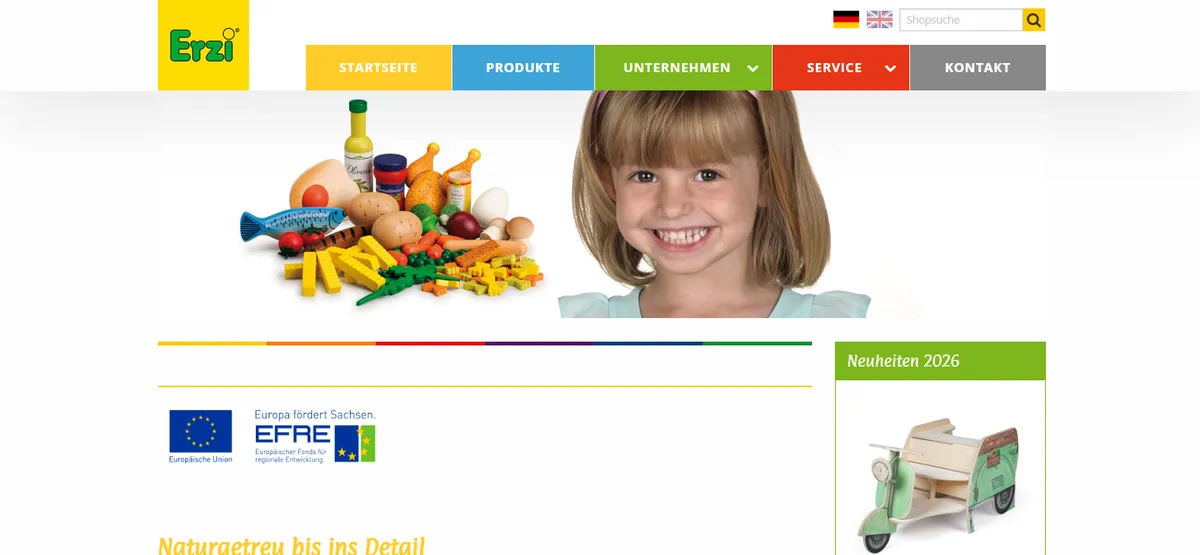
Erzi was founded in 1991 by Hartmut Eichinger as Erzi Qualitätsprodukte aus Holz and has been family-owned since 1999. It designs and manufactures in Grünhainichen in the Ore Mountains with about 50 employees, using FSC-certified beech and water-based paints.
The range is built around realistic play food, role-play shops and kitchens, and movement and balance equipment. It is a good fit for kindergarten, therapy and educational catalogues; the trade-off is a narrow, specialist assortment rather than a broad toy range.
- Production: Grünhainichen, Germany.
- OEM and MOQ: no private-label programme is published on its site; wholesale to retailers; MOQ not published.
- Certification and products: CE / EN 71; FSC-certified beech — ask for the current test report per SKU; play food, role-play shops and motor-skill toys.
- Official site: erzi.de.
Beech is the dominant species, and the trade-offs against other woods are covered in rubberwood vs beech toys.
Best for: educational, kindergarten and play-food ranges. Not for: buyers who need a broad general toy range.
BAJO — Poland (est. 1993)

BAJO was founded in 1993 by the architect Wojciech Bajor and works from Kamionna, in southern Poland. The company states that all of its products are manufactured in Poland, and it is one of the few makers on this list that combines a European factory with a large original catalogue.
The range covers stacking toys, vehicles, puzzles and modular train sets in water-based finishes, with an emphasis on open-ended play and simple forms.
- Production: Kamionna, Poland.
- OEM and MOQ: no OEM or private-label programme is published on its site; MOQ not published.
- Certification and products: CE / EN 71 — ask for the current test report per SKU; stacking toys, vehicles and modular train sets.
- Official site: bajo.eu.
We have deliberately left MOQ, lead time, sample window and volume discounts out of this entry. Those figures circulate widely online without a source, and the company does not publish them. Ask BAJO directly, and get the answer in writing.
For the category breakdown, see types of wooden toys.
Best for: Polish-made stacking toys and modular train sets. Not for: buyers who need a published MOQ or private label.
Grapat — Spain (est. 2015)

Grapat was founded in 2015 by Casiana Monczar and Jordi Soler in Catalonia and now works from Vilamalla. The company makes loose-part sets — rings, coins, tubes, peg dolls and mandala pieces — from beech, birch and maple, coloured with water-based dyes and finished with vegetable oils.
The design philosophy is deliberate: the pieces are simple, the wood grain is visible, and the finish is designed to develop a patina rather than stay pristine. That is a selling point for Montessori and Waldorf retailers and a drawback for buyers who need a uniform, factory-perfect finish across large batches.
- Production: Vilamalla, Spain.
- OEM and MOQ: no OEM or private-label programme is published on its site; MOQ not published.
- Certification and products: CE / EN 71 — ask for the current test report per SKU; loose parts, peg dolls and mandala sets.
- Official site: grapat.eu.
Best for: Montessori and loose-parts ranges. Not for: buyers who need uniform, factory-perfect finishes at large volumes.
How to verify where a wooden toy is really made?
- Read the Declaration of Conformity. The manufacturer named on the DoC is legally responsible for the toy. The address on that document should match the production site, not just the brand's marketing office.
- Check the label, not the website. EU rules require the manufacturer's or importer's name and address on the toy or its packaging. If the label says "Made in China" while the website says "European craftsmanship", the label wins.
- Ask for the factory audit. ISO 9001, BSCI or ICTI reports name the production site. A brand that cannot produce one is usually sourcing rather than manufacturing.
- Ask for a dated production video. A short clip of the line with a visible date is much harder to stage than a catalogue photo.
- Check the GPSR responsible person. Since 13 December 2024, EU rules require an EU-based responsible person and traceability information for consumer products, including toys.
- Check MOQ behaviour. A brand that only designs usually cannot accept small custom runs, because it has to place a minimum order with its own supplier.
For the underlying standards, see our guide to wooden toy safety standards and the FSC certification explained article.
European maker or OEM factory?
The right answer depends on order size, label ownership and how much of the "made in Europe" story you need.
| If you need… | European maker | OEM factory |
|---|---|---|
| 50–500 heritage or collector pieces | Yes — European maker | Not economical |
| 300–1,000 units under your own label | Usually no | Yes |
| A "made in Europe" claim on pack | Yes | No |
| Lowest landed cost at volume | No | Yes |
| Your own moulds, artwork and packaging files | No | Yes |
| Custom design and private label | Rarely | Yes |
A simple rule: European makers sell a story and a craft; OEM factories sell capacity and your label. Most buyers need one or the other, not both.
If your brief is private label at 300–1,000 units, a European heritage maker will usually decline or quote a price that does not work at retail.
In that case, compare the European route with a direct manufacturing route before you commit. LeelineToys is a custom wooden toy manufacturer in China; our OEM and ODM programme covers design, prototyping, EN 71 testing and retail packaging. Our wooden toy factory checklist covers the compliance and QC side.
Need a wooden toy under your own label?
European heritage makers are built for catalogue and collector ranges, not 300–1,000-unit private label. If that is your brief, send it to us and we will come back with a sample plan, tooling and a written quote.
Request a QuoteFree consultation · EN 71 testing and DDP delivery quoted per project.
FAQs About Wooden Toy Manufacturers Europe
Which wooden toy manufacturers are actually based and producing in Europe?
As of October 2026, nine of the ten companies profiled here state that they produce wooden toys in Europe: Jeujura (France), HABA, Ostheimer, GRIMM'S, goki and Erzi (Germany), ABAfactory (Czechia), BAJO (Poland) and Grapat (Spain). Selecta is a German brand whose current production site is not disclosed. Some makers also produce outside Europe; check the "Made in" label and the Declaration of Conformity for the exact SKU.
Where are Holztiger figures made?
Holztiger is a goki brand, acquired by Gollnest & Kiesel in 2011. The figures are carved and hand-painted from solid maple, and hand-finishing for several ranges takes place in goki's Romanian workshop on the Danube. Confirm the origin of the specific figure on the packaging, because other goki lines are also made in Germany and China.
Do European wooden toy makers accept private label or OEM orders?
Most heritage brands do not publish a private-label programme, and several do not take custom work at all. ABAfactory offers custom and logo work; the others publish no private-label programme. If you need your own label at 300–1,000 units, a factory-direct producer is usually the realistic route.
What is the minimum order quantity for European wooden toy makers?
MOQs are rarely published. ABAfactory quotes per brief; the heritage makers generally work from catalogue or wholesale quantities. Ask each maker in writing before you design a range around a number.
What certifications should European wooden toys carry?
A toy sold in the EU needs CE marking, a Declaration of Conformity and testing to EN71-1 (mechanical), EN71-2 (flammability) and EN71-3 (migration of elements). Wood sourcing is usually covered by FSC or PEFC chain-of-custody. Since December 2024, GPSR also requires an EU-based responsible person.
Why are European-made wooden toys more expensive?
European production carries higher labour and energy costs, smaller batch sizes, stricter wood sourcing and more expensive testing per unit. That cost buys traceability and a "made in Europe" claim that some retailers and gift buyers will pay for. It does not automatically mean better safety, because Asian factories also test to EN71.
Can I order a custom wooden toy below 500 units?
Most European makers do not publish MOQ, and some start well above 500 units. If you need a custom design at low volume, a factory-direct producer is usually the better fit. LeelineToys quotes MOQ per design, typically from 300 units for wooden toy lines, after reviewing the brief.
Related reading
- German wooden toy manufacturers — the German-only equivalent of this guide.
- Wooden toy manufacturers UK — British suppliers and production options.
- Wooden toy manufacturers USA — US suppliers and production options.
- Wooden toy manufacturers in Thailand — Asian production alternatives.
- Wooden toy manufacturers in India — handcrafted and export-oriented suppliers.
Sources and verification
We checked each entry against the company's own website or company history, and cross-checked founding years and production statements against trade directories and industry reporting. Where sources disagree, the entry says so instead of picking a number.
- goki official site · goki factory visit report (Grüne Büchen, 2024)
- ABAfactory official site
- BAJO official site
- GRIMM'S official site
- Grapat official site
- Selecta official site
- Ostheimer official site · Ostheimer company history
- Jeujura official site · Jeujura profile (Le Progrès, 2025)
- HABA official site · HABA company history
- Erzi official site