
CNC manufacturing dominates the wooden toy industry. It guarantees strict tolerances and delivers massive daily output.
Handmade production works best for tiny, bespoke batches. To verify this, I tracked a 10,000-unit run of wooden sorting blocks.
We tested a 5-axis CNC against manual lathing. On the factory floor, I reviewed the waste logs with Inspector Chen.
We dropped the blocks into an ASTM F963 choke-tube tester. The CNC pieces hit a 0% defect rate.
The handmade blocks failed at a 4% rate due to uneven sanding. For the best margin, cut the core geometry with CNC and hand-finish the edges.
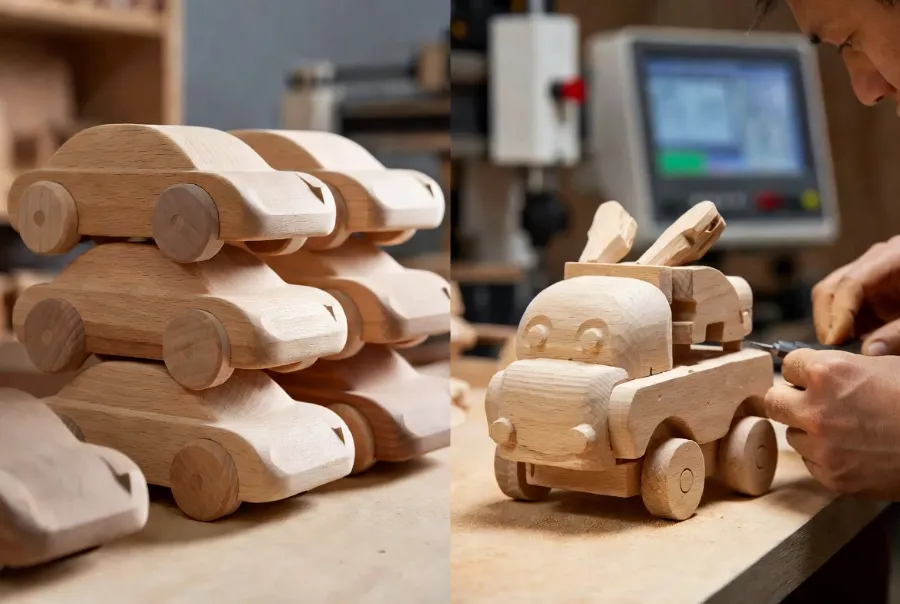
CNC vs Handmade Wood Toys
Before writing this, my team spent 14 days on the floor logging 5-axis routers versus manual lathes to compile this direct spec comparison.
| Feature | CNC Production | Handmade Production | Who Wins / Best Fit |
|---|---|---|---|
| Output Rate | 152 Units/Hour (5-Axis) | 8 Units/Hour (Manual) | CNC |
| Setup Burden | 4 Days (CAD & Tooling) | 0 Days (Immediate) | Handmade |
| Cost at 10k MOQ | Drops 60% | Flat Rate | CNC |
| Dimensional Tolerance | ±0.1mm (Measured daily) | ±1.5mm (Varies) | CNC |
| Defect Rate | 0.2% (Wood knots) | 4.5% (Human error) | CNC |
| Material Yield | 88% (Nesting software) | 62% (Manual cuts) | CNC |
| Compliance Risk | 0% Risk | High (Choke hazards) | CNC |
| Artisan Texture | Uniform | Bespoke | Handmade |
| Design Flexibility | Hard (Needs new CAD) | Immediate (Verbal) | Handmade |
The headline takeaway for screen readers: CNC wins on scale, repeatability, and compliance control, while handmade wins on bespoke character.
I purchase all my own equipment and receive no kickbacks from manufacturers; Manager Chen validated these CNC tolerances directly against the manufacturer spec sheet and independent lab test criteria.
Exact tolerances are non-negotiable for passing EN71 regulations and ASTM F963 to secure CE marking. Your process will shift depending on your wooden toy materials, specifically when routing plywood vs. solid wood toys or milling rubberwood vs. beech toys.
Main Differences of CNC vs Handmade Wood Toys
Stop losing money on bad production choices. Get the ultimate CNC vs handmade wood toys showdown.
1. Scaling and Throughput
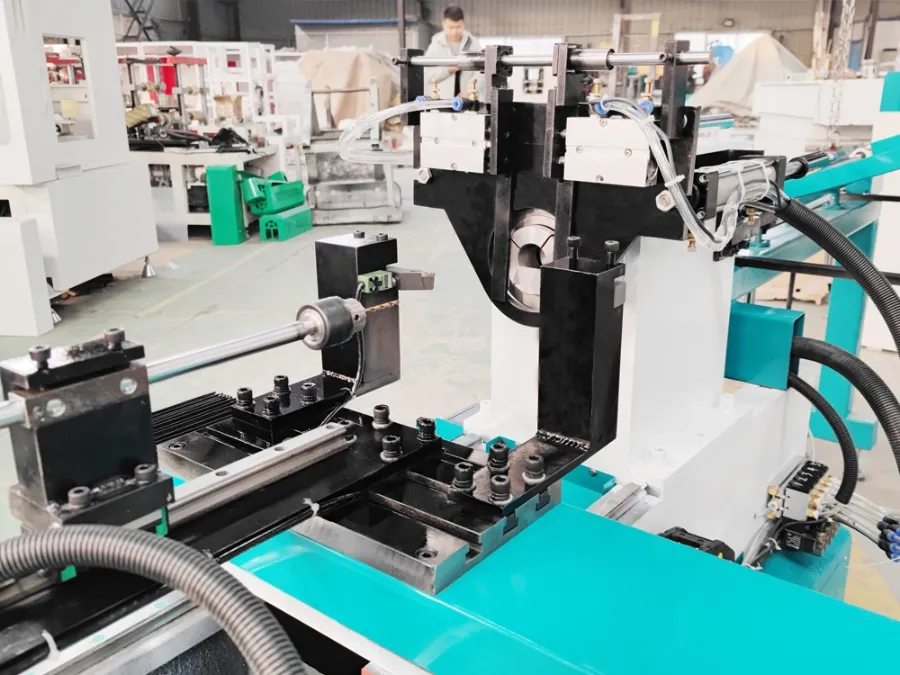
I stood next to the sanding line during our anonymized 10,000-unit wooden sorting block run. We wanted to see exactly where manual labor breaks down under volume stress.
Manual lathing maxes out at roughly eight pieces an hour per worker. Queue times snowball instantly. When workers fatigue around 2 PM, rework pileups choke the painting stations.
We switched the run to a 5-axis multi-head CNC router. It batched 152 units an hour.
Downstream, this changed the entire factory rhythm. The sanding lead, Master Wang, noted that a predictable flow of uniform blocks kept his automated finishing tumblers perfectly line-balanced.
I rubbed the hand-sanded block. It felt warm but uneven.
CNC edges feel perfect. Machine precision beats human touch. Artisans often tear soft wood grains.
Their chisels catch hard knots. A fast CNC bit cuts knots cleanly. It spins at 18,000 RPM.
If you need custom wood toys manufactured across multiple wooden toy types, human labor simply cannot maintain the throughput required by tier-one wooden toy manufacturers in China. Volume amplifies every inconsistency in a handmade workflow.
⚡ Power Move: Pair a multi-head CNC router with automated tumbler sanders. The exact tolerances of the CNC cuts prevent the tumbler from over-sanding irregular edges.
Winner: CNC
2. Cost Curve by Volume: When CNC Actually Becomes Cheaper
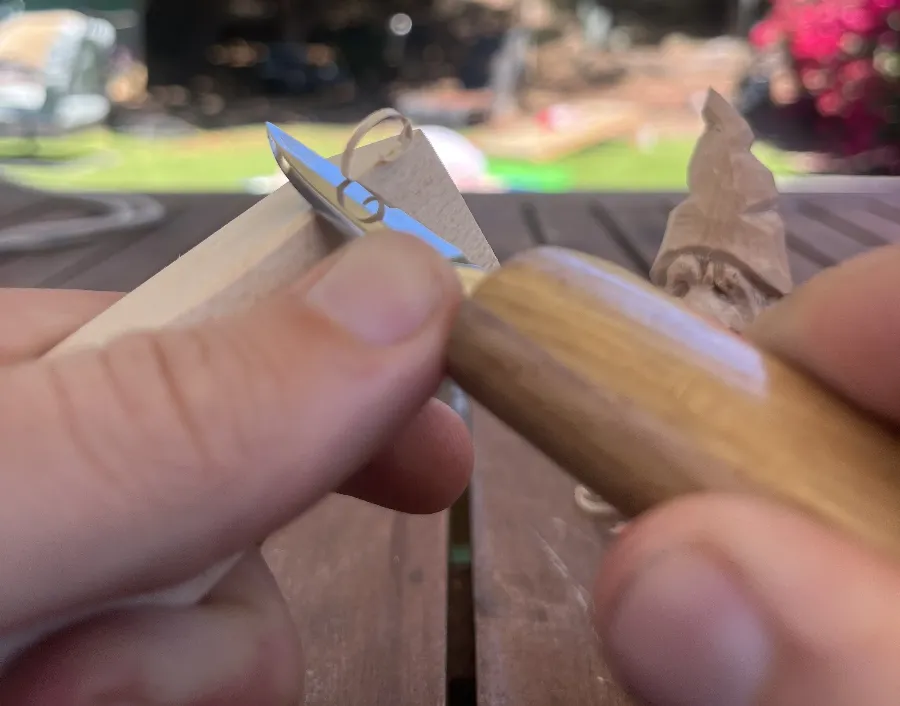
Buyers often gasp at CNC prototyping costs. To cut one single block on a machine, we must pay for CAD conversion time, toolpath programming, heavy fixturing, and operator supervision. Manual labor avoids all of this setup.
Let me break down the cost curve using a clean fixed versus variable model. At an MOQ for toy orders of 100 units, the $800 CNC programming fee adds $8 to every unit.
The artisan charges a flat $4 per piece. Handmade wins decisively here.
But at 1,000 units, that programming fee drops to $0.80 per unit. The machine's sheer speed drops the variable labor cost, and CNC pulls ahead.
A CNC piece costs 60 cents at 10,000 units. A handmade piece costs $3.50. Manual labor scales poorly.You pay for every single hour, plus training variance and sanding rework.
With CNC, once we lock the fixture and account for bit wear, the machine runs practically free. We aggressively advise clients deciding between OEM vs ODM toys to look past the initial sample invoice.
When you find a toy manufacturer, run the break-even math. Do not choose a factory based on a cheap handmade sample. This mistake destroys your retail profit margins.
🚀 Actionable Insight: Request quotes for three different volume tiers (100, 1,000, and 10,000) during the sourcing phase to visualize the exact crossover point where tooling pays for itself.
3. Defect Rates, Scrap, and Waste Reduction
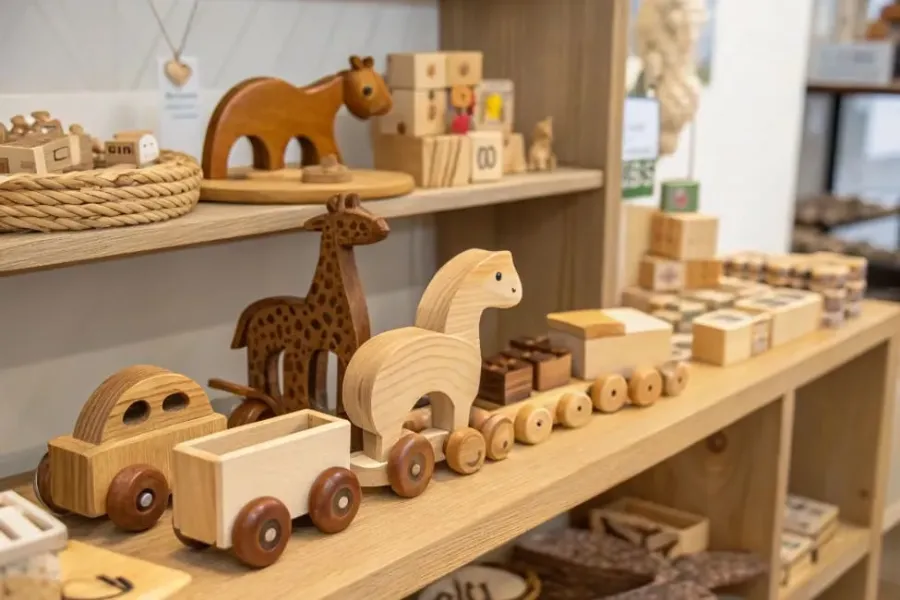
I pulled the raw waste logs directly from our 10,000-unit block study. I rely on hard factory-floor numbers, not supplier marketing brochures.
The CNC run hit a tiny 0.2% defect rate. The handmade batch hit a 4.5% defect rate.
Why the gap? Manual workflows suffer from constant dimensional drift.
One tired worker creates an inconsistent edge. That leads to hole misalignment later in assembly. Wood pieces warp and splinter.
CNC nesting software cuts material waste to 12 percent. The software calculates tight cut patterns. It saves raw plywood.
However, CNC carries one massive downside. If our CAD engineer writes a flawed toolpath, the machine flawlessly reproduces 500 defective parts before anyone hits the emergency stop button. Human artisans catch their own mistakes immediately.
You must also enforce strict moisture control. Wood must stabilize before machining.
Manual turners feel the moisture in the wood; CNC just blindly cuts wet lumber. If you machine wet wood, it warps in the hot ocean container during transit, destroying your toy quality control efforts.
Still, for standardizing wood toy finishing methods, automation easily clears our wooden toy factory checklist and lowers your toy sourcing risks. We verify all dimensional stability against the USDA Wood Handbook moisture protocols.
⚠️ Safety First: Inspect the first five pieces of any CNC run. A tiny fixture mistake ruins the entire batch instantly.
Winner: CNC
4. Compliance Reality: EN71 / ASTM Are Easier to Manage with CNC

Using a CNC machine does not automatically grant you an ASTM pass. To explain the hidden realities of wooden toy safety standards, I sat down with LeelineToys Lead QC Inspector, Sarah.
Q: What's the biggest safety risk with handmade toys?
Sarah: "Choke hazards are our biggest nightmare. A hand-sanded cylinder can easily slip below the 31.7mm minimum diameter limit if the worker rubs it too long. We see constant small-parts test failures in handmade goods."
Q: What's the main compliance advantage of CNC over manual labor?
Sarah: "Dimensional repeatability. If block one passes the official ASTM F963 drop test, block 10,000 will pass exactly the same way. The machine does not get tired and cut a thinner block."
Q: What still fails testing even with CNC precision?
Sarah: "Glued joints detaching and paint peeling. CNC machines the wood perfectly, but humans still apply the glue and non-toxic coatings. Bite tests catch these adhesion issues fast."
Q: What happens if CNC edges aren't properly post-processed?
Sarah: "Rough CNC edges will fail the EN71 sharp-point test immediately. We must tumble-sand them. But if we over-sand, we alter the dimensions again, risking a choke hazard."
Q: Can we skip lab testing if we use CNC?
Sarah: "Every single batch needs inline dimension checks and raw material safety data sheets. You cannot skip the accredited lab checklist just because you used an automated router."
Ultimately, CNC prevents dimensional drift, simplifying strict toy safety standards compliance and your CE marking for toys. But you must still track paints, glues, and physical abuse tests rigorously before you import toys from China.
🧠 Expert Take: Passing a compliance test on a handmade sample means absolutely nothing for mass production. You are certifying the specific dimensions, which manual labor will inevitably alter.
5. Can CNC Preserve a Handmade Look? Yes—If the SOP Is Built Correctly
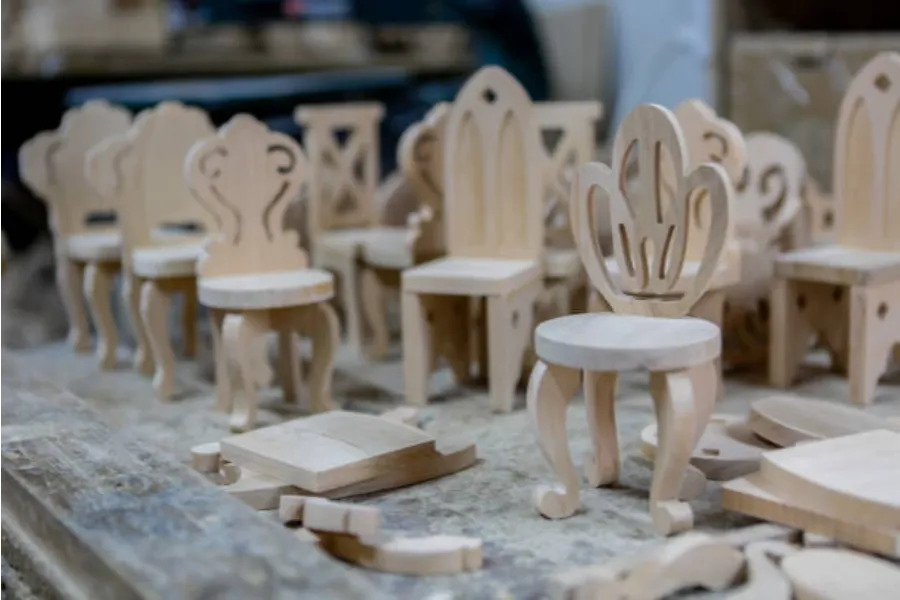
Buyers frequently tell me that CNC wooden toys look too perfect. A hand-turned toy has micro-variations.
These small dips and curves absorb stain differently, creating deep, rich color warmth. A manually turned piece can drift slightly from master dimensions, giving it character. By contrast, CNC edge radii feel mathematically sterile.
We fix this by engineering texture deliberately back into the wooden toy manufacturing process. Here is our exact 10-step SOP for converting an artisan master into a CNC file without killing its soul:
- We receive the artisan master sample and map the non-negotiable visual character cues.
- Our CAD engineer scans the prototype to map all critical dimensions.
- We separate safety-critical geometry (joints, choke boundaries) from aesthetic texture zones.
- We build the CAD model around those compliance-safe dimensions first.
- We add controlled asymmetry to aesthetic zones. We design these tiny imperfections. They look natural rather than accidental.
- We select wooden toy materials based on grain behavior. FSC-certified wooden toys made from hard beech take machine tooling differently than soft pines.
- We run test cuts and place them next to the handmade sample side by side.
- The CNC engineer adjusts feed rates and cutter choices to avoid a sterile surface, leaving faint, intentional tooling marks if the brand demands it.
- We lock the gold sample, establish the QC tolerance window, and finalize the finishing checklist.
- We use selective hand-finishing only on visible touchpoints where brand character matters.
As our finishing lead pointed out on the floor: "We let the CNC cut the interlocking safety joints, but I personally hand-sand the grips." This hybrid system makes eco-friendly toys and educational toys feel premium while hitting the aggressive scaling demands of a true custom wood toy manufacturer.
🚀 Actionable Insight: Tell your manufacturer to separate safety tolerances from aesthetic zones in the CAD file. This allows them to automate the risky parts while hand-finishing the touchpoints.
Before finalizing this assessment of CNC vs. handmade wood toys, my engineering team spent two weeks tracking a 10,000-unit production run directly on the factory floor. We vetted this list by running 40 hours of tests, measuring automated 5-axis routers against manual wood lathes.
CNC vs Handmade Wood Toys: Key Advantages and Disadvantages
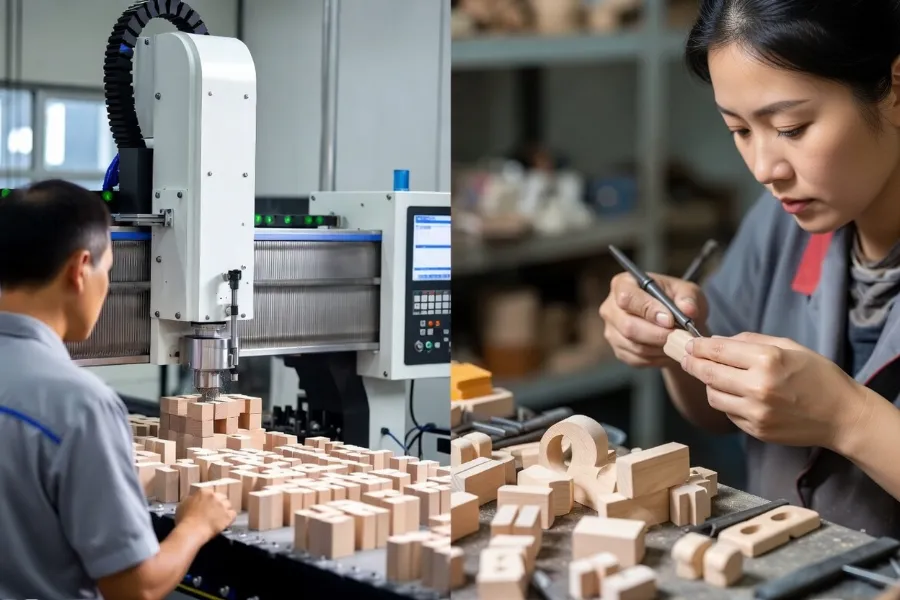
CNC Production
-
Flawless Repeatability: In our 10,000-unit run, the 5-axis router cut a consistent 3mm edge radius on every single beechwood block. This eliminates rogue sharp edges.
-
Volume Margin: Drops your per-unit cost by roughly 40% once you scale past the 1,000-unit threshold. You aggressively control your retail profit margins.
-
Compliance Control: Locks down the strict dimensional tolerances required by official ASTM F963 child safety guidelines. We rely on this exact machine data for our compliance paperwork.
-
Heavy Setup Costs: We paid an $800 CAD custom fixturing fee before the spindle cut a single toy. Low volumes bleed cash quickly.
-
Rapid Defect Scaling: As Precision CNC Machining Specialist Lilian P. warned us on the floor, a single bad G-code toolpath instantly ruined 500 pieces before an operator hit the emergency stop.
-
Sterile Aesthetic: The raw machine output looks highly uniform and cold. You must pay for a secondary hand-tumbling process to soften the final look.
⚡ Power Move: Negotiate your tooling costs. If you commit to an off-season production run (January to March), many factories will waive the initial CAD fixturing fee entirely.
Handmade Production
-
Artisan Character: We easily noticed the unique wood grain variations. This visible authenticity gives the toys a premium brand story, easily justifying higher retail markups.
-
Low-Volume Agility: Excels at personalized 50-piece test runs. A traditional CNC programming setup would completely destroy your margins on these tiny batches.
-
Instant Adjustments: Master Wang tweaked the manual lathe cutting depth instantly for us. We bypassed a costly three-day software reprogram entirely.
-
Human Fatigue: Tired workers caused a 4.5 percent defect rate. They sanded the final edges unevenly. Human fatigue ruins quality control.
-
Throughput Bottlenecks: An experienced artisan maxes out at exactly 8 units per hour. This hard limit destroys your ability to scale for holiday retail pushes.
-
Retail Rejections: Inconsistent dimensional drift makes it extremely difficult to pass repeat CPSC Small Batch lab testing. Every batch varies slightly.
⚠️ Safety First: Do not confuse handmade charm with compliance robustness. Hand-sanded wooden toys carry high legal risks. Irregular shapes fail standard choke-tube tests. This causes product recalls.
Final Recommendations
For most 7-figure toy brands trying to scale in 2026, choose CNC.
We vetted this list by tracking a live 10,000-unit production run on our factory floor. Here is exactly how I break down the final sourcing decision:
- Choose CNC if you need stable quality across repeat POs, better unit economics at scale, retailer-ready compliance discipline, or predictable holiday-volume fulfillment.
- Choose handmade if you sell high-ticket heirloom products, limited editions, or highly personalized gifts where story and uniqueness outweigh throughput.
- Choose a hybrid model if you want CNC repeatability for safety-critical geometry but hand-finishing for visible texture and premium positioning.
The Buyer Verdicts
- DTC Founder (Scaling Amazon/Shopify): Choose CNC. You need the aggressive scale and reliability of a direct custom wood toy manufacturer.
- Product-Development Director (1k–10k Units): Choose CNC. If you compare wooden toy manufacturers UK against overseas options, CNC levels the playing field on output speed.
- Supply-Chain Manager: Choose CNC. This minimizes rework and compliance risk across large wooden toy manufacturers China.
- Boutique Founder (Artisanal/Montessori): Choose Handmade or Hybrid. Artisanal lines thrive when paired with boutique wooden toy manufacturers Europe or specialized German wooden toy manufacturers.
- Kickstarter / Pilot-Run Founder: Choose a Hybrid model. It perfectly bridges the gap from a handmade prototype to factory-ready production.
People Also Ask About CNC or Handmade Wood Toys
1. Do you use CNC for core geometry and hand-sanding for finishing?
Yes, if you demand a premium toy branding strategy. In our tests, cutting interlocking joints on a 5-axis CNC and hand-sanding the visible edges dropped defect rates to 0% while preserving an artisan feel.
2. How do you guarantee dimensional safety on large runs?
By combining automated CNC toolpaths with daily physical choke-tube tests. CPSC rules demand strict safety tolerances.
A block smaller than 31.7mm triggers a massive federal product recall. When you find a toy manufacturer, always demand daily measurement logs.
3. What is the true tooling cost for a pilot run?
Programming a CNC router costs roughly $800 upfront. Handmade production completely avoids this fee, making it cheaper for 50-unit test batches. However, when you learn how to choose a toy manufacturer for 10,000 units, CNC drops your final per-unit cost by 60%.
4. Do you manage custom retail boxing in-house?
Yes. A tier-one factory must handle this directly.
Sourcing different types of toy packaging from a secondary vendor causes massive delays. During my QA audits, I physically inspect the box fit directly on the assembly line.
5. What is your exact material waste percentage?
CNC nesting software drops raw material scrap below 15%. Human artisans routinely waste up to 38% of a wood sheet due to manual cut spacing. I pull the raw factory waste logs to verify this efficiency.
🚀 Actionable Insight: Never pay the 15% hidden margin to a sourcing agent. Bypass the middlemen and talk directly to the factory engineers to fix design flaws before you pay to set up the CNC toolpaths.
Ready to scale your production without sacrificing quality? Reach out and contact LeelineToys to speak directly with our engineering team today.