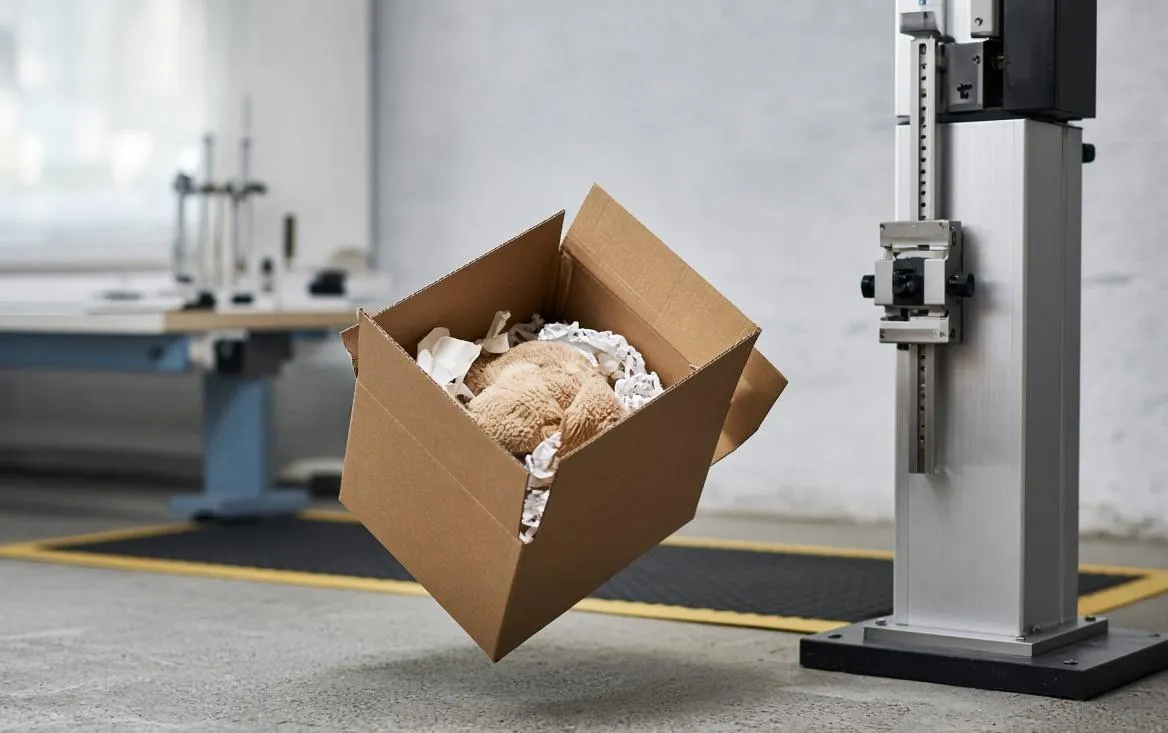

A New Jersey buyer rejected 1,200 window-box plush units. The master carton had passed factory inspection, then arrived with cracked display windows, popped tape, retailer chargebacks, and FBA rejection. I opened one box and heard a hollow rattle — loose internal parts moving. A secure pack-out lands with a solid, dead thud.
This is where a toy packaging drop test earns its keep. It checks whether the toy survives transit inside its retail box, and nothing more. It never replaces the mandatory toy-safety abuse tests.
Under ASTM F963 (Section 8.7.1) and EN 71-1 (Clause 8.5), labs drop the bare toy onto vinyl-covered concrete to check for choking hazards, sharp points, and exposed batteries after a child drops it.
For how the two standards differ, see ASTM F963 vs EN 71. I built this SOP by mapping shipping standards, marketplace rules, and toy-safety rules into one factory-floor workflow.
Expect a hands-on pre-shipment process, not theory: sample counts, choosing the right test path, repeated drops, scoring, and lab escalation. This guide is for founders, product teams, and sourcing directors running OEM production. If you are still shaping the line, start with how to start a toy brand and return once you have a pack-out to test.
Key Takeaways
- A toy packaging drop test proves transit protection, not toy safety. It never replaces ASTM F963 or EN 71 abuse testing.
- Pin one test article and the real distribution path before any drop, and test the worst-case sales channel first.
- Choose the standard by shipping channel, not product weight. ISTA 1A for basic screening, ISTA 3A for parcel, and ISTA 6-Amazon.com-SIOC for Amazon SIPP.
- Run one primary method plus one backup. The corner-edge-face sequence is the workhorse; precondition plastics and fluids first.
- Lock the production pack to the signed sample. Board grade, insert, seal, and retail face must match, or the test proves nothing.
- Score in three layers — product, inner pack, outer carton — then assign an A/B/C grade only after scoring.
- Diagnose by symptom, then escalate. Use a factory retest for speed; book a certified lab when a marketplace or buyer needs proof.
Prerequisites
2–3 hours hands-on | Intermediate. Cold or humidity preconditioning (method 7 below) runs 24–72 hours before test day and is not counted in the hands-on time.
Pull:
- Customer packaging spec, drawing, BOM, corrugate/insert specs, and sealing method.
- ISTA procedures from the official ISTA site and ASTM D5276 from the ASTM store.
- Amazon SIPP/FFP pages if selling there: the Amazon Seller Central SIPP help page. Confirm FFP-to-SIPP compliance.
- Toy safety: the CPSC toy-safety guidance and the EU Toy Safety Directive. Verify the accepted ASTM F963 version. Keep safety separate from packaging. See Toy Safety Standards.
Kit:
- Calibrated scale, dimension tools, drop tester or controlled free-fall rig, rigid impact surface, camera or phone, and a report template.
- Production-true samples, plus spares for repeat drops and redesigns. Keep certification samples separate from factory screening. See Amazon FBA Plush Packaging.
Safety: Clear the drop zone. Isolate batteries and electronics. Watch for sharp blisters or cracked-window fragments. Never present screening drops as certified lab results.
✅ Verdict: A packed sample should feel tight, balanced, and dead in the hand. Shake it lightly; if the contents shift, rework the pack before any drop.
Toy Packaging Drop Test: Expert SOP From a Real Toy Factory
This section walks through the full drop-test SOP, from sample planning to lab escalation. Read it top to bottom, or jump straight to the step you need.
Step 1: Pin Down the Exact Test Article
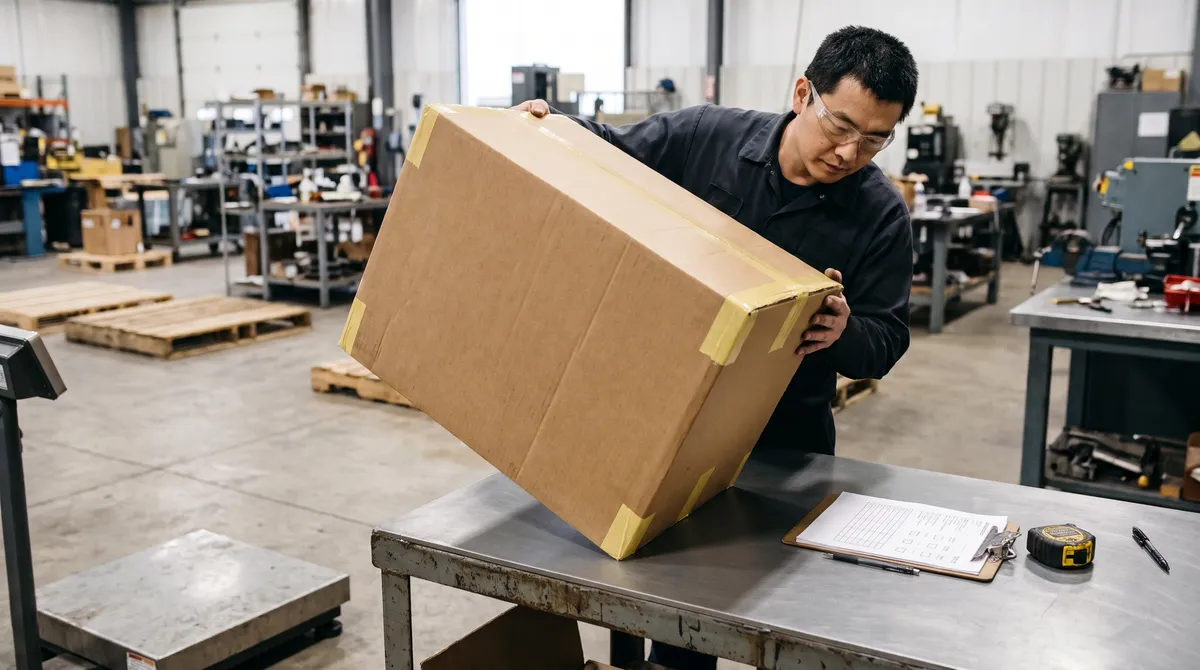
I start by handling the real shipping unit. Lift a master carton and feel where the weight sits. If the heft shifts to one side, the pack has a center-of-gravity imbalance. Rotate it gently and listen: a hollow rattle means loose contents.
As Package Box Manufacturer Emily Wong puts it plainly, a pack that shifts in your hands will shift the same way in transit — lock the inner tray and fill the voids before you ever drop it.
Select one test article: retail package only; retail package inside an Amazon or parcel shipper; master carton with multiple units; or a palletized or bundled configuration.
Map the real distribution path in order: factory to freight forwarder, ocean or air leg, DC or FBA inbound, then parcel final-mile if used. For the wider flow, see Toy Supply Chain Management.
Filter by toy category — each with its own types of toy packaging and failure points: plush toy, window-box figure, blister pack, battery-operated toy, weighted plush, or accessory-heavy set.
Define the success target before any drop: no product damage, no loose or detached parts, no unacceptable retail-face damage, no carton rupture, and no major loss of stacking strength.
Test the worst-case sales channel first; a dual-channel SKU may need two pack-outs or two validation paths. Describe face-label or orientation diagrams in text for screen readers, and never rely on color alone.
You will have a one-page test brief: article, route, category, success target, and pack-out count. That brief is your baseline.
✅ Verdict: A hand-packed sample can pass while the production master carton fails because the insert is a few millimetres thinner. Test the pack that actually ships, not the demo pack.
Step 2: Choose the Right Packaging Drop Test Standard
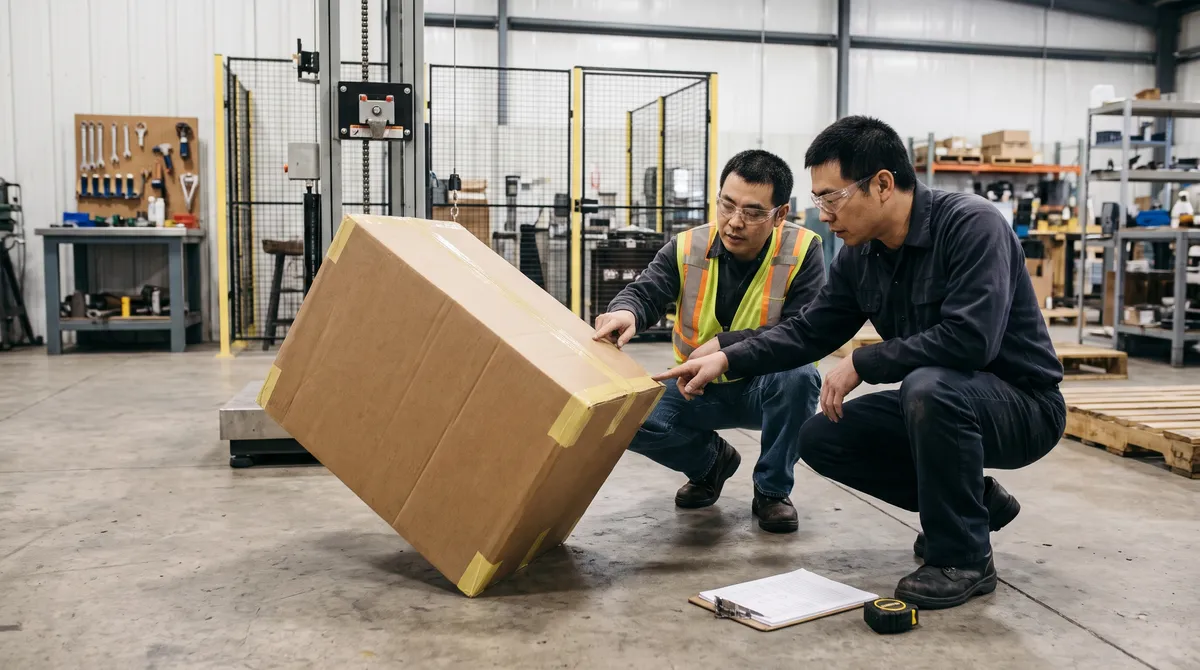
Choosing a standard is about your shipping channel, not the product's weight. A heavier pack changes the drop height within a given standard; it does not, by itself, move you from ISTA 1A to ISTA 3A. Pick the procedure that matches how the parcel actually travels, then read its drop height for the packed weight.
- ASTM D5276: free-fall drop methodology on loaded shipping containers.
- ISTA 1A: basic package integrity screening.
- ISTA 2A: partial simulation.
- ISTA 3A: individual parcel-delivery packaged-product within the procedure scope (150 lb / 70 kg or less).
- Amazon SIPP: when the SKU must ship in its own retail packaging and pass ISTA 6-Amazon.com-SIOC.
A packaging drop test does not replace ASTM F963 or EN 71 toy safety testing — for the compliance side, see US Toy Safety Compliance.
Table 1 — Which drop-test standard fits which shipping channel.
| Standard | Best Use Case | What It Tests | What It Does Not Prove |
|---|---|---|---|
| ASTM D5276 | Single retail packs and master cartons | Free-fall drop resistance from set heights | Vibration, compression, or toy safety |
| ISTA 1A | Basic screening for packs under 150 lb | Fixed-displacement vibration and 10 drops | Real parcel sorting or climate stress |
| ISTA 2A | Partial simulation of mixed distribution | Vibration plus selected drop and compression | Full parcel-network or safety compliance |
| ISTA 3A | E-commerce and parcel shipments | Random vibration, 17 drops, and hazard impacts | Chemical or mechanical toy safety |
| Amazon SIPP | Toys shipping in their own retail box | ISTA 6-Amazon.com-SIOC drop, crush, and prep rules | ASTM F963 or EN 71 compliance |
Drop-height tables, Amazon program names, and certification pathways change, so confirm the current numbers with the official ISTA, Amazon Seller Central, CPSC, and EU sources before you plan the test. For internal guides, see EN71 Compliance, CPSIA Compliance for Plush Toys, and Sell Toys on Amazon.
You will have a standard selection matrix that matches your distribution path.
✅ Verdict: For Amazon, ISTA 3A is my screening step for other parcel channels. SIPP itself wants ISTA 6-Amazon.com-SIOC, so go straight to that when it is the requirement.
Step 3: Compare Five Drop-Test Methods and Two Supporting Checks
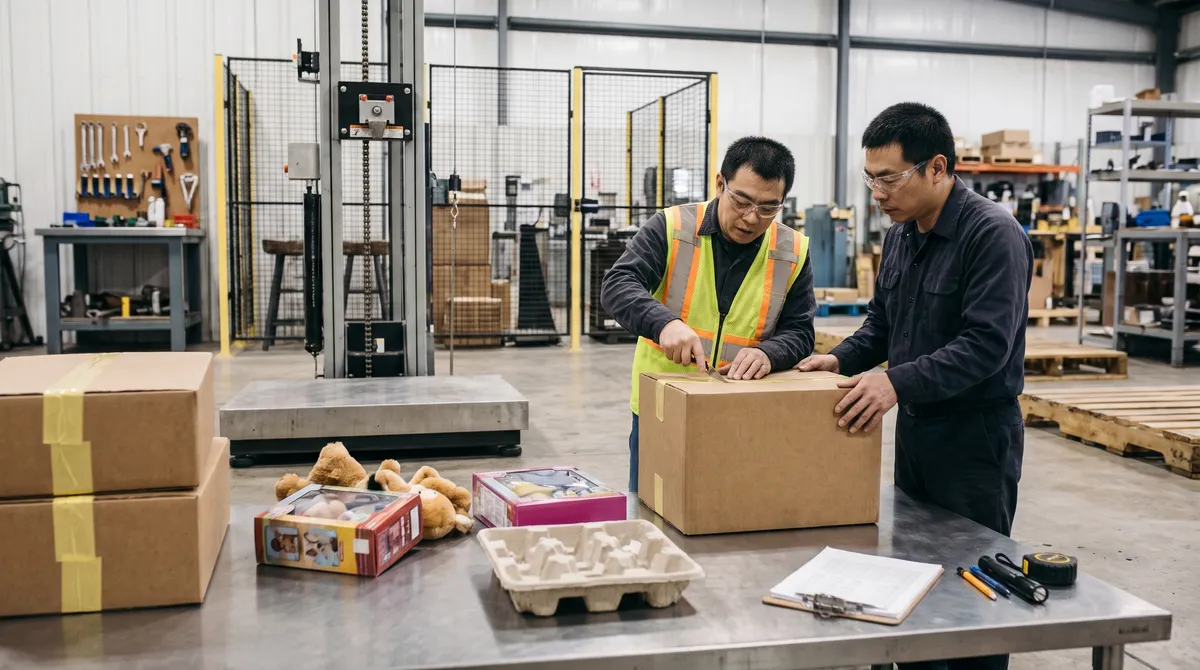
Step 2 chose the standard; this step chooses the physical method you run, plus two supporting checks that decide pass or fail. Pick one primary method and one backup.
Five methods imitate a real impact: free-fall, corner-edge-face sequence, rotational edge drop, shock machine, and pallet impact. Two supporting checks — post-unboxing self-check and environmental preconditioning — make the results trustworthy.
Table 2 — Five drop methods plus two supporting checks.
| Method | Best fit | Equipment | Sample planning | Pros / Cons |
|---|---|---|---|---|
| 1. Free-fall drop (ASTM D5276 context) | Small parcels; single retail packs | Drop rig; rigid surface; scale | 3-5 true samples; same height | Fast, cheap; misses sequence stress |
| 2. Corner-edge-face sequence (ISTA-style orientation drops) | Parcel packs; master cartons | Drop tester; face and edge marks; camera | 5 samples; label six faces and four vertical edges; repeat | Finds corner crush and insert shift; slower |
| 3. Rotational edge drop for larger or heavier cartons | Heavy or bulky cartons over 50 lb | Rotational fixture; hoist; edge marks | 3-5 samples; weigh first; one edge per cycle | Realistic for heavy packs; fixture access limits |
| 4. Shock-machine / simulated-drop testing | Repeatable lab screening | Shock machine; accelerometers; calibration | 3 per SKU; log pulse and orientation | Data-rich; costly; not certification unless accredited |
| 5. Palletized or bundled impact/drop checks | Pallets; bundles | Forklift; pallet rig; impact block; straps | 1-2 builds; test corners and strapped edges | Finds tray puncture and stack shift; slow, hazardous |
| Check 6. Post-unboxing product self-check plus functional inspection | Final gate for all methods | Checklist; battery tester; tools | 100% of samples; photo before and after | Finds hidden defects; human error |
| Check 7. Environmental preconditioning before drop testing | Plastic or electronic packs | Chamber; hygrometer; timer | 24-72 hours at target temp and humidity; then drop | Shows window whitening and brittle plastic; adds time |
Use the official ISTA procedures for current orientation sequences. You will have a shortlist: primary method, backup method, and sample count.
Selection rules:
- Small-parcel toy packs: start with method 2, then add method 1 for D5276 drop-height confirmation.
- Master cartons: use method 3 for heavy cartons and method 2 for lighter ones. Add method 5 for pallets or bundles.
- Special checks: plush packs can hide core movement even when the carton looks clean. Window boxes often fail at the plastic window or unsupported opening. Heavy accessories can puncture trays or inner cartons. Weighted or electronic plush need internal immobilization checks.
The primary path is lab-grade equipment; the alternate path is a controlled factory screen for rapid iteration. Never present a screening drop as certified lab results. If you include a drop-orientation graphic, name each face and edge in text — top, bottom, front, back, left, right, and the top-front and top-back edges — rather than pointing at a color.
✅ Verdict: In our tests, a plush master carton passed free-fall with a clean outer box, yet the inner core had shifted 12 mm. A post-drop cut-and-check found it in eight minutes. Add that check for plush and weighted plush.
Step 4: Lock the Approved Sample to Production Reality
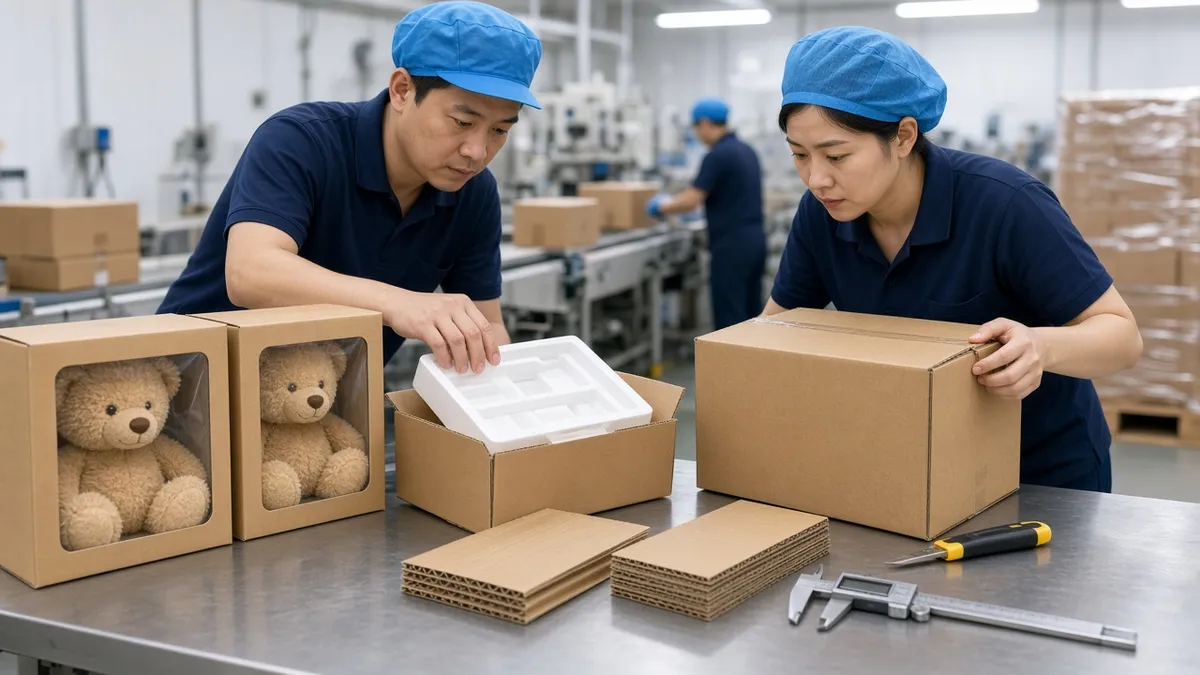
Before any drop, confirm production matches the signed sample. On a pre-shipment visit to our China packing line, the retail boxes looked identical to the signed sample.
Our packaging engineer pressed the inner tray and felt it wobble. Our QA lead pushed the outer carton corner with a thumb and said it gave too easily. We cut a box open and measured the wall: the supplier had swapped 5-ply board for cheaper 3-ply stock without telling us.
Lock the approved sample to production reality. Confirm these items match the signed sample:
- Corrugated construction: same wall, same flute, same board grade.
- Seal pattern: same tape or glue pattern.
- Inner pack: same blister, tray, polybag, and carton count. See Retail Packaging and Volumetric Optimization.
- Retail face: same barcode labels and retail window structure. See Toy Product Packaging.
Know whether you are checking a folding carton or a corrugated shipper. Retail display boxes are usually folding carton board (SBS, white card, or greyboard), not corrugated. ECT ratings apply to corrugated shipping cartons: Edge Crush Test measures stacking strength, while Mullen burst measures puncture resistance.
Light parcel shippers are commonly 32 ECT single-wall; heavy ocean master cartons usually need a double-wall board in the 48–51 ECT range (BC flute, or "K=K" in the Chinese mill notation). Always ask your box supplier for the mill spec sheet, and confirm the grade printed on the board, before you approve the sample.
Run a sensory check. Press the carton corners; they should resist your thumb. Squeeze the plush; it should rebound — unless it is vacuum-packed, which is compressed on purpose and will not spring back until the bag is opened. Shake the pack; you should hear nothing. A slight shift means loose contents or new void space.
Check the product type:
- Plush toys: compression recovery, polybag venting, and weighted-core or accessory migration. See Vacuum Packing Plush Toys.
- Window-box toys: reinforce unsupported panels and protect the window opening.
- Battery or motorized toys: immobilize dense internal masses and inspect battery-compartment security.
- Wooden or rigid plastic toys: control hard-point contact inside the box. See Non-Toxic Toy Materials.
Ask the production team: "What changed since sampling?" Run this five-point checklist:
- Board downgraded?
- Cavity enlarged?
- Insert material swapped?
- Accessories added?
- Carton count increased?
If any answer is yes, restart sample approval. A pack that no longer matches the approved sample is not the pack you tested.
You will have a locked pack-out spec sheet signed by the packaging engineer and QA lead. It lists every material, count, and seal pattern. If any item is missing, stop — and do not start the drop test on a pack that no longer matches the approved sample.
✅ Verdict: A pilot run swapped the insert from EVA foam to PE foam without notice. The sample felt snug; the production pack felt loose. Only the QA lead's thumb caught it before the drop test.
Step 5: Run the Drop Sequence
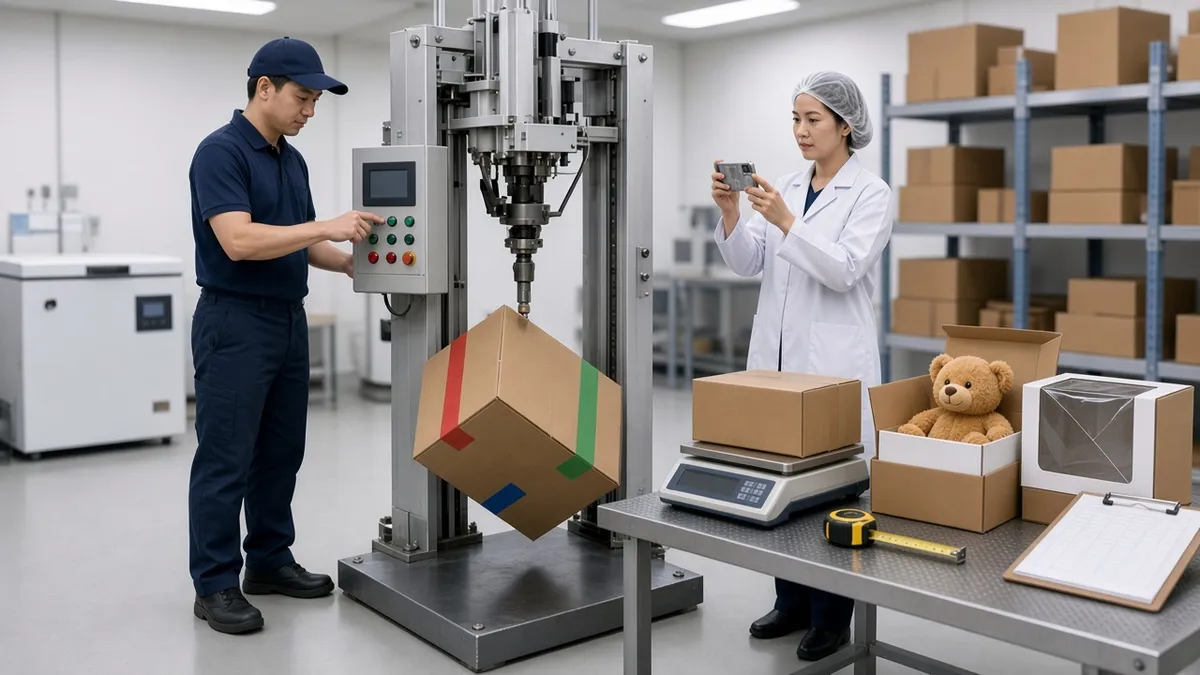
Clear the drop zone and place the packed sample on the rigid impact surface. Follow this sequence exactly.
-
Weigh and measure the final packed sample. Record the weight and dimensions — they set the drop height.
-
Label all six faces (top, bottom, front, back, left, right). Mark the four vertical edges and all critical corners with tape or marker.
-
Set the drop height from your governing standard and the actual packed weight. Use the table in ASTM D5276 or your chosen ISTA procedure.
-
Precondition your samples before dropping them. Cold weather makes clear plastic brittle. We once skipped cold conditioning on a run of action-figure boxes: the PVC windows passed room-temperature drops at our factory, then cracked in a 40°F warehouse in Chicago.
Now we chill plastic-window samples for 24 hours, and drop them within minutes of coming out of the chamber so they test at the target temperature.
-
Run the standard sequence for your chosen procedure. ISTA 1A uses a 10-drop sequence: start with the weakest corner (usually the manufacturer's glue joint, corner 2-3-5), then the three edges meeting there from shortest to longest, then all six flat faces. ISTA 3A uses 17 drops. Log each impact as C-E-F (corner, edges, faces) on your test sheet.
-
Add vibration or compression where your protocol requires it, then complete any post-vibration drops.
Listen for the sound of tape lift, watch for corner whitening, and feel for tray wobble. A sharper impact means a dense component migrated.
After every drop, stop and inspect. Listen for rattling accessories, check battery movement, feel plush seam strain, look for blister cracking, and check window deformation. A factory pre-screen is useful, but it is not certified lab testing; standardized equipment controls release behavior and surface conditions.
Film each drop, or at minimum the setup and result. Photograph every damage point. Log the sequence number, operator, date, and sample ID. Caption photos in words — describe the damaged area rather than relying on circles or arrows.
✅ Verdict: Inspect after every single drop, not only at the end. A pack can pass the corner impacts and only reveal a shifted tray after the fourth or fifth drop. The pause is what catches it.
Step 6: Score Damage in Layers
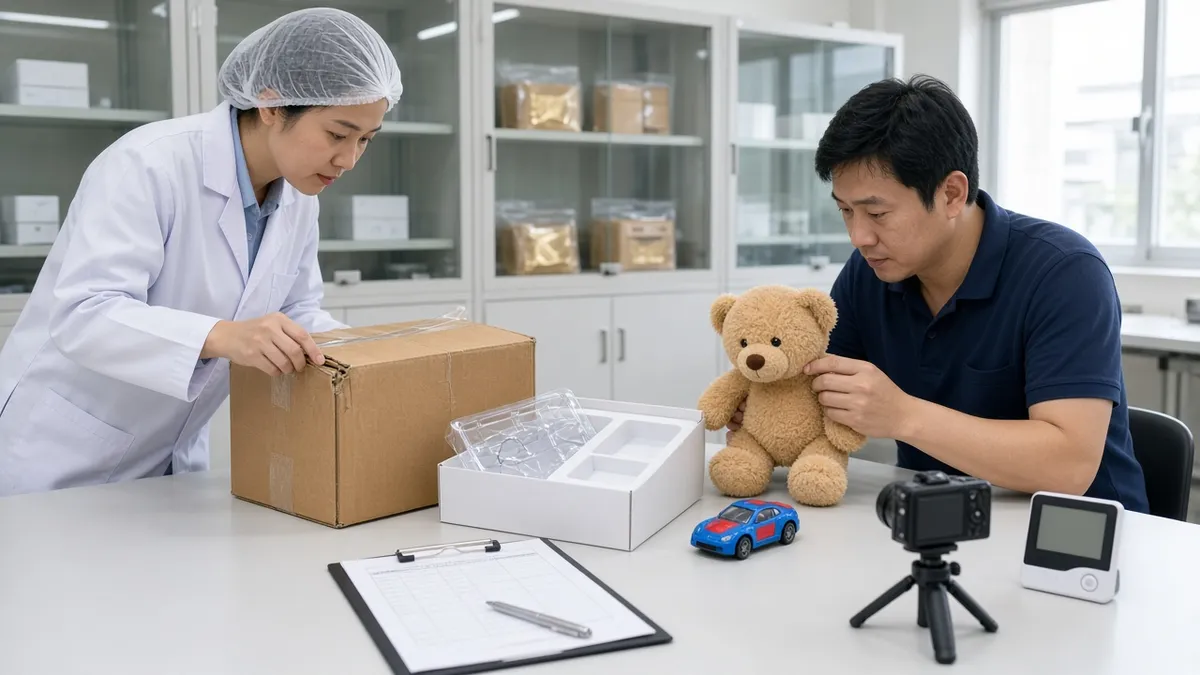
Score every sample in three layers. Use this buyer-facing acceptance table, and write Pass or Fail in each row.
Table 3 — Three-layer acceptance scoring.
| Layer | Pass | Fail |
|---|---|---|
| Product | No broken or detached parts; no sharp edges or exposed hard points; sound, lights, movement, and mechanisms work. | Any loose small part, sharp point, or functional failure. Escalate to toy-safety review. |
| Inner pack | Blister uncracked; cardback within distortion tolerance; window film intact; tray retains product; polybag and seals intact. | Cracked blister, detached tray, open seal, or crushed window. |
| Outer carton | No rupture; no tape opening; no major panel collapse; barcode readable; stacking ability intact. | Rupture, popped tape, collapsed panel, unreadable barcode, or obvious stack failure. |
Press a crushed corner; it should feel firm, not soft. Run a finger along a blister edge; it should not feel sharp. Pinch a plush seam; it should feel taut, not stretched. A soft corner can hide a cracked tray.
Assign a cosmetic grade: A retail-ready, B shipper acceptable but not retail-face perfect, C fail.
Log every detail so buyers can audit the work: report ID, room temperature, exact sample weight, drop height, and the pass/fail result for each face. Attach before-and-after photos with clear timestamps.
Archive every drop-test report and keep one golden sample for at least 12 months. If the toy shows a loose small part or a sharp point, log it in packaging review and toy-safety escalation.
You will have a scored report and a clear A/B/C grade.
✅ Verdict: Score the table first, then grade. Grading first hides safety failures.
Step 7: Diagnose Failures and Choose Your Escalation Path
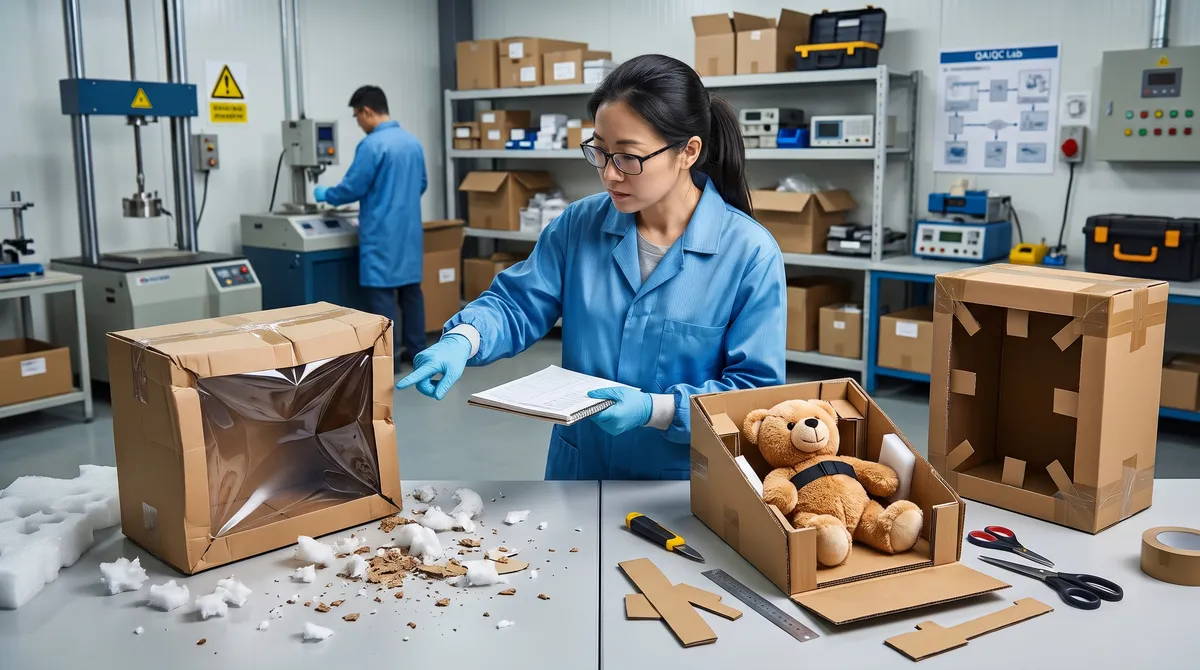
After scoring, you will have failures. Use this root-cause list to pick the fastest fix. Match the symptom to the action.
- Too much headspace (rattle): reduce voids or redesign insert lock points.
- Weak board or corner crush: upgrade board construction or reduce carton load.
- Tape pop or seam split: revise the sealing pattern or carton dimensions.
- Accessory puncture: immobilize dense parts or add local protection.
- Window cave-in: reinforce the opening or overbox the retail pack for parcel channels.
- Plush core or wire migration: lock internal components and review construction, not just the outer box. See Toy Quality Control and Plush Factory Audit Checklist.
Now decide your retest path. Use factory retesting for early iterations, speed, lower cost, and quick comparison of insert changes. Use a third-party or certified lab for marketplace or retailer requirements, customer-dispute risk, or formal compliance proof. For OEM production, keep your lab choice aligned with your buyer. See OEM vs ODM Toys.
Document a case study for your records: before-and-after packaging photos, the QA or packaging role that ran the test, the exact change made, and the result after retesting. That proves your process, not just your opinion, and it feeds straight back into your toy production process.
You will have a diagnosis table and a clear escalation decision.
✅ Verdict: Most "mystery" failures come from samples that no longer match production. Lock the pack-out first, then fix the box.
Troubleshooting
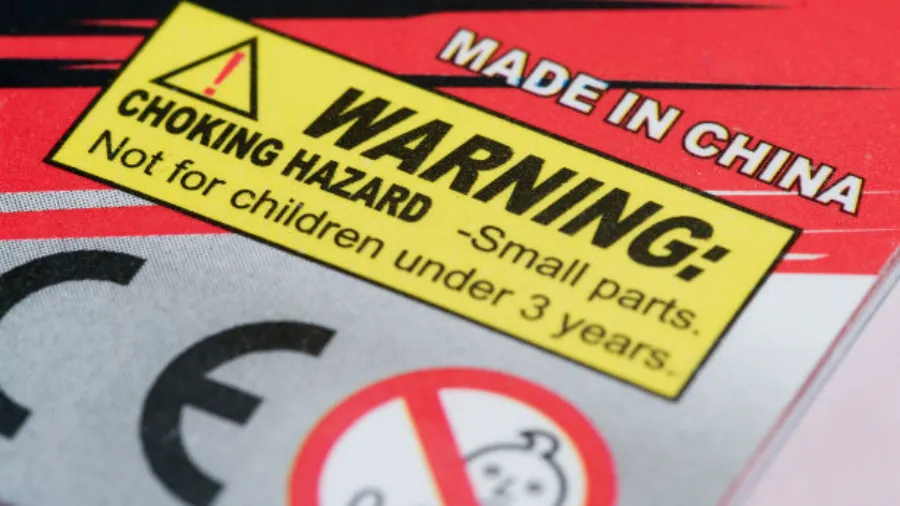
These are the failures I see on the floor: a loose pack rattles on impact, a window crack shows a white stress line immediately, and a shifted core makes a plush feel lumpy. Here is how to catch each one before it reaches a buyer.
Carton passes early drops but fails after vibration
Likely cause: loose insert, oversized headspace, or a migrated accessory. Fix: tighten cavity fit, add retention, and retest after vibration, not before.
Clear window cracks while walls look fine
Likely cause: unsupported opening span or part pressure. Fix: reinforce the perimeter, shrink the unsupported area, and use an overbox for parcels. A window that feels soft is the warning sign.
Plush looks fine but hard parts shift or poke
Likely cause: weighted core, sound box, or wire not immobilized. Fix: secure the part, strengthen seams, and review toy safety separately — ASTM F963 stays mandatory.
Amazon rejects even after an ISTA-style pass
Likely cause: you used standard ISTA 3A instead of Amazon's specific protocol. Amazon's Ships in Product Packaging (SIPP) program requires ISTA 6-Amazon.com-SIOC testing.
Fix: check your ASIN size and weight tier in Seller Central first. For oversized or fragile toys, run your final test through an Amazon APASS-certified lab to get an official pass certificate. A parcel pass does not equal toy-safety clearance.
Factory video passes but the customer lab fails
Likely cause: your factory floor does not match the lab floor. A certified lab once failed a plush carton that had passed our factory video. We audited the video and spotted the issue: our team had dropped the box onto a 6 mm rubber floor mat, while the lab dropped it onto a rigid steel plate. Fix: bolt a flat steel plate onto a concrete floor for all factory drop tests.
💡 Pro Tip: Cut open a passing sample after vibration. A clean box can hide a shifted core.
FAQ: Toy Packaging Drop Test
-
Does a drop test certify my toy for Amazon or retail?
No. A drop test proves transit protection only. It does not clear toy safety. Amazon SIPP and FFP, plus retailer programs, each run their own lab path. A pack can pass ISTA 3A and still stall at SIPP intake until you submit the right report, and SIPP itself calls for ISTA 6-Amazon.com-SIOC.
Confirm the exact program before you ship. See Steps 2 and 7 for the escalation split.
-
How many samples should I plan for?
Plan three to five production-true samples per pack-out, plus spares. Inserts often change mid-test, so budget extra. Keep screening samples and certification samples in separate piles so nobody mixes them up.
-
Can the factory run this instead of a lab?
Yes for screening, no for certification. Factory drops catch corner crushes and insert shifts fast and cheap. They do not produce a signed compliance document. A customer lab can fail a pack that already passed on a softer factory surface, so audit every variable before you trust a factory video. Use a certified lab when a marketplace or buyer asks for proof.
Conclusion
You now hold a validated package concept, a documented result, and a clear escalation path if marketplace or retailer certification is still open. Move now: freeze the packaging revision, update the BOM and artwork revision, archive the photos, videos, and reports, and run incoming checks so production does not drift from the approved pack-out.
My release standard is simple: press the finished sample, shake it, and it should stay silent, hold its corners, and show no tape lift.
Disclosure: We do not claim certification unless the test was run under the required official or lab conditions. I am not paid by any lab or testing firm to promote these findings.
Need packaging design and drop-test support? See our toy packaging design and custom toy manufacturing services, or talk to our team.