

Only a handful of US companies still cut and sew teddy bears on American soil. Vermont Teddy Bear makes its Classic bears in Shelburne, Vermont, and Big Plush hand-stuffs its Made in USA collection in Little River, South Carolina.
As far as we can verify, those are the only two US operations that make domestic plush at any scale. Most of the famous "American" names below — Build-A-Bear, Douglas, Aurora — are US brands whose bears are made in Asia.
Every company on this page carries an origin label: US-made, US-finished from imported parts, US brand manufacturing overseas, or US wholesaler. Where a company does not publish where its bears are made, this page says "not stated" instead of guessing.
This page is published by LeelineToys, a plush factory in Suizhou, China. We are not a US manufacturer and we are not part of the list below. Our own option is set out separately at the end, including the cases where we are the wrong choice.
Last verified: 29 October 2026.
Key Takeaways
- Only two US companies verifiably make teddy bears in America: Vermont Teddy Bear, for its Classic line in Shelburne, Vermont, and Big Plush, for its Made in USA collection in Little River, South Carolina.
- Build-A-Bear owns no factories. Its FY2025 Form 10-K states that merchandise is sourced from multiple vendors primarily in China and Vietnam.
- Douglas designs in New Hampshire and manufactures in Asia. The company says so plainly on its own About page.
- An unqualified "Made in USA" claim requires all or virtually all US content. "Assembled in USA" is a weaker claim with its own test.
- Most US plush companies do not publish an MOQ. Ask per project, in writing, as part of the quotation rather than trusting a directory listing.
- If a US origin label is not a requirement, the overseas route starts in the low hundreds of units instead of the high thousands.
How We Verified Each Company
The origin label on every entry comes from one of four places:
- The company's own site — the About page, a "where it's made" page, or the contact page, which is usually where the factory address sits.
- SEC filings — for public companies, the 10-K states plainly whether the business owns factories and where merchandise is sourced.
- Published product documentation — a Children's Product Certificate or test report naming the manufacturer.
- Third-party origin trackers — allamerican.org and wheredotheymakeit.com, used as a cross-check and never as the only source.
Three rules applied throughout. We only used public information, and we did not contact any company. Where a company does not publish where its bears are made, the entry says "not stated" rather than copying a directory listing.
We also have not published an MOQ or a lead time for any company that does not publish one itself.
Where a third-party tracker disagrees with a company's own wording, the entry follows the company and notes the conflict. The method follows our fact-checking process, and corrections are handled under our editorial policy.
The checks in each profile are not theoretical. We have been manufacturing plush since 2015, and the questions under "What a buyer should know" are the ones buyers raise with us most often before a teddy bear order.
Quick Comparison
| Company | Type | Made in USA? |
|---|---|---|
| Vermont Teddy Bear | Factory | Yes (Classic) |
| Big Plush | Factory | Partly |
| Beverly Hills Teddy Bear | Brand | Not stated |
| Douglas Cuddle Toys | Brand | No |
| Build-A-Bear Workshop | Retailer | No |
| Best Plush Inc. | Supplier | No |
| Aurora World | Brand | No |
| MS Teddy Bear | Wholesaler | Not stated |
| First & Main | Wholesaler | Not stated |
| Teddy Mountain | DIY kits | Not stated |
| The Bear Factory | DIY kits | Not stated |
| Cuddly Bear Plush Toys | Supplier | Not stated |
Two footnotes on how to read this table. "Not stated" means the company does not publish where its products are made on its own site; it is not a claim that production is domestic.
"Partly" means the company makes some lines domestically and imports the rest. Base city, founding year and the official site are in each profile below.
We have not listed MOQs or lead times, because US plush companies quote both per project and a figure taken from a directory listing is unconfirmed until it is in writing. Our MOQ guide explains how minimums are quoted.
Made in the USA
Two companies, and the distinction inside each one matters as much as the label.
1. Vermont Teddy Bear — Shelburne, Vermont (est. 1981)
Origin: US-made, Classic line only. Custom: personalised bears and corporate gifting, sold direct. Official site: vermontteddybear.com.
Vermont Teddy Bear runs the best-documented US teddy bear factory still operating, and its own "Where it's made" page splits the range into two product lines that buyers routinely confuse:
- Classic bears are cut, sewn, stuffed and finished in Shelburne, Vermont. The eyes, joints and suede paw pads are also made in the US, and the stuffing is recycled and US-sourced.
- Hybrid bears are designed in Vermont, then cut and partly sewn in China and finished by hand back in Shelburne. The 18-inch Oh So Soft bear is described by the company as "assembled in Vermont from parts made abroad."
- Many outfits and accessories are imported from China.
If your brand needs an unqualified "Made in USA" claim, only the Classic line qualifies, and you should have the specific SKU confirmed in writing before you commit to a run.
The build is unusually hands-on. Patterns are cut on a 15-ton hydraulic die press that slices through up to 14 layers of faux fur at once, then stitchers sew the heads and bodies by hand.
Head seams get the most attention, because that is where wear shows first. Limbs are reinforced with pin-and-lock washers, and every bear carries a lifetime guarantee.
The filling is made from recycled plastic bottles, and the fur comes largely from Wisconsin suppliers, with specialty mohair from Germany.
What a Buyer Should Know
Domestic production costs more per unit than an overseas run, and capacity is fixed by the Shelburne factory floor — that trade-off is the product. Ask which line each SKU sits in, and whether the eyes, joints, stuffing and outfit are domestic, then put the answer on the purchase order.
2. Big Plush — Little River, South Carolina (est. 2006)
Origin: mostly US-made, with a separate Made in USA collection. Custom: yes, with no minimum. Official site: bigplush.com.
Big Plush is the second US operation that makes domestic plush at scale, and it is the one most lists miss. The company states that its custom plush is designed and manufactured in Little River, South Carolina, and that each animal is hand-stuffed to order rather than vacuum-packed.
The caveat matters. Big Plush says plainly that "not all stuffed animals are made in the USA, but many are," and keeps a separate Made in USA collection so buyers can identify domestic items. Order outside that collection and you are buying imported stock.
The specialty is giant and jumbo plush — oversized teddy bears, stuffed pillows, emoji and food shapes — produced in small batches with a short path from order to ship.
For a retail display piece or a promotional centrepiece, that combination of domestic origin and hand-stuffing is hard to match elsewhere in the US.
Its business-to-business page goes further than most: single commissions and larger runs, no stated minimum, and a choice between fully US-made and American-finished options.
What a Buyer Should Know
American-finished is not the same claim as Made in USA, and both appear on the same site. Confirm whether the item you are ordering sits in the Made in USA collection or is only American-finished, and get that in writing before you print a label.
US Brands and Product Developers
The companies below own the design, the brand and the customer relationship. Production happens elsewhere, and the two that say so plainly on their own sites are Douglas and Best Plush.
3. Beverly Hills Teddy Bear Company — Sylmar, California (est. 1994)
Origin: not stated. Custom: yes, via customplush.com. Official site: plush.com.
Beverly Hills Teddy Bear is a brand and product developer rather than a factory you can visit. Its custom division, customplush.com, takes brand work: mascots, pet replicas, licensed characters and private-label lines.
What stands out is the speed of concept work. Design, prototyping and pricing are handled in-house before production is placed, so a brand can hold a sample in hand quickly and then decide on volume.
Two of its own lines, Surprizamals and Squeezamals, show the house style: novelty plush built for impulse purchase rather than heirloom keepsakes.
What a Buyer Should Know
Two questions matter more than the rest. Which factory produces the run, and where is it. And which entity appears as the manufacturer on the test report, because that is the name a regulator will check.
4. Douglas Cuddle Toys — Keene, New Hampshire (est. 1956)
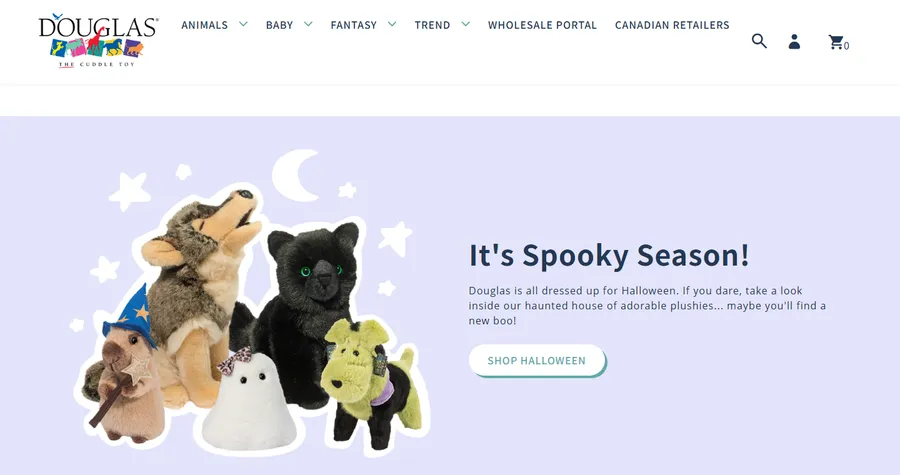
Origin: US design, manufactured in Asia. Custom: not published. Official site: douglascuddletoy.com.
Douglas states its position in one sentence on its own About page: "DOUGLAS designs are created in New Hampshire and manufactured in Asia to our exacting specifications and standards."
That is an honest description of a common model, and it is worth reading closely. The design, brand and quality control sit in the US; the cut-and-sew work does not. Any list that calls Douglas a US teddy bear manufacturer is wrong on the factory question.
The line itself is built on realism rather than cuddliness. Weighted bodies, lifelike gestures and embroidered detail let the company produce recognisable versions of more than 100 dog and cat breeds, in sizes from 8 to 24 inches.
That is unusual range for a single plush brand. Certification documentation is supplied to trade buyers on request.
What a Buyer Should Know
Ask for the test report per SKU and check the manufacturer named on it, together with the country-of-origin marking on the care label. Design work in New Hampshire changes neither.
5. Build-A-Bear Workshop — St. Louis, Missouri (est. 1997)
Origin: imported; the company owns no factories. Custom: no — it is a retailer, not a contract manufacturer. Official site: buildabear.com.
Build-A-Bear appears on almost every "US teddy bear manufacturer" list, and the label is wrong.
Its FY2025 Form 10-K states: "We do not own or operate any factories that produce our plush products, clothing, shoes or accessories," and that merchandise is "sourced from multiple vendors primarily in China and Vietnam."
Build-A-Bear is a retailer and a brand. As of 31 January 2026 it operated 662 locations worldwide through corporate, partner-operated and franchise models.
You cannot place a custom OEM run with it, and any page that offers a Build-A-Bear "pilot run" or "wholesale kit program" is describing something the company does not publish.
What a Buyer Should Know
There is no OEM programme to apply to, so treat any page advertising a Build-A-Bear pilot run or wholesale kit programme with suspicion.
If you want a bear in this retail style, the route is a licence from the character or brand owner plus a contract factory, not an order placed with Build-A-Bear.
6. Best Plush Inc. — Mt. Laurel, New Jersey (est. 1988)
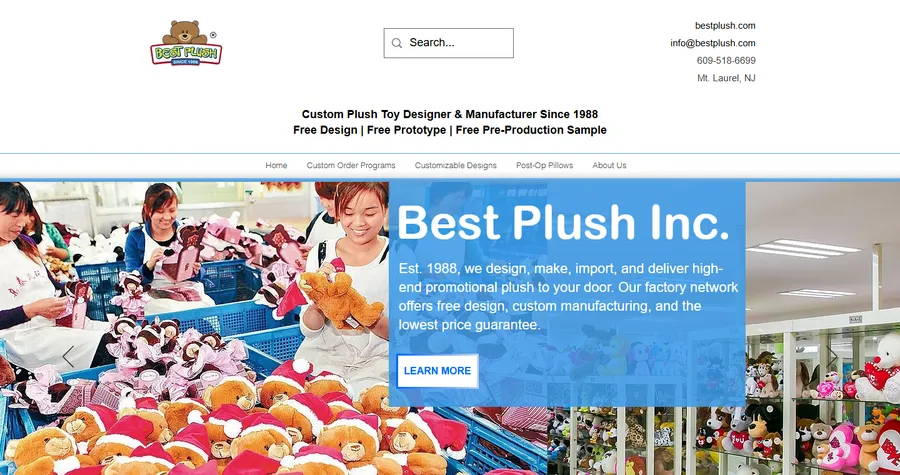
Origin: US design and sourcing, manufactured through an overseas factory network. Custom: yes, with free design and a free prototype. Official site: bestplush.com.
Best Plush describes the model in one line on its own homepage: "we design, make, import, and deliver high-end promotional plush to your door," backed by "a reliable factory network" that it says has been in place since 1988.
That is the honest version of the arrangement most US plush suppliers run. Design, account management and quality sign-off sit in New Jersey; the sewing happens in partner factories abroad. The company's own address is Mt. Laurel, and nothing on the site claims a US plant.
The commercial offer is aimed at promotional and corporate work — company mascots, logo bears, giveaway plush — and the site advertises free design, a free prototype and a free pre-production sample, which lowers the cost of testing an idea before you commit to a run.
What a Buyer Should Know
Ask which factory will run the order and where it is, and ask for the test report naming the manufacturer. "Factory network" is accurate but deliberately unspecific, so the origin answer only arrives when you request it in writing.
7. Aurora World — Pico Rivera, California (est. 1981)
Origin: US sales arm of a Korean company, made overseas. Custom: not published. Official site: auroragift.com.
Aurora World Inc. is the US arm of Korea's Aurora World Corp., founded in 1981 and headquartered in Pico Rivera, California. The catalogue covers a wide price band, from small novelty plush to mid-size gift bears, sold mainly through gift and specialty retail.
The strength here is breadth of range and distribution rather than domestic production.
What a Buyer Should Know
The US arm handles sales and distribution rather than manufacturing. Ask which Aurora entity would be the seller of record, and where the goods ship from, before treating it as a domestic supplier.
US Wholesalers and DIY Suppliers
The last group sells plush they do not make. For a buyer, that is not a disqualification — it is a different kind of supplier, with different terms, minimums and control.
8. MS Teddy Bear — El Monte, California (est. 2006)
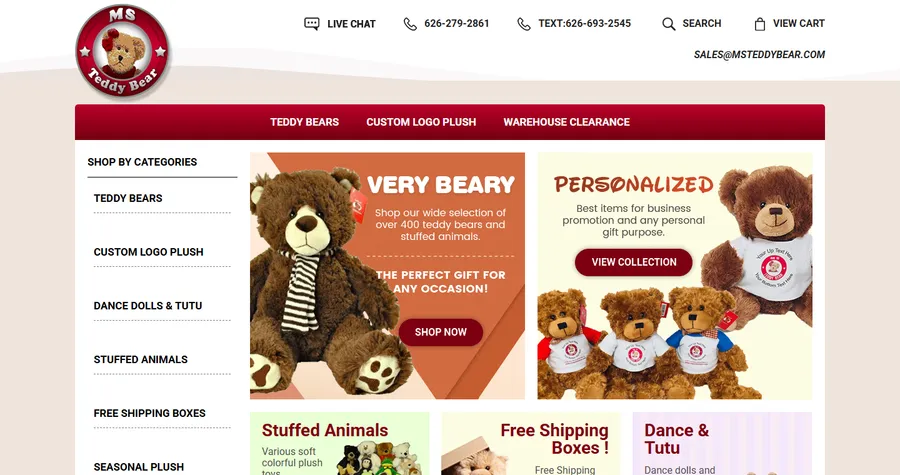
Origin: US wholesaler; production location not stated. Custom: logo embroidery and branding on its own range. Official site: msteddybear.com.
MS Teddy Bear is a wholesaler, and says so: its El Monte office is described on its own site as a wholesale location that is not open to public walk-ins.
The offer is broad rather than deep. Buyers can order standard teddy bears in a wide range of sizes, add custom logo embroidery for corporate and event work, and buy from warehouse clearance stock at short notice.
What a Buyer Should Know
Good for promotional and event volume where the design is simple and the deadline is short. Ask who actually cuts and sews the bear before you commit to a custom pattern, because a wholesaler passes the tooling work to a supplier you do not control.
9. First & Main — St. Charles, Illinois (est. 1994)
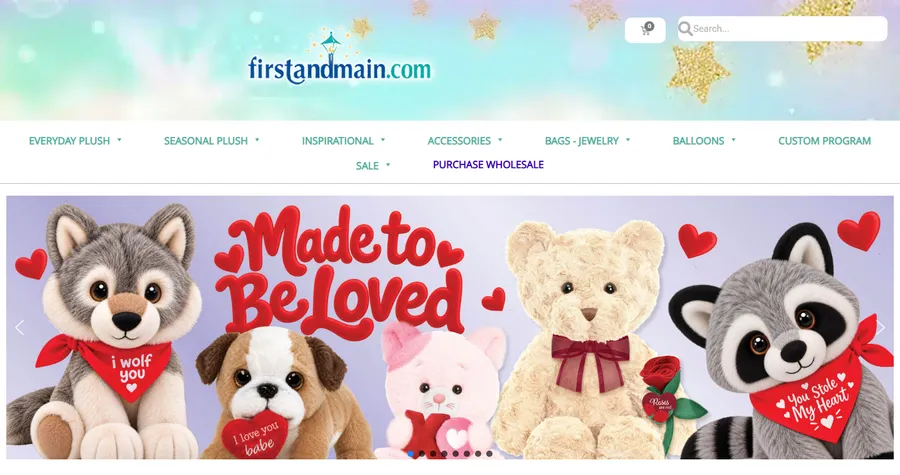
Origin: US wholesaler and importer; production location not stated. Custom: not published. Official site: firstandmain.com.
First & Main has supplied retailers with gift-quality plush since 1994, and describes itself as a manufacturer, importer and wholesale distributor — the second and third words are the operative ones.
The product line leans on character and personality: soulful expressions, floppy ears, embroidered smiles, textures chosen for shelf appeal. That is a merchandising strength rather than a manufacturing one.
What a Buyer Should Know
Ask for the country of origin on the specific assortment you are being offered. A catalogue that mixes imported and domestic items changes what you can print on a retail label, and the answer is per item rather than per company.
10. Teddy Mountain — Winter Haven, Florida
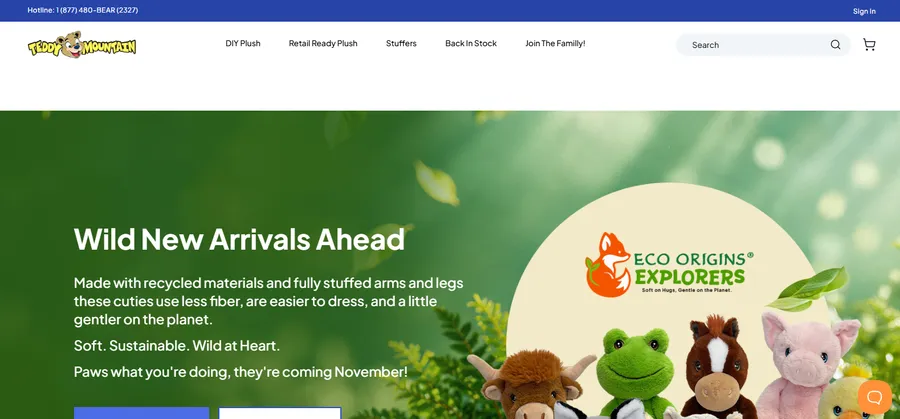
Origin: US wholesale supplier of DIY kits; production location not stated. Custom: wholesale kits only. Official site: teddymountain.com.
Teddy Mountain supplies the make-your-own-bear trade rather than finished bears. The catalogue runs to hundreds of items: unstuffed skins, outfits, accessories, stuffing machines and fibre, so a shop or event operator can run a stuffing station without buying finished inventory.
Headquarters are in Winter Haven, Florida, with a US warehouse in Champlain, New York.
The company describes itself as the largest wholesale supplier of DIY teddy bear products and markets its plush as "the softest plush on the planet" — both are its own marketing claims, not independently verified.
What a Buyer Should Know
Ask what a starter package actually includes — skins, stuffing machine, fibre, signage and spares — and what ships separately, because a kit price rarely covers the whole station.
It suits experiential retail, parties and pop-up events; it is not a route to a finished, packaged bear at volume.
11. The Bear Factory — Whitmore Lake, Michigan (est. 2001)
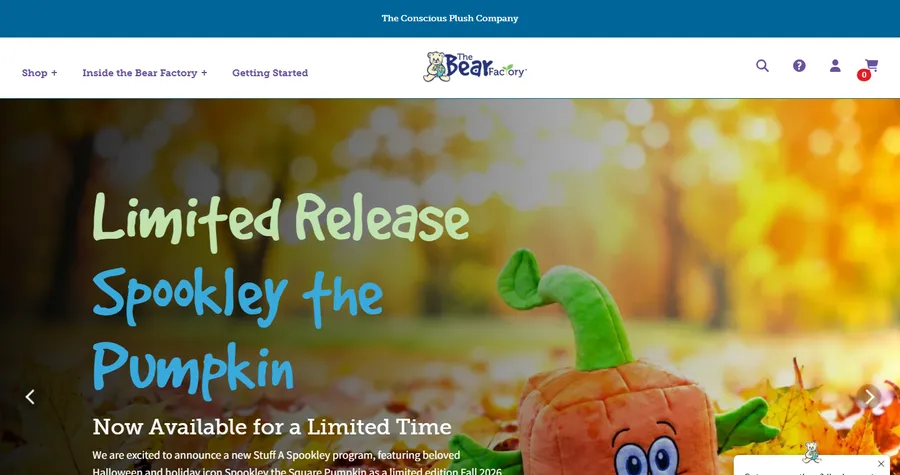
Origin: US supplier of build-your-own kits; production location not stated. Custom: wholesale kits only. Official site: thebearfactory.com.
The Bear Factory is a family-run build-your-own plush supplier, relocated from Wixom to Whitmore Lake, Michigan, in 2019. Its sustainability angle is more concrete than most: it trades as "The Sustainable Plush Company" and uses recycled PET (rPET) fibre recovered from plastic bottles and textiles.
The offer mirrors Teddy Mountain's — unstuffed animals, outfits, accessories and event support — with a stronger environmental pitch.
What a Buyer Should Know
If you plan to make an environmental claim, ask for the recycled content percentage and the certificate behind it, because rPET content varies by product line. The rest of the offer follows the DIY-kit model rather than finished-goods manufacturing.
12. Cuddly Bear Plush Toys — Denver, Colorado (est. 1986)
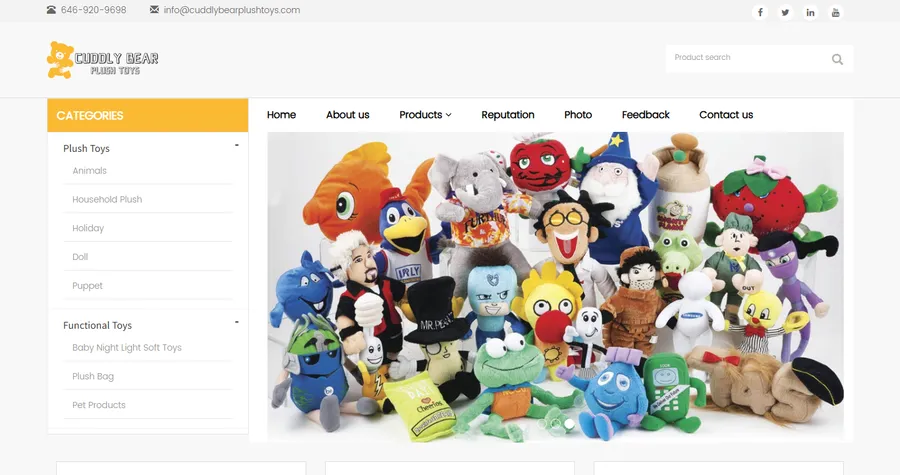
Origin: not stated. Custom: OEM/ODM per trade directories. Official site: cuddlybearplushtoys.com.
Cuddly Bear Plush Toys appears in trade directories as an OEM/ODM plush supplier, established in 1986, covering teddy bears, mascots, slippers, cushions and seasonal plush. Sizes run from small keyring-scale pieces to display animals around two metres tall.
Treat the origin question as open. The published address is an office suite rather than a plant, and the site does not describe a factory.
What a Buyer Should Know
Ask for the production address, a factory audit and a test report naming the manufacturer before any deposit. Until those arrive, read any "US supplier" description as a business address rather than a production claim.
What "Made in USA" Requires
The phrase is regulated, not a marketing adjective. The FTC's Made in USA Labeling Rule, 16 C.F.R. Part 323, sets three conditions for an unqualified claim:
- Final assembly or processing happens in the United States.
- All significant processing happens in the United States.
- All or virtually all components are made and sourced there.
In practice the test is "all or virtually all", with at most negligible foreign content.
The FTC weighs how much of total manufacturing cost is American, how far removed any foreign content sits from the finished product, and how important that content is to how the product works.
| Label | What it requires |
|---|---|
| Made in USA | All or virtually all US |
| Assembled in USA | Substantial assembly in US |
| Made in USA from imported parts | Qualified, disclose the foreign content |
| Imported | Country of origin marked |
The "Assembled in USA" row is where most plush claims live. The FTC allows it without qualification only if the principal assembly is in the US, is substantial, and the last substantial transformation happened there. Screwdriver assembly of foreign components does not qualify.
🧠 Expert Take: In plush, a Made in USA claim usually breaks on components, not fabric. Eyes, joints and stuffing are the three parts buyers forget to ask about — and they decide the answer.
There is also a line-level catch that matters directly for the two domestic makers above. A company cannot imply that an entire product line is US-made when only some of it is.
That is why Vermont Teddy Bear separates Classic from Hybrid, and why Big Plush keeps a Made in USA collection apart from the rest of its catalogue. If a supplier says "all our bears are Made in USA" without that split, ask which SKUs.
How to Verify a US Origin Claim
Eight checks, in the order that catches the most problems:
- Ask for the production address, not the office address. A suite in an office building is not a factory.
- Ask which legal entity appears as the manufacturer on the test report and the Children's Product Certificate.
- Ask which SKUs qualify, in writing, and match the answer against the care label on a physical sample.
- Read the company's own origin page, if it publishes one, and check the wording rather than the headline.
- Check the 10-K for a public company; "we do not own or operate any factories" is hard to argue with.
- Cross-check an origin tracker such as allamerican.org or wheredotheymakeit.com, then confirm with the company.
- Buy one sample before the first bulk order and read the label on the bear itself; our plush toy label requirements guide lists what has to appear.
- Put the claim in the contract, including who carries liability if the label turns out to be wrong.
💡 Pro Tip: Start with the Children's Product Certificate. It names the manufacturer, and that name is the first thing a regulator checks — not the sales page.
US vs Overseas Production
Neither route is better in the abstract; they buy different things.
| Aspect | US factory | Overseas OEM |
|---|---|---|
| MOQ | Higher | Low hundreds |
| Unit cost | 2–3× higher | Baseline |
| Lead time | No sea freight | Adds 3–6 weeks |
| Made in USA | Possible | Not possible |
| Design control | Direct | Through factory |
| Best for | Premium, US label | Cost and volume |
Treat that table as a planning assumption rather than a quote. The multipliers move with size, fabric and order volume, and the only reliable figure is the one you get in writing from both routes with the same specification attached.
⚖️ Trade-Off: A domestic run buys a label and a shorter chain, not better stitching. A well-run Asian factory can make the same bear — what changes is the claim and the margin.
If you are weighing the overseas route, our guide to importing plush toys to the USA covers duties, labelling and clearance.
Overseas OEM Option: LeelineToys
This page is published by LeelineToys, and we are not a US manufacturer. We run a plush factory in Suizhou, Hubei Province, China, with 300–500 unit MOQs on plush and 5–7 day prototypes.
Testing runs through third-party labs to ASTM F963, CPSIA and EN 71, and on-time delivery runs at 98.2% across 45+ countries.
Choose us if you need a custom teddy bear at a MOQ no US factory will take, your market does not require a Made in USA claim, or you want one partner from pattern to DDP delivery.
Do not choose us if a retail listing, government contract or brand promise requires a Made in USA label. Start with Vermont Teddy Bear or Big Plush instead — that route is real, and it is priced accordingly.
What Drives the Price of a Custom Teddy Bear
Unit cost is set by the specification long before volume is discussed. These are the levers that move it:
| Cost driver | Effect on unit price |
|---|---|
| Order volume | Large |
| Size | Large |
| Premium fabric | Large |
| Sound or motion module | Large |
| Jointed limbs | Medium |
| Embroidery coverage | Medium |
| Fill type | Medium |
| Retail packaging | Medium |
Volume is the biggest single lever. A run of a few hundred units can cost two to three times the per-unit price of a run ten times larger, because pattern making, sampling and line set-up are fixed costs spread across fewer pieces.
Two practical notes. Ask for a quote per specification rather than a price list, because a bear defined by sketch vs one defined by a tech pack are different jobs.
Put tooling ownership, MOQ, tolerances and the inspection standard in the quotation, not in a later email.
Custom Teddy Bear Manufacturing Process
Understanding the workflow helps you plan a launch and avoid surprises. This is the standard path from concept to delivery.
Phase 1: Design and Pattern Development (1–2 Weeks)
You supply a concept — sketch, reference photos, or a full brief. The pattern maker converts it into a technical pattern with seam allowances, a material specification sheet covering fabric, colour and pile direction, and an accessory list for eyes, nose, ribbons and clothing.
If you have a physical sample you want matched, send it. A reference sample removes ambiguity and typically halves pattern development time.
Phase 2: Prototype and Sampling (2–4 Weeks)
The factory produces two or three prototypes for review. Judge each one against five things: proportions against your reference, the hand-feel of the fabric, embroidery placement and eye spacing, stuffing density, and seam strength at the stress points.
Most projects go through two or three revision rounds before the pre-production sample is approved. Each round adds about a week.
Phase 3: Pre-Production Sample (1–2 Weeks)
The pre-production sample is the final approved version and the contractual quality benchmark. Keep one copy and have the factory sign and return another. Any deviation from it in bulk is grounds for rejection.
🧠 Expert Take: Most bulk disputes are settled by the PPS, not the contract. Keep one signed copy, photograph it, and write "any deviation from this sample is grounds for rejection" into the PO.
Phase 4: Bulk Production (4–8 Weeks)
- Weeks 1–2: fabric cutting
- Weeks 2–4: sewing, turning and stuffing
- Weeks 4–5: facial embroidery and closing
- Weeks 5–6: accessory attachment and finishing
- Weeks 6–7: quality inspection
- Weeks 7–8: packing, cartoning and palletising
Phase 5: Inspection (3–5 Days)
A final inspection samples finished units at random for stray threads, misaligned features, colour variation, loose seams, under-stuffing, detached accessories, and label accuracy. It also pulls at eyes and noses and checks for sharp points and small parts.
On sampling terms, be precise with your supplier. AQL 2.5 is an acceptance quality limit, not a licence to ship 2.5% rejects.
Critical defects are normally set at zero, major at 2.5 and minor at 4.0, each with its own accept and reject numbers for the sample size. Our AQL 2.5 guide sets out how the numbers work.
Phase 6: Shipping (2–5 Weeks)
- Ocean freight, Asia to US West Coast: about 2–3 weeks plus customs and trucking
- Ocean freight, Asia to US East Coast: about 4–5 weeks plus customs and trucking
- Air freight: about 5–7 days plus customs and trucking, at four to six times the ocean cost
For a first order, budget two to three weeks of buffer on top of the quoted schedule. Delays cluster around Chinese New Year in January and February, and around the pre-Christmas peak from August to October.
People Also Ask About Teddy Bear Manufacturers USA
1. Which Teddy Bear Manufacturers Actually Make Bears in the USA?
Two, as far as we can verify. Vermont Teddy Bear makes its Classic line in Shelburne, Vermont. Big Plush hand-stuffs plush in Little River, South Carolina, and sells its domestic items through a separate Made in USA collection.
Every other well-known US name we reviewed manufactures abroad, or is a wholesaler that does not publish where production happens.
2. Is Build-A-Bear Made in America?
No. Build-A-Bear's FY2025 Form 10-K states that the company does not own or operate any factories, and that merchandise is sourced from multiple vendors primarily in China and Vietnam.
It is a retailer and a brand, not a contract manufacturer, so a custom OEM run is not something it offers.
3. What Is the Minimum Order Quantity for Custom Teddy Bears?
Most US plush companies do not publish an MOQ; they quote it per project, because minimums move with fabric, component count and packaging. Ask for the figure in writing as part of the quotation rather than relying on a directory listing.
US-made runs are constrained by factory floor time, so expect a higher minimum than an overseas OEM. Overseas plush makers typically start in the low hundreds of units. LeelineToys runs 300–500 units on plush, and 100 units only on vinyl, sensory, fidget and weighted plush.
4. What Safety Certifications Do I Need to Sell Teddy Bears in the USA?
For the US market you need compliance with ASTM F963, the mandatory toy safety standard, and with CPSIA, which covers lead, phthalates, tracking labels and the Children's Product Certificate.
The certificate is issued by the manufacturer or importer, and the testing has to come from a CPSC-accepted third-party lab. For under-threes, small-parts testing applies as well.
Ask for the test report per SKU and check which company is named as the manufacturer on it. Our plush toy safety certifications guide compares the standards side by side.
5. What Materials Are Best for Premium Teddy Bears?
Mohair is the classic collectible fabric: shiny, durable and expensive. Alpaca is softer and more luxurious again.
Organic cotton suits baby and toddler lines where a natural hand-feel matters. Minky and polyester plush cover most of the mid-to-high market because they hold colour consistently and photograph well.
For filling, polyester fibre is standard. Recycled PET offers an eco story, and glass beads add weight — but weight in a children's product brings its own testing and hazard questions, so spec it deliberately.
6. Can I Manufacture Teddy Bears Domestically in the USA?
Yes, but the choice is narrow. Vermont Teddy Bear and Big Plush are the two documented domestic producers, and both work within defined ranges: Vermont's Classic line and Big Plush's Made in USA collection.
Several companies that present as US manufacturers design and prototype domestically while production happens in Asia. Douglas says so openly. If a Made in USA label is part of your brand promise, confirm which production stage happens where, in writing, before you place a deposit.
7. What Is the Typical Profit Margin on Custom Teddy Bears?
A well-planned program can reach 55–70% gross margin at retail, depending on positioning. The usual pattern is a retail price roughly three times the landed cost, which lands near 68%.
Premium lines — limited editions, specialty fabrics, gift packaging — support higher retail prices and similar percentage margins. Volume promotional bears run thinner: low unit cost, low price, margin carried by quantity. Your margin is set by positioning more than by manufacturing cost.
Conclusion
The honest answer to "who manufactures teddy bears in the USA" is short: two companies, and one of them only within a defined collection. Everyone else on this page either makes its bears abroad or distributes plush made elsewhere.
If a Made in USA label is a requirement, start with Vermont Teddy Bear and Big Plush, and confirm the specific SKU in writing.
If it is not, run the comparison properly. Send the same specification to a US factory and to an overseas OEM, and put tooling ownership, MOQ, tolerances and the inspection standard in writing on both quotes before you decide.
To compare the overseas route, see our custom teddy bear manufacturing page or our teddy bear manufacturers in China list. For plush supply beyond teddy bears, the plush toy manufacturers USA guide covers the wider category.
Request a quote with your bear size, fabric and quantity, and we will reply with an overseas OEM price and a sample timeline.
Sources and Verification
Page-level sources, all checked on 29 October 2026 unless stated otherwise.
- Vermont Teddy Bear — Where it's made
- Big Plush — B2B custom plush manufacturing
- Beverly Hills Teddy Bear — plush.com contact page and customplush.com
- Douglas Cuddle Toys — About page and contact page
- Build-A-Bear Workshop — FY2025 Form 10-K
- Best Plush Inc. — bestplush.com
- Aurora World — auroragift.com
- MS Teddy Bear — msteddybear.com
- First & Main — firstandmain.com
- Teddy Mountain — contact page
- The Bear Factory — thebearfactory.com
- Cuddly Bear Plush Toys — contact page; founding year from Thomasnet
- Origin labelling law — FTC, Made in USA Rule
- Cross-checks — allamerican.org, wheredotheymakeit.com
Companies that publish no origin information are marked "not stated" throughout. No company was contacted for this page; nothing here is a quotation from a supplier's sales material unless it is attributed in the text.
Corrections: if a company is acquired, relocates, or changes where it manufactures, tell us and we will re-check the entry against its own disclosures.