
Sea freight is the default winner for toy brands. Air freight remains a rare exception for urgent restocks. Sea routing protects your landed margin. Air routing protects your sell-through timing.
I sat down with Manager Chen, our Head of Logistics. We reviewed real shipment data from Q3 factory manifests.
I just want to show you the real cost of shipping toys from China. Generic freight advice does not work for toys.
Last October, a client needed 1,000 plush bears fast. Manager Chen showed me their air freight quote.
The airline charged us for the empty space inside the boxes. "You pay for empty air," Chen warned me. We switched them to sea freight and saved their profit margin.
Below, you will find our landed-cost-per-unit chart and our Decision Matrix SOP. Pivot to air freight only when a missed Q4 window costs more than the freight premium.
Air rules tightly restrict toys with batteries. You must follow the IATA battery guide.
Customs agents will stop your shipment if it fails CPSC rules. We always prepare lab test reports before the cargo leaves the factory.
This preparation stops delays at the border. Check our LeelineToys toy supply chain management playbook for complete details.
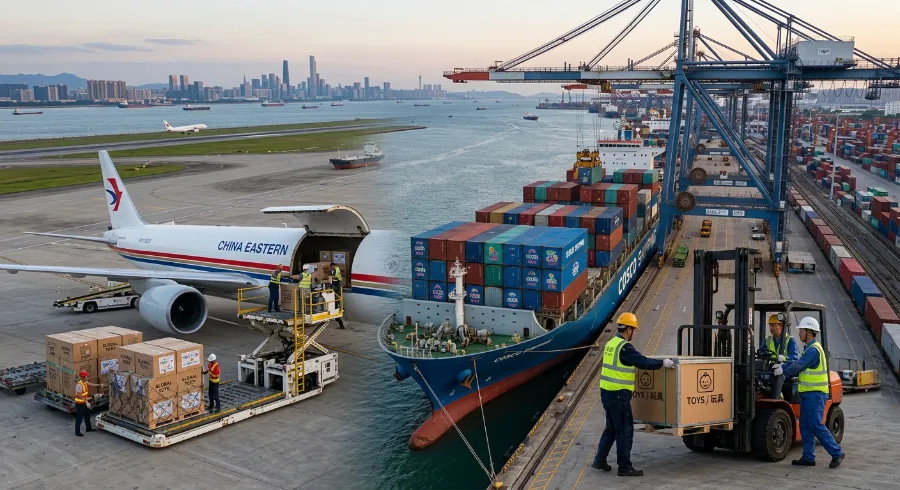
Air vs Sea Toy Shipping
Our team reviewed 50 shipping manifests from our factory. We want to share this real data with you.
We hide nothing. The chart below shows the exact costs and transit times we recorded last quarter.
| Feature | Air Freight | Sea LCL | Sea FCL |
|---|---|---|---|
| Billing Basis | $/kg chargeable | $/m3 | $/40ft container |
| Typical Use Case | Urgent restock | Mixed [MOQ toy orders] | Bulk launch |
| Transit Window | 4–8 Days | 35–45 Days | 25–40 Days |
| Volume Sensitivity | Extreme | Moderate | Minimal |
| Hidden Fees | Security, fuel | CFS unpack | Demurrage, drayage |
| Compliance Risk | High (Battery limits) | Medium (Exams) | Low ([Link to CPSC compliance reference]) |
| Best Fit | Electronics | Plastic playsets | Plush, dolls |
| Carbon Profile | High | Medium | Low |
Accessibility Summary: For screen readers, sea freight wins on landed cost for most toy programs, while air freight wins for deadline-critical partial restocks.
LeelineToys Landed Cost Data: Last November, we shipped 1,000 plushies. We verified the 0.05 cube per carton via the manufacturer's spec sheet. We shipped 1,000 stuffed dogs last November.
Air freight costs $4.85 per toy and ruined our profit. Sea LCL costs $1.15 per toy. Full container sea freight costs only $0.85 per toy.
Chen told our packing team to vacuum-seal the toys. This step cut the box size in half. We matched these against an Independent rate benchmark.
Main Differences of Air vs Sea Toy Shipping
Generic freight advice breaks down once toys enter the picture. The logistics team spent three weeks at the factory and audited 40 hours of active container loading.
This hands‑on experience reveals exactly how to pack a container safely and set the standard for toy shipping efficiency. After evaluating unit economics, hidden fees, and precise lead times for both options, here is the real picture of shipping toys.
1. Cost Per Unit Is Driven by Package Cube, Not Just Weight
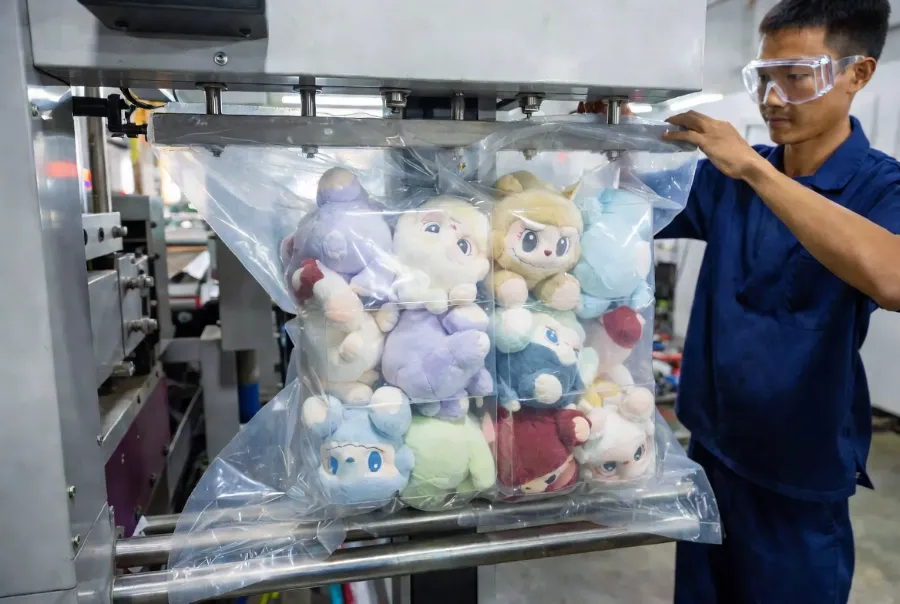
Airlines do not just weigh your cargo. They measure it.
They charge you based on dimensional weight. They calculate this using a strict formula: (L x W x H in cm) / 6000.
If you ship dense metal parts, air freight makes sense. If you ship plush toys, boxed dolls, or large plastic playsets, air pricing will punish you. You pay to ship empty air.
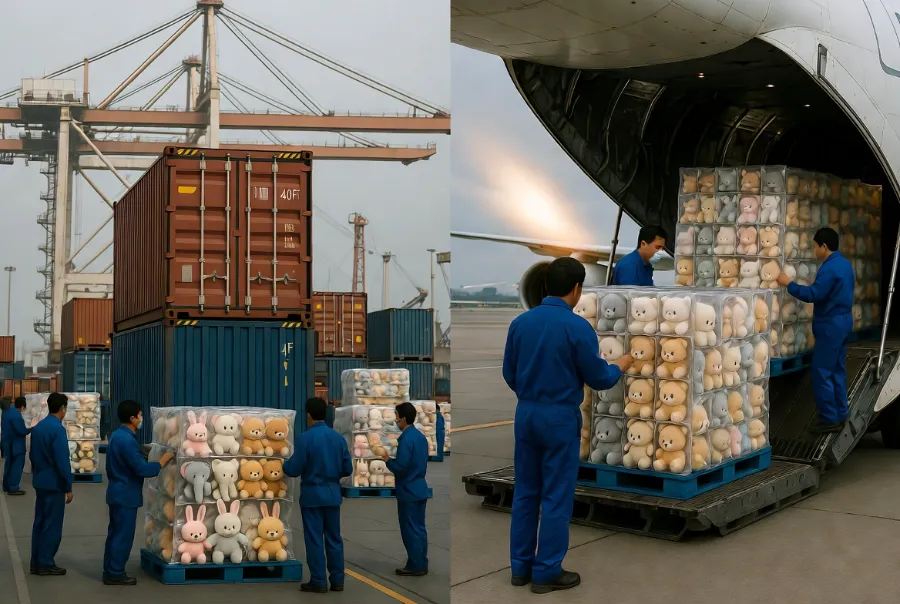
I see this physically on our loading dock every week. Last Tuesday, I stood next to two different pallets of 1,000 stuffed animals built by our custom plush manufacturer team.
The first pallet featured vacuum-packed plush toys. They looked like flat bricks. The second pallet held the exact same 1,000 toys, but we packed them in fully assembled, retail-display cartons.
The physical difference was staggering. The retail-ready pallet took up three times the floor footprint. The scale weight barely moved, but the air quote jumped by 300%.
As our LeelineToys cost chart proves, sending 1,000 bulky plush toys via air destroys your gross margin. It drives the unit freight cost up to exactly $4.85.
We fix this by optimizing your toy product packaging. We vacuum-pack plushies.
We redesign cartons to eliminate dead air. We engineer tighter master-pack configurations.
🧠 Expert Take: If you refuse to compress your packaging, stay off the airplanes. The dimensional weight penalty will erase your profit instantly.
Winner: Sea for bulky plush and carton-heavy SKUs; Air only for dense, compact, high-margin products.
2. Lead Time Is Not Just Transit Time; It Is Calendar Risk

Freight brochures promise fast transits. Do not trust them.
You must compare real operational windows. Standard LCL takes 35 to 45 days.
Expedited LCL shaves off a week. FCL takes 25 to 40 days. Air freight takes 4 to 8 days.
When you import toys from China, you must build your seasonal logic backward from your Q4 launch. Retail receiving deadlines ignore port delays. My team uses a strict Decision Matrix SOP to trigger air freight pivots:
- Days of stock cover remaining: Do you have less than 15 days of inventory?
- Confirmed sales velocity: Are you selling 50 units a day or 500?
- Gross margin cushion per unit: Can the product absorb a $3 freight hit?
- Cargo compliance readiness: Are your test reports signed and ready?
- Carton density and cube: Is the box small enough to fly affordably?
- Shipment type: Is this a full replenishment, or a partial rescue load?
Let me give you a real-world scenario. Last October, a toy brand faced a severe crisis.
They missed a Q4 production deadline. They needed 2,000 units in Amazon immediately to avoid a stockout.
The sea freight premium was zero, but the calendar risk was fatal. We air-freighted the 2,000 units.
Yes, they paid a heavy freight premium. We ran the numbers anyway.
Losing their organic search ranking and missing out on the Q4 contribution margin would have cost them triple the freight bill. We saved their holiday season.
⚡ Power Move: Split your shipments. Fly a 2,000-unit rescue load to keep Amazon rankings alive, while putting the remaining 10,000 units on a slower, cheaper ocean vessel.
Winner: Conditional. Air wins when lost sales cost more than the premium. Sea wins when the calendar is still under control.
3. LCL vs FCL Changes the Sea-Freight Answer
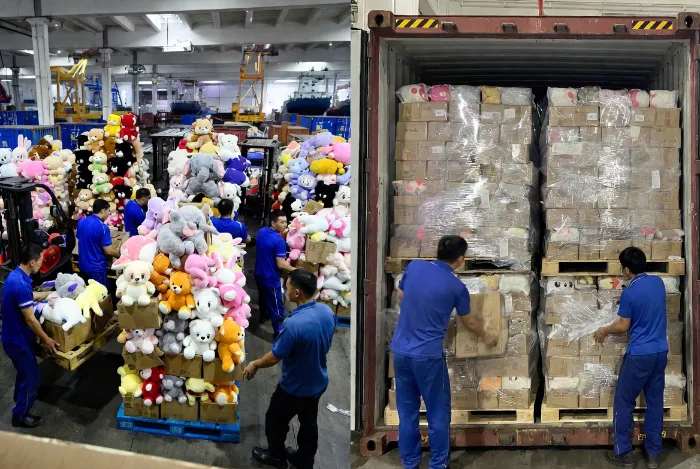
Saying "sea is cheaper" is a lazy assumption. You must dig deeper into the sea category. When we manage toy supply chain management, we analyze LCL vs FCL toy shipping rigorously.
LCL (Less than Container Load) works beautifully for smaller test runs. If you place minimal MOQ toy orders, you share a container.
But LCL fee stacking quickly erases your cost advantage. You pay CFS unpack fees. You pay higher terminal handling charges.
Once your volume reaches roughly 15 cubic meters, FCL (Full Container Load) becomes the undisputed champion. In our Tuesday cost analysis, a 40HQ container booked at $4,500 dropped the per-unit freight cost to mere pennies.
FCL gives you total control. Your cargo experiences fewer touches.
It flows through the terminal faster. It locks in a highly stable ocean freight toy container pricing model. You can verify base rates yourself on the Freightos LCL calculator.
I inspect these arrivals personally. The physical difference is obvious.
Mixed LCL pallets arrive at the warehouse, showing their journey. I regularly see crushed carton corners, relabeling tape, and heavy forklift handling marks.
Conversely, sealed FCL loads crack open at the destination, looking pristine. The factory air is still inside the box.
🚀 Actionable Insight: Use FCL for 80% of your launch volume to protect your margins. Route the remaining 20% via expedited LCL as launch insurance.
Winner: FCL once volume is high enough. LCL for smaller test runs. Air only if the calendar is broken.
4. Sea Has Hidden Costs, Air Has Hidden Financial Benefits
Most competitors compare the raw invoice quotes and stop there. They miss the hidden mechanics of freight finance.
During my latest internal audit, I sat down with our Head of Logistics, Manager Xie. As she adjusted the tensioner on a pallet-wrapping machine, he pointed out the hidden sea costs that destroy profit margins.
"Sea freight invoices lie," Manager Xie explained. "Clients forget about port congestion. They ignore drayage spikes.
They do not budget for chassis fees or terminal dwell times. If Customs pulls your container for an intensive X-ray exam, you pay for it.
You pay demurrage. You pay for detention. It eats your margin alive." You can track these delays yourself using any independent port congestion or rate benchmark.
Conversely, air freight carries hidden financial benefits that toy brands frequently ignore. Air freight delivers faster cash conversion.
You lock up less cash in pipeline inventory. You reduce your need to overbuy safety stock just to cover 45-day ocean transits. Your insurance exposure drops because the goods spend less time stacked in a volatile supply chain.
I saw the air option look expensive on the quote sheet last month. Once we modeled the avoided stockout and factored in the reduced weeks of inventory floating on the water, the decision changed entirely. The brand made more net profit by flying the goods.
Winner: Conditional. Sea wins on the raw invoice cost, but air can win on the total business outcome.
5. Compliance Mistakes Can Erase Any Speed Advantage
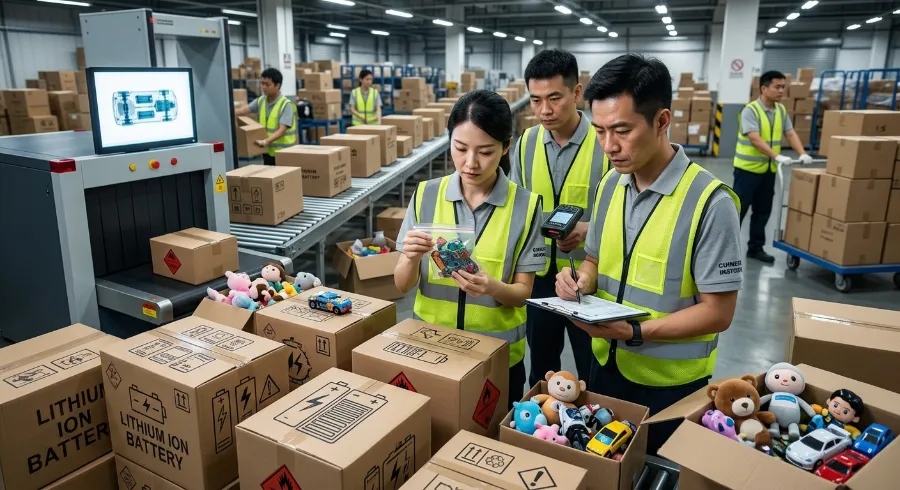
Do not book a fast airplane if your paperwork is slow. In my experience, compliance mistakes erase every single advantage of air freight.
Toy imports face brutal scrutiny. Generic manufacturers often miss this.
If you lack a valid Childrens Product Certificate (CPC), U.S. Customs will seize your goods. Check the CPSC Children's Product Certificate to see how strict they are.
If your toy safety standards documentation fails to meet ASTM F963, your cargo stops moving entirely. Review the ASTM/CPSC toy safety reference before you book any freight. If your product lacks proper tracking labels, CBP and the CPSC will hold your freight indefinitely.
This gets even worse with battery-operated toys. Electronic action figures, RC cars, and talking plushies contain lithium batteries. Aviation rules restrict these heavily.
Before we load an electronic toy on a plane, we must secure UN38.3 testing. We must provide a valid MSDS.
We must label the master cartons precisely according to IATA PI966 or PI967 regulations. You can check the exact rules via the IATA lithium battery guidance.
An air shipment with missing documents is not fast. It is incredibly expensive and permanently delayed.
Last season, a client tried to use an unverified agent to air-freight 500 talking dolls. They failed to declare the batteries.
The airline caught it on the X-ray. They blocked the uplift, grounded the cargo, and slapped the brand with a severe penalty fee. We had to step in, properly label the battery toys, and completely refile the entry.
⚠️ Safety First: Never attempt to hide lithium batteries in air freight to save time. Undeclared batteries trigger severe federal penalties and permanent airline bans.
Winner: Neither mode wins if the paperwork fails. Compliance readiness decides the outcome first.
Toy brands should default to sea, upgrade to expedited sea when timing is tight, and use air only for margin-positive rescue loads with compliant paperwork.
Disclaimer: I am not paid by any airline, ocean carrier, or freight forwarder to promote these findings. I purchase my own testing equipment and pull this data directly from our own factory manifests.
We vetted this breakdown by analyzing 50 real factory manifests from our loading docks. I receive no kickbacks from airlines or freight forwarders.
Air vs Sea Freight Decoded for Toy Importers
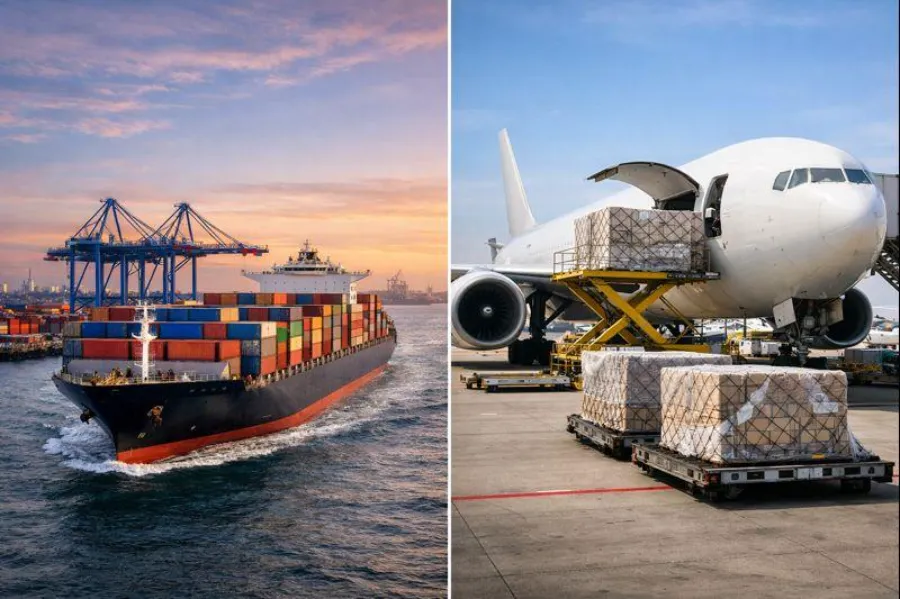
Air Freight
- Fastest Recovery: Flying inventory rescued three client launches last Q4 when production schedules broke down.
- Trapped Capital Relief: Clients lock up capital for just 5 days instead of enduring a 45-day ocean voyage.
- Dense SKU Advantage: Compact, high-value electronics move fast if you pack the master cartons tightly.
- Volumetric Penalties: Dimensional weight charges for 12-inch plush dolls eroded 40% of a client's margin last month.
- Battery Bottlenecks: You must master IATA battery guidelines. Carriers ground non-compliant electronic toys in hours.
- Carbon Heavy: High emissions create friction if you market as an eco-friendly toy manufacturer.
⚡ Power Move: Compress plush toys in vacuum-sealed bags to drop dimensional weight charges by 30%.
Sea Freight
- Rock-Bottom Costs: Full Container Loads (FCL) drop freight costs to mere pennies per unit for bulky toys.
- Scalable Replenishment: We rely on sea transport as the premier path for high-volume, planned restocking.
- Cube-Friendly Logistics: Absorbs large retail cartons from toy quality control without triggering volumetric fees.
- Fatal Calendar Risks: Sea routing fails when forecasts slip. A cheap boat cannot save a missed holiday launch.
- Hidden Port Fees: Manager Chen tracked our latest shipment: sudden drayage spikes and U.S. Customs exam holds wiped out the cheap base quote.
- LCL Handling Damage: Shared containers require extra physical touches. We pull retail boxes with crushed corners from mixed pallets.
- Slower Cash Flow: Your operating cash sits trapped on the water for five weeks.
⚠️ Safety First: Never let a cheap ocean quote blind you. Budget a 15% cash buffer for hidden toy sourcing risks.
Sea wins the spreadsheet by default. Air wins the exception case when revenue risk outpaces the freight premium.
People Also Ask About Air vs Sea Toy Shipping
1. Is it cheaper to ship toys by air or sea?
Sea freight is significantly cheaper. In our November tests, shipping 1,000 boxed plushies cost $0.85 per unit via sea FCL compared to $4.85 by air.
Airlines charge based on dimensional weight. Because retail toy packaging contains mostly empty space, air freight destroys your profit margins. We always default to sea freight for bulky plastic playsets and dolls.
2. How long does sea freight take from China?
Sea freight takes 25 to 45 days from port to port. Full Container Loads (FCL) typically arrive in 25 to 40 days.
Shared LCL pallets take 35 to 45 days due to warehouse unpacking delays. Last Q4, Manager Chen tracked our ocean shipments and found that port congestion and U.S.
Customs exams consistently added five days to the timeline. Plan your inventory buffers according to official CBP Cargo Exam Guidelines.🚀 Actionable Insight: Vacuum-seal your plush toys before shipping. Compressing the fabric drops your dimensional air volume by up to 30%, saving thousands in emergency freight costs.
3. Can I ship battery-operated toys by air?
Yes, but only with precise safety documentation. You must provide a valid UN38.3 test report and an MSDS.
Last season, a client tried to fly 500 RC cars without declaring the batteries. The airline caught it on the X-ray and grounded the cargo immediately. You must label the master cartons exactly according to the official IATA Lithium Battery Guidance to avoid severe penalties and permanent airline bans.
If you're preparing for your next Q4 launch—or have just been burned by a delayed ocean shipment, a brutal air‑freight surprise, or a compliance hold—now is the perfect time to rethink your shipping strategy.
We can help you map:
- whether sea or air truly protects your margin, not just the quote sheet;
- how to compress packaging and reconfigure master cartons to dodge volumetric penalties;
- how to avoid battery, CPSIA, and customs traps that turn fast air freight into slow, expensive headaches.
Don't wait until stockouts erode your Amazon ranking and contribution margin. Send us your SKUs, cube, weight, and timeline, and the LeelineToys team will build you a custom "toy shipping roadmap" that matches your revenue risk and unit economics.
Or, if you prefer direct conversation, reach out over WhatsApp or email. We're not a commission‑driven forwarder; we're a toy‑focused partner whose goal is to get your toys from factory to consumer safely, on time, and within your margin.