
It often starts with a notification. Amazon requests a children's product certificate within 72 hours to keep your listing active.
For many sellers, this is where a profitable launch turns into a liability. A missing or incorrect certificate leads to suppressed listings, inventory seizures at US Customs, and costly compliance chargebacks.
The CPC is not a document you simply buy from a testing laboratory.
This is the most common misconception among new importers. While a CPSC-accepted laboratory provides the test results, the Consumer Product Safety Commission (CPSC) legally requires the manufacturer or importer to draft and issue the actual certificate. It is a self-issued declaration that your product complies with all applicable safety rules.
We will begin by defining the legal role this document plays in your supply chain.
What is a Children's Product Certificate?
A children's product certificate (CPC) is a formal document issued by a U.S. importer or domestic manufacturer. It certifies that a product complies with all applicable safety rules based on passing test results from a CPSC-accepted laboratory.
This requirement applies specifically to "children's products," defined by the Consumer Product Safety Commission (CPSC) as any consumer product designed primarily for children 12 years of age or younger.
The Critical Distinction: Report vs. Certificate
New importers often confuse the lab report with the certificate. They are distinct documents with different legal functions:
- Test Report (Lab-issued): The evidence. This contains raw technical data, testing methods, and pass/fail results.
- Certificate / CPC (Importer-issued): The attestation. This is a legal declaration where you reference the lab report to swear the product is safe.
Common Misconception: A CPC is not something you "buy" from a lab. While the lab provides the data you need, you must generate and sign the certificate yourself.
Who is Responsible?
Compliance falls squarely on the entity entering the goods into commerce. This is the core of importer of record responsibilities: if you sell it, you are liable for it.
Consider these two scenarios:
- The Amazon FBA Seller: You are based in Texas but import custom plastic figures from a factory in Shenzhen. You are the importer of record. You must issue the CPC.
- The Domestic Maker: You manufacture wooden baby rattles in a workshop in Vermont. You are the domestic manufacturer. You must issue the CPC.
Quick Decision Tree
Use this logic flow to determine your requirements immediately:
- Is the product intended for a user 12 years old or younger?
- No: You likely need a General Certificate of Conformity (GCC).
- Yes: Proceed to question 2.
- Is it a toy, article of clothing, piece of furniture, or childcare article?
- Yes: A CPC is mandatory.
Safety standards are not static. While current rules apply today, children's safety regulations 2026 and beyond may introduce new testing protocols. Always verify current citations before issuance.
To be valid, your CPC must contain seven specific data fields. If even one is missing, Amazon or Customs can reject the shipment.
💡 Key Insight: The lab provides the proof, but the importer provides the promise. You cannot outsource the legal responsibility of signing the CPC.
Core Concepts: How the CPC Workflow Operates
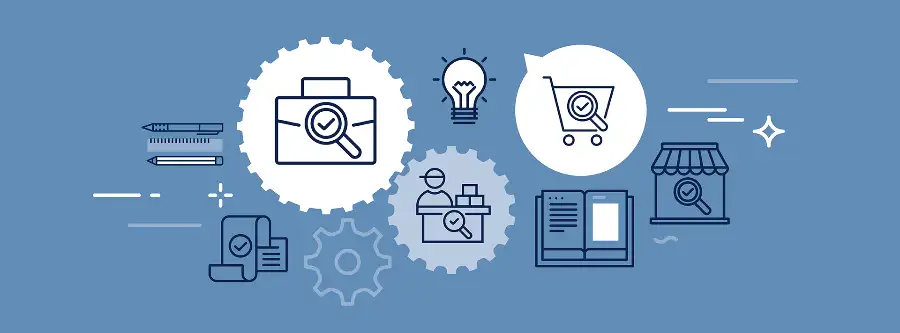
Understanding the Children's Product Certificate (CPC) requires looking under the hood of the regulatory machine. It is not merely a paperwork exercise; it is a closed-loop system of verification. This system relies on a specific sequence: material identification, destructive testing, physical labeling, and final certification.
Think of the CPC as a passport for your product. Just as a traveler needs a birth certificate (proof of origin) to obtain a passport (permission to travel), your product needs a Laboratory Test Report (proof of safety) to obtain a CPC (permission to enter the market). One cannot exist without the other.
1) The CPC Workflow (End-to-End Map)
The compliance process moves linearly from the factory floor to the retailer. Interrupting this flow—such as ordering mass production before material testing—creates significant financial risk.
- Confirm Status: Verify the product is a "children's product" (intended for ages 0–12) and determine the specific age grading (e.g., 3+ vs. under 3).
- Identify Rules: Map applicable standards (CPSIA chemical limits, ASTM toy standards, small parts regulations).
- Select Lab: Commission a CPSC-accepted third-party laboratory whose accreditation scope covers your specific rules.
- Test Samples: Send production-grade samples to the lab and receive the Test Report(s).
- Tracking Labels: Implement permanent tracking information on the product and its packaging.
- Draft Certificate: The Importer or Domestic Manufacturer drafts and signs the CPC.
- Record Keeping: Store records for five years and furnish the certificate to retailers (like Amazon) upon request.
2) Core Standards: Toys and Beyond
The CPC is a summary document that cites specific safety rules. You cannot simply write "Safe for Kids"; you must cite the exact regulatory code found in your test report.
CPSIA Compliance (Chemical Limits)
The Consumer Product Safety Improvement Act (CPSIA) applies to almost all children's products, not just toys.
- Total Lead Content: Limits lead in accessible substrates (metal, plastic) and surface coatings (paint, varnish).
- Phthalates: Restrictions on specific plasticizers found in soft vinyl or plastics. This applies specifically to children's toys and child care articles.
- Accessible Components: Testing focuses on parts a child can touch, lick, or swallow. Internal components (like a battery inside a sealed, screw-secured compartment) may be exempt from certain tests.
ASTM F963 (The Toy Safety Standard)
If your product is a toy, it must comply with ASTM F963. This is a bundle of requirements covering mechanical hazards (sharp points), flammability, and toxicity.
- Citation Protocol: Your CPC must cite the specific version currently in force (e.g., ASTM F963-17 or F963-23).
- Physical Testing: Includes "use and abuse" testing—dropping, torque, and tension tests—to ensure small parts do not detach and create choking hazards.
🧠 Expert Insight: While ASTM F963 is synonymous with toys, non-toy items like children's backpacks or lunch bags have their own risk profile. A backpack often requires testing for:
- Lead in Surface Coatings: On painted zipper pulls.
- Phthalates: In PVC linings or thermal insulation layers.
- Sharp Edges: On metal hardware or buckles.
- CPSIA Section 103: Mandatory tracking labels.
3) CPSC Accepted Laboratories (How to Verify)
A common failure point is using a lab that is ISO-accredited but not CPSC-accepted. The CPSC maintains a specific list of labs authorized to test for US compliance. If your lab is not on this list, their test report is legally void for CPC purposes.
⚙️ Technical Detail: A lab might be accepted for "Lead Testing" but not for "Small Parts Testing." You must verify the lab's scope matches every rule you are certifying.
Use these official tools to verify your laboratory credentials:
- CPSC CPC Overview and Requirements
- CPSC Accepted Third-Party Testing Laboratories (Database)
Lab Verification Checklist:
- Identity Match: Does the Lab Name/Address on the quote match the CPSC database exactly?
- Scope Check: Is the lab accredited for the specific test standards needed (e.g., 16 CFR Part 1303)?
- Language: Will the final report be in English?
- Traceability: Does the report list the exact unique Sample ID/SKU of your product?
4) Lead and Phthalate Testing Protocols
Understanding what the lab actually tests helps you design for compliance.
- Lead Testing: Labs use X-ray Fluorescence (XRF) screening or wet chemistry (dissolving material in acid) to measure lead content in parts per million (PPM). They test substrates (the base material) and surface coatings (paint/ink) separately.
- Phthalate Testing: This targets "plasticized" components. Hard polypropylene plastic usually does not require this; soft vinyl (PVC) always does.
Component Risk Assessment (Backpack & Bag Focus): If you are manufacturing a children's lunch bag, you must test the high-risk components:
| Component | Material Risk | Typical Test Required |
|---|---|---|
| Zipper Pull | Painted Metal | Lead in Substrate + Lead in Paint |
| Logo Patch | Soft PVC / Rubber | Phthalates (8-phthalate panel) |
| Webbing Strap | Synthetic Fiber | Total Lead Content |
| Graphic Decal | Screen Print Ink | Lead in Surface Coating |
5) Tracking Labels for Traceability
CPSIA Section 103 requires permanent tracking information on the product and its packaging. This allows for targeted recalls of specific batches rather than total market withdrawals.
The "Permanency" Rule: The label must be legible and permanent "to the extent practicable." A paper sticker that peels off the product is non-compliant.
- Custom Plush Toys: A textile label sewn into the seam (often behind the care tag).
- Plastic Toys: Molded text directly into the plastic (requires tooling) or a pad-printed code.
- Wooden Toys: Laser engraving or permanent ink stamping on the base.
- Backpacks/Bags: A woven label stitched into an interior seam, plus a sticker on the polybag.
🔄 Process Loop: Amazon frequently requests photos of your tracking label during compliance review. The label must include:
- Manufacturer or Private Labeler Name.
- Location of Production (City, Country).
- Date of Production (Month/Year).
- Cohort ID (Batch Number or Run ID).
6) How to Draft a CPC (The Walkthrough)
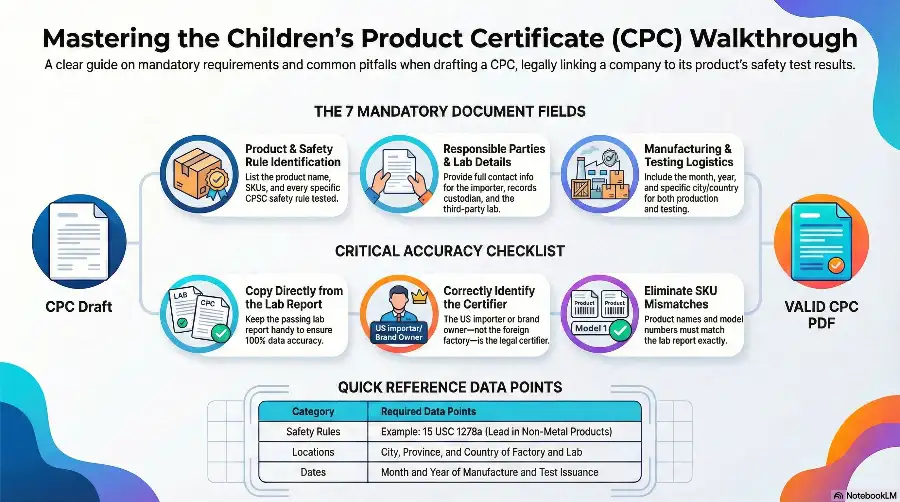
Once you have the passing lab report and the product is labeled, you draft the CPC. This is a text document (PDF) that links your company to the test results.
Pre-requisite: Have your Test Report handy. You will need to copy data directly from it to ensure 100% accuracy.
The 7 Mandatory CPC Fields
Ensure your document contains these seven distinct sections:
- Identification of the Product: Detail the product name, description, colors, and specific Model/SKU numbers.
- Citation to each CPSC Product Safety Rule: List every rule tested. Example: "15 USC 1278a: Lead in Non-Metal Children's Products."
- Identification of the Importer or Manufacturer: Name, Full Mailing Address, and Phone Number of the certifying party (usually the US importer/brand owner).
- Contact Information for the Records Custodian: The person responsible for maintaining the test results (Name, Email, Phone, Address).
- Date and Place of Manufacture: Month/Year of production and the City/Province/Country of the factory (e.g., Shenzhen, Guangdong, China).
- Date and Place of Testing: Month/Year the test report was issued and the location of the lab.
- Identification of the Third-Party Laboratory: Exact Name, Address, and Phone Number of the lab (copied from the report).
Common Drafting Mistakes:
- Wrong Certifier: Listing the Chinese factory as the "Importer." If you are the Amazon seller based in the US, you are the certifier.
- Mismatched SKUs: The CPC lists "Red Bear Model A" but the test report says "Blue Bear Model B." These must align perfectly.
7) Amazon-Specific: The Operational Reality
When Amazon "gatekeeps" a category, their compliance bots and human reviewers scrutinize your documents.
- The Trinity: They typically request the CPC, the Test Report, and Product Images (showing the tracking label) simultaneously.
- Consistency Check: The "Applicant" name on the test report must match the "Manufacturer/Importer" on the CPC, which must match the "Brand/Seller" name on Amazon. Any deviation triggers a rejection.
- Policy Updates: Amazon enforcement is often stricter than federal law (e.g., requiring test reports to be less than 12 months old for certain categories). Always verify the current requirement in Seller Central.
8) 'LeelineToys CPC Checklist' (Downloadable Asset)
To help you navigate this workflow, we utilize an internal protocol that ensures our OEM manufacturing clients pass compliance reviews on the first attempt.
- SKU Mapping Sheet: Grouping products for efficient testing.
- Material Risk Scan: Identifying lead/phthalate hotspots before production.
- Lab Scope Verification: Ensuring the lab is CPSC-accepted for your specific items.
- Tracking Label Proof: Visual check of label permanency and data accuracy.
- CPC Drafting Template: A fill-in-the-blank structure to prevent clerical errors.
Access the consultation team to review your compliance strategy.
The Strategic Value of a Children's Product Certificate
Compliance is often viewed as a cost center, but experienced importers treat it as a risk management system. A correctly executed Children's Product Certificate (CPC) transforms compliance from a hurdle into a competitive moat.
Here is the commercial impact of rigorous documentation.
1. Prevents Amazon Revenue Gaps
Marketplace algorithms suspend listings first and verify documents second. When a bot flags a SKU for review during peak season, every hour of downtime equals lost revenue and ranking decay.
- The Outcome: A pre-verified CPC ensures your documentation matches your SKU and test reports exactly, allowing for instant reinstatement.
- The Proof: According to Amazon's compliance policies, failure to provide valid documentation within specified windows results in permanent inventory removal.
2. Systematizes Risk Management
As the Importer of Record, you assume full legal responsibility for the product the moment it clears Customs. You cannot outsource liability to an overseas factory.
- The Outcome: The CPC is a binding declaration that connects your company to the safety data, shifting your legal standing from negligent to diligent.
- The Proof: The CPSC emphasizes that the importer must issue the certificate, reinforcing that due diligence is a domestic obligation, not a foreign one.
3. Enables Surgical Recalls
If a quality control issue arises, the difference between a minor operational hiccup and a business-ending event is traceability.
- The Outcome: Combining a CPC with a robust tracking label system allows you to isolate specific production batches.
- The Impact: You can recall a specific date code (e.g., 500 units) rather than issuing a blanket recall for your entire sales history (e.g., 50,000 units).
4. Enforces Supply Chain Discipline
Factories may attempt to swap verified materials for cheaper substitutes mid-run (e.g., changing plastic resin suppliers).
- The Outcome: Requiring a CPC based on a specific pre-production sample forces material discipline. It signals that you are auditing output against the initial test report, preventing "silent substitutions."
- Context: This level of vetting is critical when learning how to find a toy manufacturer that prioritizes long-term partnership over quick margins.
What Good Looks Like: The "Ready-First" Workflow
Best-in-class importers do not wait for goods to arrive in the US to draft paperwork.
- Test: Lab tests are conducted on the pre-production sample.
- Verify: The CPC is drafted and linked to the batch tracking label.
- Ship: Documents are digitized before the container hits the water.
📉 ROI Check: This proactive loop prevents the "panic tax" of expedited testing fees and lost sales velocity. Whether you are sourcing for the US or working with baby toy manufacturers for Australia, compliance is speed.
🚀 Strategic Insight: Reliable toy manufacturers in Australia and global markets recognize that a CPC is not just paper—it is the blueprint for a scalable, insurable brand.
Why Compliance Fails: Common Risks & Pitfalls

Compliance is not a static checkbox; it is a continuous audit of your supply chain. Most children's product certificate (CPC) rejections stem from administrative negligence rather than unsafe products. If your shipment is held or your Amazon listing suppressed, it is likely due to one of the following friction points.
Misconception: Relying on Factory-Issued Certificates
New importers frequently assume a factory-provided CPC is sufficient. This is a critical error. The legal responsibility to certify compliance lies with the Importer of Record, not the manufacturer.
- The Risk: A factory-issued CPC effectively admits you are not the entity managing compliance. This often leads to immediate rejection by Amazon algorithms.
- The Fix: You must draft the CPC on your own letterhead, referencing the factory's test data but certifying it under your entity's authority.
Data Mismatches Triggering Auto-Rejection
Compliance bots scan for exact data matching between the product listing, packaging, and test report. Human nuance does not apply here.
- The Conflict: If a test report lists "Model A-1" but the packaging says "Model A," the system flags the SKU as unverified.
- Color Variations: Testing a blue toy does not automatically clear a red variant. Different pigments require distinct chemical testing scopes.
Invalid Lab Scope and Accreditation
Not all laboratories carry equal weight. A common failure occurs when an importer uses a lab that is ISO-accredited but lacks specific CPSC acceptance for the required tests.
- The Nuance: A lab might be accepted for "Lead Testing" but not for "ASTM F963 Mechanical Hazards." If the lab lacks the specific CPSC Lab ID for the test performed, the data is legally void.
Tracking Label and Traceability Failures
Section 103 of the CPSIA mandates permanent tracking labels.
- The Impact: Adhesive stickers often fail the "permanence" requirement. If Customs cannot trace a specific unit back to its production batch via the label, the product is deemed "misbranded" and subject to seizure.
- Operational Failure: Internal teams often lack the key to decode batch numbers, making surgical recalls impossible.
Manufacturing Reality: Material Substitution Risks
The "Golden Sample" provided for testing may not match the mass production run.
- The Reality: Suppliers may swap a verified non-toxic plasticizer for a cheaper alternative during production to increase margins.
- 🛡️ Mitigation: Implement "Incoming Material Verification" and legally lock the Bill of Materials (BOM) prior to production.
Citing Outdated Standard Versions
Regulations evolve, yet importers often copy-paste citations from old templates. Citing an outdated standard (e.g., ASTM F963-11) instead of the current mandatory version invalidates the certificate immediately.
Final Thoughts: Securing Your Supply Chain
Ultimately, the Children's Product Certificate is more than an administrative hurdle; it is the legal bridge between a safe design and a sellable product. The most critical takeaway for any importer is clear: do not confuse the test report with the certificate. The laboratory provides the scientific evidence, but you—as the importer of record—must issue the binding legal declaration.
As marketplaces like Amazon increasingly automate their compliance gates, the margin for error has vanished. Success favors brands that treat compliance as an engineering specification rather than a paperwork afterthought.
The Final Compliance Checklist
To ensure your product clears Customs and remains active on digital shelves, verify these three pillars before shipping:
- Verify Scope: Confirm the specific age grading and applicable standards (e.g., ASTM F963-23 vs. general CPSIA) before production begins.
- Test Correctly: Commission a CPSC-accepted laboratory whose accreditation scope explicitly matches your product's chemical and mechanical risks.
- Execute Documentation: Draft the CPC on your company letterhead, apply permanent tracking labels to the product and packaging, and archive all records for five years.
Next Steps
If you need assistance aligning your product design with current safety standards, or require a manufacturing partner who integrates compliance directly into the production workflow, contact our team for a consultation.