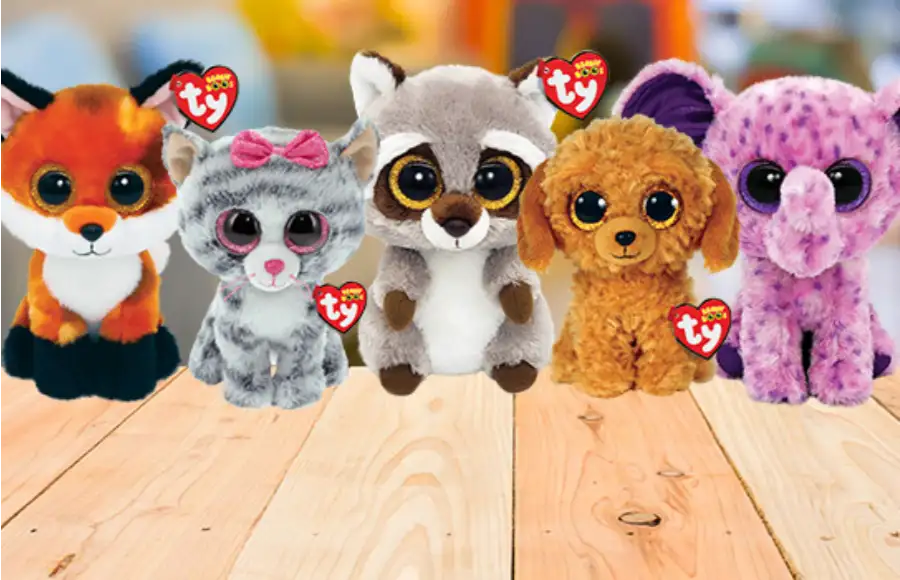

Embroidery is the mandatory winner for infants (0+), while Safety Eyes take the lead for children 3+. For true child-safe stuffed animal eyes, embroidery is non-negotiable; hard plastic "safety eyes for toys" are a misnomer and pose a defined choking risk for toddlers. Conversely, installing safety eyes on plush offers superior production speed and the glossy retail look required for older demographics. This is a compliance decision, not a design preference: use non-choking toy eyes like satin stitch for any product accessible to infants.
Verify your sourcing against our Age Grading Guidelines or contact our engineering team for a safety audit.
Here is the direct technical specification comparison between mechanical safety eyes and embroidered alternatives.
| Metric | Safety Eyes (Plastic / Snap-on) | Embroidered / Felt Eyes |
|---|---|---|
| Recommended Age | 3 Years+ | 0 Months+ (Birth) |
| Choke Hazard | Present (If Detached) | None (Integral to Skin) |
| Retention Standard | 70N / 15 lbf Tension [Link to ASTM F963 standard page] | General Seam Strength |
| Spec Unit | Diameter (mm) | Stitch Density / Denier |
| Installation | Post + Locking Washer | Satin Stitch / Appliqué |
| Process Control | Mechanical Snap Verification | Digital Sewing File |
| Compliance Burden | High (Traceability + [Link to EN 71-1 overview/official source]) | Low (Material Testing Only) |
| Best Application | Visual Realism / Glint | Infant Safety |
Screen-Reader Summary: If your product requires a 0+ age grade, embroidery is the mandatory choice due to zero detachment risk; for 3+ products, safety eyes are viable only with verified 70N tension testing and batch traceability.
Main Differences of Safety Eyes for Toys vs. Embroidery Eyes
Read now and upgrade your next toy project.
1. Age Grading & The 'Safety Eyes' Misnomer
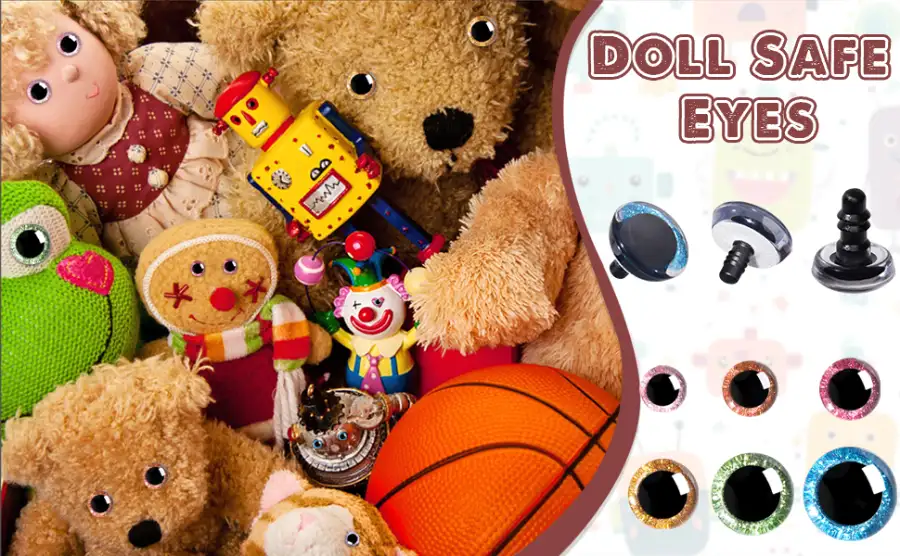
Despite the marketing name, "safety eyes" are technically small parts. If a plastic eye detaches, it fits within the small parts test cylinder defined by standards like ASTM F963, instantly becoming a choking hazard. This physical reality dictates your compliance strategy.
Embroidery creates a unitary construction. Because the eye is stitched directly into the plush skin, there is no component to detach. Even if a child chews through the threads, they unravel into soft fibers rather than forming a rigid obstruction.
- 0+ (Infants): You must use embroidered or appliqué eyes. Hard plastic components are generally prohibited or require testing thresholds so high that most brands refuse the risk.
- 3+ (Toddlers): Safety eyes are acceptable, but the "safety" designation is only valid if the washer is correctly locked and the fabric maintains structural integrity under stress.
⚠️ Safety First: Never assume "Safety Eyes" bought at retail are safe for infants. Without documented retention testing, they are legally treated as "craft supplies" and are not compliant for products intended for children under 3 years old.
2. Retention Strength: ASTM F963 Requirements
The difference lies in tensile failure points. When a child bites a plastic eye and pulls, they exert shear force on the locking washer. For safety eyes to be compliant in custom toy manufacturing, they must withstand a specific tension test—typically a ~90 Newton (approx. 20 lbf) pull force held for 10 seconds.
Failure manifests in three ways:
- Washer Walk-Back: Low-quality soft plastic washers slide back over the post ridges.
- Post Snap: The stem shears off under torque.
- Fabric Failure: The eye remains locked, but the fabric tears, allowing the entire assembly to pop out.
Embroidery bypasses this failure matrix entirely. To remove an embroidered eye, a child would have to cut the face of the plush toy apart physically. There is no single point of failure to test against a force gauge.
🧠 Expert Take: In laboratory testing, fabric failure is more common than plastic failure. If you use safety eyes on low-pile or loose-knit plush without reinforcement, the eye will rip right through the fabric long before the washer unlocks.
Winner: Embroidery (Structural integrity). Safety eyes only win if retention >20 lbf is documented. Official CPSC Guidance on Small Parts.
3. Locking Mechanism: The 'Click Test'
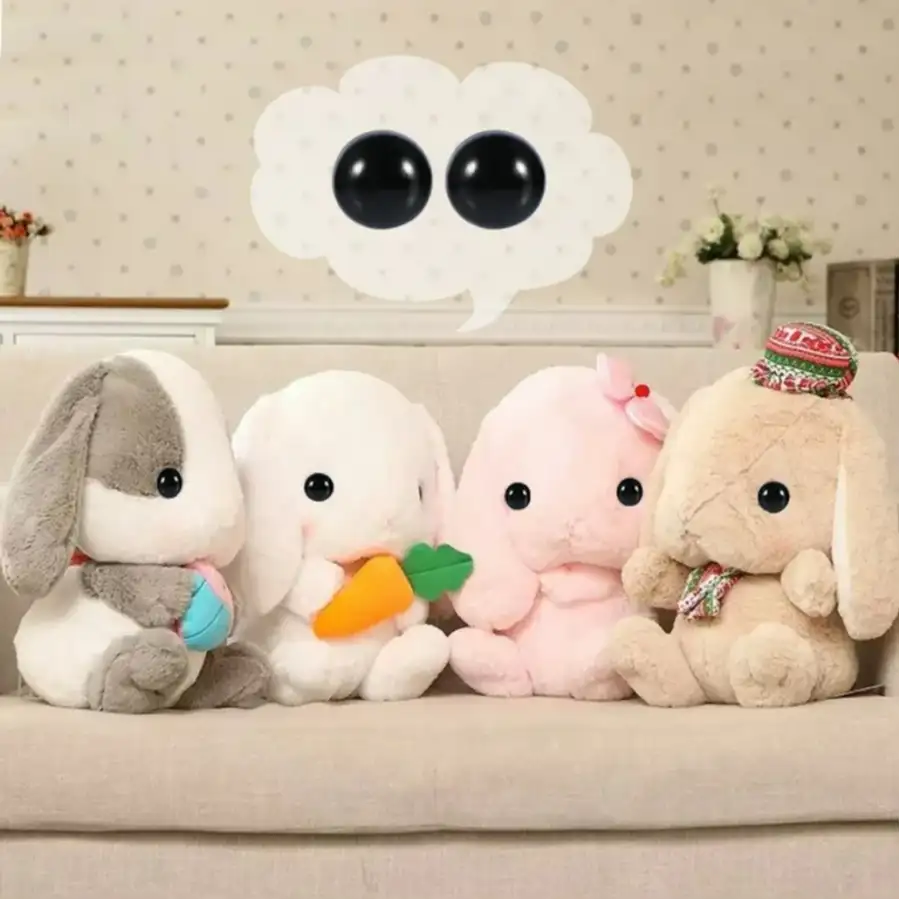
A standard snap-on doll eye relies on the interaction between the ridged post and the backing (often called locking washers for craft eyes). The difference is audible and tactile.
- The Tactile Experience: When installing a safety eye, you must feel the washer ratchet over multiple ridges. It is not a silent slide.
- The "Click Test": In professional workflows, operators listen for a specific count. If the washer only passes one ridge, it is not locked. It must pass 2–3 ridges (depending on the mold geometry) to be secure.
- Failure Signs: If the washer feels "mushy" or stops without a distinct click, the plastic is too soft or the hole is undersized, compressing the post rather than engaging the lock.
Embroidery relies on thread tension, which is automated and flush with the surface. There are no ridges to count and no risk of an operator failing to seat a washer fully.
🚀 Actionable Insight: Implement a "Go/No-Go" gauge in production. If a safety eye can be rotated easily by hand or rocked to reveal the post, the washer is not fully seated. Reject the unit immediately.
4. Installation Workflow & Repeatability
Embroidery is a digital-first, highly repeatable process. The design is digitized once, and the machine executes the exact stitch pattern on every unit. Whether you produce 10 or 10,000 toys, the eye placement and look are identical. This ensures consistent brand character for high-volume lines.
Safety Eyes introduce manual variables that increase risk:
- Hole Sizing: The puncture must be exact. Too big, and the eye pulls through; too small, and the washer won't seat.
- Reinforcement: Loose-weave plush requires a secondary internal patch to give the washer a solid grip.
- The Rework Rule: Once a washer is forced on, it is deformed. If an eye is installed crooked, the component must be destroyed. You cannot "back it off" and reuse it.
⚡ Power Move: When using safety eyes on long-pile fur, use a thin plastic film or non-woven stabilizer between the eye and the fabric. This prevents fur from getting trapped in the locking mechanism, which weakens the lock retention.
Winner: Depends on Volume. Embroidery for zero-rework consistency; Safety Eyes for standard 3+ SKUs. Learn more about our Production Process | Explore ODM/OEM Solutions
5. Sourcing & Compliance Paperwork
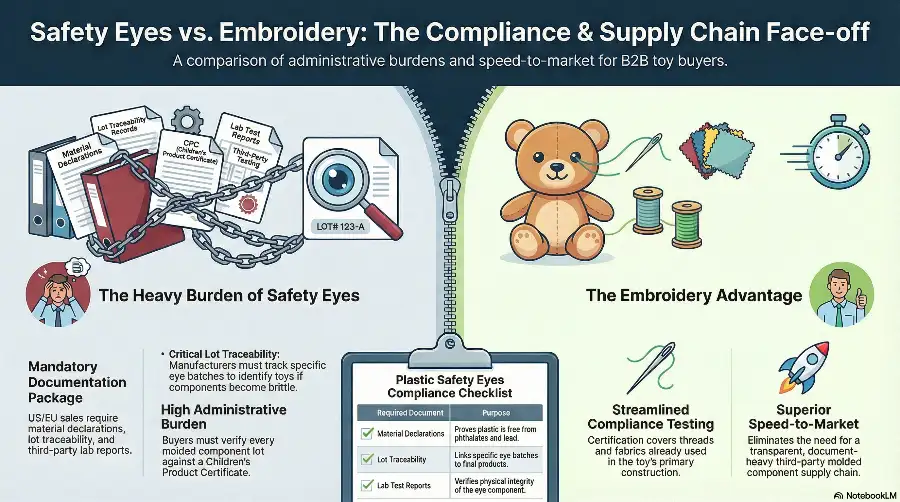
For B2B buyers, Safety Eyes introduce a third-party molded component into the supply chain, significantly increasing the administrative burden. To sell legally in US/EU markets, you cannot simply use bulk eyes; you must demand a full data package:
- Material Declarations: Proof the plastic (ABS/PS) is free from phthalates and lead.
- Lot Traceability: If a batch is brittle, you must know exactly which toys used it.
- Third-Party Test Reports: A lab report verifying the physical integrity of the eye component itself.
Embroidery streamlines compliance because you are testing the thread and fabric—materials you are already certifying for the rest of the toy. If your supplier cannot provide a Children's Product Certificate (CPC) covering the specific eye lot, the product is non-compliant.
Winner: Embroidery (Speed-to-market). Safety eyes require a transparent, document-heavy supply chain.
Mini Decision Rubric
- If your product is for ages 0-3: Stop. Use Embroidery. It is the only option that guarantees sleep-safe compliance.
- If your product is 3+ and requires a "glint" or realistic look: Use Safety Eyes, but mandate a "pull test" protocol in your QC agreement.
- If you cannot get material certifications from the eye vendor: Treat the eyes as "craft supplies" and do not use them for commercial children's products.
See Types of Plastic Toys for context.
Safety Eyes (Plastic, Snap-On)
Pros
- Retail-Ready Polish: High-gloss finishes mimic the "wetness" of biological eyes, offering immediate shelf appeal that many buyers associate with premium brands.
- Rapid Assembly: A manual press operator can install these in seconds. Compared to the minutes required for embroidery machines, this drastically reduces labor time for high-volume safety eyes for toys.
- Consistency: Unlike hand-stitching or variable machine tension, injection-molded parts ensure every character has the exact same expression.
Cons
- The "Under-3" Dealbreaker: Despite the name, these are detachable small parts. They automatically fail CPSC Small Parts Regulations for the 0-3 age bracket due to choking risks if the post shears.
- Destructive Rework: Once the locking washer engages, it cannot be removed without ruining the fabric. A slightly off-center installation often turns the entire plush skin into scrap.
- Washer Walk-Back: In our testing, cheaper plastic batches often have soft washers that slip over the retention ridges under tension, leading to field failures.
⚠️ Safety First: Do not rely on the "snap" sound. In professional manufacturing, we use a "Go/No-Go" gauge to verify the washer has passed the second retention ridge. If it sits on the first ridge, it will likely fail standard torque testing.
Embroidered / Felt Eyes
Pros
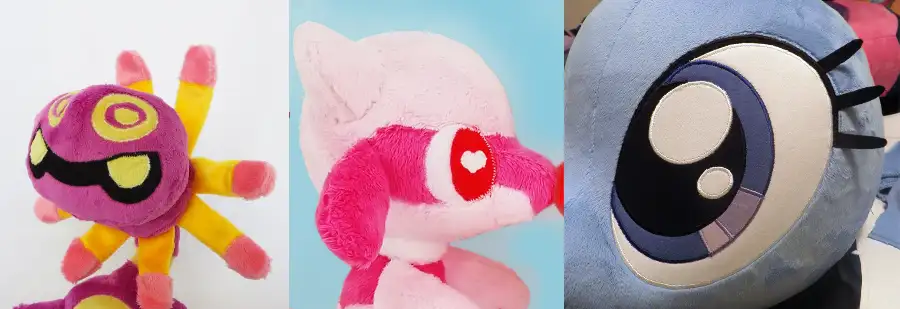
- 0+ Age Compliance: The best path for non-choking toy eyes. By stitching the design into the fabric matrix, you create a unitary construction that eliminates the risk of hard plastic detachment.
- Sleep-Safe Texture: Parents prefer the lack of hard protrusions for bedtime plushies. There are no rigid posts to scratch a sleeping child's face or cause discomfort during cuddling.
- Complex Expressions: Allows for eyelids, asymmetry, and floating eyebrows that hard plastic molds cannot replicate without expensive custom tooling.
Cons
- Fabric Distortion (The "Pucker" Risk): High stitch density on stretch fabrics (like Minky) causes the material to bunch. Preventing the "imploded face" look requires precise stabilizers and tension settings that vary by operator.
- Production Bottlenecks: A complex satin-stitch eye can take 5–10 minutes per unit. This ties up expensive machinery and slows throughput significantly compared to snap-on assembly.
- Matte Finish: You sacrifice the glassy reflection of plastic. While you can use high-sheen thread, it will never achieve the true "glint" of a sinker eye, which some buyers perceive as lower value. See ASTM F963 for specific tension test requirements on appliqué components.
🧠 Expert Take: You don't need plastic to get a "sparkle." We often use a trilobal polyester thread or a white satin-stitch "gleam" dot within the pupil to simulate light reflection while maintaining a 100% soft, baby-safe profile.
Trust Check: Compliance Over Aesthetics
Age grade dictates the material, not the other way around. A beautiful plastic eye is a liability if it forces a warning label on an infant product.
Read More:
People Also Ask About Safety Eyes for Toys
1. When should I choose embroidered eyes over safety eyes?
Choose embroidered eyes immediately if you are designing for the 0+ infant market, sleep-safe plush, or baby gifts. Embroidery creates a unitary construction with the fabric, eliminating the risk of detachment and choking hazards inherent to hard plastic parts.
This is the mandatory choice for brands targeting the safest compliance tier or boutique makers who can control stitch density (satin or tight backstitch) to prevent unraveling.⚠️ Safety First: Never assume "Safety Eyes" are safe for infants. Legally, they are considered "Small Parts" and are non-compliant for children under 3 years old unless they undergo rigorous torque and tension testing.
2. When are plastic safety eyes the better choice?
Select safety eyes only for 3+ product lines where you require a high-gloss retail aesthetic and consistent production speed. They are ideal for amigurumi or realistic plush where a "glint" is required.
However, this choice requires a controlled process: you must verify the washer geometry and perform retention checks (clicking past multiple ridges) to ensure the eye cannot be pulled out with less than 70N of force (approx. 15 lbs).🚀 Actionable Insight: Implement a "Click Test" protocol. If a washer slides on silently without a tactile "snap" over the post ridges, reject the batch. It will likely fail CPSC Small Parts retention standards.
3. How do I spec toy eyes for scaling to mass production?
If moving from samples to manufacturing, you must define the eye type and washer geometry as a controlled specification in your Tech Pack. Do not rely on generic "craft store" sourcing.
You need a partner who can bake Quality Control (QC) into the line, ensuring every batch meets ASTM/EN71 standards.Sourcing & Manufacturing Pathways:· Textile Specialists: Custom Plush Manufacturer (China) or Custom Plush Toy Manufacturer UK.· Traditional Styles: Teddy Bear Manufacturers.· Mixed Materials: Vinyl Toy Manufacturer (for hard plastic/soft body hybrids) or Wooden Toy Manufacturers.⚡ Power Move: Need help selecting compliant components or building age grading into your design? Contact LeelineToys Engineering to set up your QC protocol before you cut the first mold.