

A decorative button snapping off a plushie during a lab torque test can turn a $50,000 shipment into unsellable waste. This is rarely just a manufacturing defect; it is frequently a failure to apply accurate toy age grading guidelines during the design phase.
Age grading is the regulatory logic that assigns specific safety tests based on the developmental abilities of the child the product attracts. For importers, this grading serves as the "master switch" for the entire supply chain.
It dictates the severity of mechanical abuse tests (drop, torque, tension), the allowable chemical limits, and the specific labeling requirements for market access. Get this calculation wrong, and the consequences are costly: you either over-engineer the product with unnecessary material expenses, or you under-test it and face customs seizures.
Global importers most often face compliance failures by confusing three distinct concepts:
- Appeal Age: The child who intuitively interacts with the product based on color, size, and theme.
- Marketing Age: The target demographic printed on the packaging to drive sales.
- Safety Age: The developmental stage where the child can use the product without unacceptable hazard.
Regulatory bodies prioritize the Appeal Age defined in CPSC guidance over the marketing label. If a product visually appeals to a 2-year-old, it must withstand the physical abuse tests designed for toddlers, even if the box claims "Ages 3+."
This guide outlines a practical Standard Operating Procedure (SOP) for establishing the correct safety age. We will cover the mechanical requirements of ASTM F963 toy safety standards, the small parts prohibitions under 16 CFR 1501, and how to align these with global frameworks like ISO/TR 8124-8.
If you're sourcing from overseas and want a factory-side pre-check before lab testing, talk to LeelineToys.
What is Toy Age Grading?
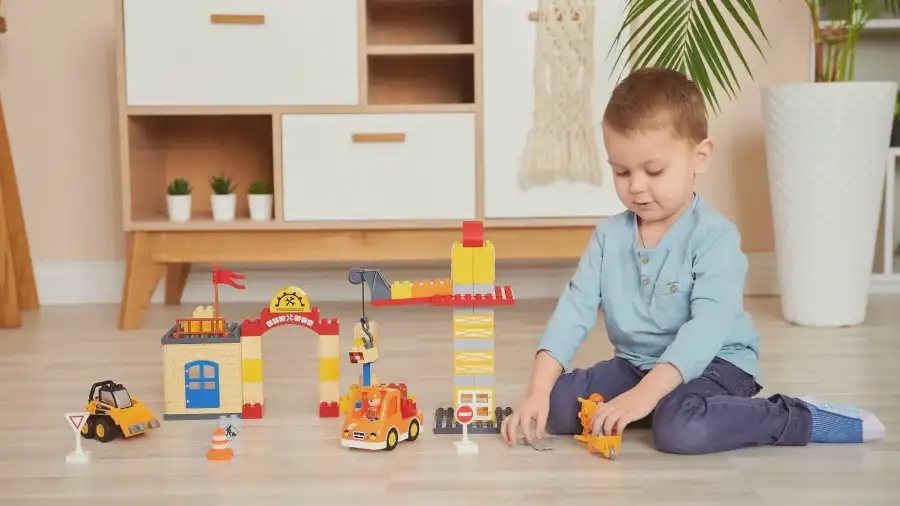
Toy age grading is a structured decision-making process that aligns a product's physical characteristics with a child's developmental skills, cognitive behaviors, and mandatory safety requirements. It is not a marketing choice used to target a demographic; it is a defensive engineering determination.
Think of age grading as "zoning laws" for toy safety. Just as you cannot build a factory in a residential neighborhood, you cannot market a complex, small-part-heavy toy to a toddler lacking the motor skills to handle it safely. This process connects child development (what they can do) with product hazards (what the toy might do to them).
The Regulatory Frameworks
To navigate compliance, you must distinguish between guidance documents (which help you choose the age) and mandatory standards (which enforce the rules).
- CPSC Age Determination Guidelines: The official U.S. staff guidance used to justify why a toy belongs in a specific age band based on anthropometric data and child psychology.
- 16 CFR Part 1501: The federal regulation strictly banning small parts in toys intended for children under 3 years old.
- ASTM F963: The comprehensive U.S. toy safety standard. Note that the scope of testing depends entirely on the age grade (e.g., a toy for 8-year-olds has different impact tests than one for 18-month-olds).
- ISO 8124-8: International guidelines useful for harmonizing global Standard Operating Procedures (SOPs).
- CPSIA Compliance: Requires manufacturers to prove safety through third-party testing and a Children's Product Certificate (CPC).
If you are currently vetting suppliers, ensure they understand how these frameworks apply to your specific product type.
Guidance vs. Mandatory Rules
A clear mental model for compliance separates subjective assessment from objective testing:
- Guidance (Subjective): You use guidelines to decide if a toy appeals to a 2-year-old versus a 4-year-old. This assesses "play value" and cognitive appeal.
- Mandatory Rules (Objective): Once the age is set, the rules become binary. If a toy is graded for 2-year-olds, it faces strict physical tests—tension, compression, and bite tests—defined specifically for that age group.
Critical Age Bands
Safety standards loosen as the child ages. The most critical threshold is the "Under-3" zone, where choking hazards are strictly regulated.
- The "Choking Hazard" Zone (0–36 Months):
- 0–6 Mos: Visual stimulation and grasping (rattles).
- 6–12 Mos: Mouthing and manipulation.
- 12–24 Mos: Mobile play and cause-and-effect.
- 24–36 Mos: Early pretend play.
- The Retail Zone (3+ Years): The small parts ban lifts, but choking hazard warning labels are mandatory.
- Older Grades (6+, 8+, 12+): Focus shifts to complex hazards like magnets, projectiles, or chemistry sets.
Quick Glossary
- Age Grade: The defensible assignment of an age group based on safety and development.
- Intended Use: How the manufacturer plans for the toy to be used.
- Reasonably Foreseeable Abuse: Conditions of use that are not "intended" but are expected (e.g., dropping a toy on concrete).
- Small Part: Any object that fits completely into the standard test cylinder (approx. 1.25 inches diameter).
- Safety Age vs. Marketing Age: Safety Age is dictated by hazards; Marketing Age is the sales target. Safety Age always overrides Marketing Age.
💡 Key Insight: Age grading is not about who wants the toy, but who has the physical and cognitive ability to interact with it safely.
Core Concepts: The Age Grading Workflow

To move from "guessing" to a defensible compliance strategy, you must treat toy age grading guidelines as an engineering workflow rather than a marketing brainstorming session. The goal is to determine the most restrictive age group that is likely to interact with the toy, and then apply the safety standards relevant to that group.
This workflow operates on a specific logic: Input (Product Specs) $\rightarrow$ Process (Abuse Testing & Development Matching) $\rightarrow$ Output (Grading & Labeling).
1. Start with a 2-Lane Decision Model
When evaluating a new product design, separate your analysis into two distinct lanes. These often contradict each other, which is where compliance risks usually hide.
- Lane A: Appeal Age (Who wants it?) This is determined by market research, aesthetics, and play patterns. Does the toy look like a cartoon character popular with toddlers? Is the difficulty level simple enough for a 2-year-old? This lane assesses "play value."
- Lane B: Safety Age (Who is safe with it?) This assesses physical hazards. Does the toy have long cords (strangulation risk)? Does it have small detachable parts (choking risk)? Does it require literacy to operate?
The Golden Rule: If the lanes disagree, the Safety Age wins. If a toy has high appeal to a 2-year-old (Lane A) but contains small magnets deemed safe only for 8+ (Lane B), you cannot simply label it "8+." The regulatory view is that a 2-year-old will access it because it appeals to them. You must either redesign the toy to remove the hazard or change the aesthetics to remove the appeal to the younger demographic.
2. The Age Grading Inputs Checklist
You cannot grade a concept; you can only grade a defined specification. Before committing to a mold, document the following inputs. This documentation is your first line of defense during a CPSC audit.
- Product Description & Play Value: How is the child supposed to interact with it? (e.g., Cuddling vs. assembling).
- Materials: Specifics matter. Is it untreated wood (splinters?), plush fabric (flammability?), or rigid plastic (impact fracture?)?
- Components & Attachments: Audit every add-on. Eyes, zippers, pull tabs, battery doors, and magnets are high-failure points.
- Packaging Cues: Imagery is part of the grade. If your box features a photo of a toddler, the product is a toddler toy legally, regardless of the text warning.
- Sales Channels: Amazon and major retailers often have automated compliance bots that flag listings based on keywords like "teether" or "baby," triggering immediate documentation requests.
3. Child Development Stages (Product Requirements)
Age grading translates biological milestones into engineering constraints. You must map your toy's features against what children are physically and cognitively capable of doing.
- Fine Motor Development: A toy requiring a "pincer grasp" (thumb and forefinger) implies an older child. A toy that can be activated by a "palmar grasp" (whole hand) appeals to infants.
- Oral Exploration: This is the highest risk factor. Mouthing peaks between 6–12 months but continues through age 3. Any toy intended for babies or toddlers must be chemically safe (lead/phthalates) and mechanically impossible to swallow.
- Cognitive Ability: Can the child follow instructions? If a puzzle is too complex, a younger child may use the pieces as projectiles rather than fitting them together.
- Strength & Force: Older children generate higher torque and tension forces. A toy graded for 6+ must withstand harder impacts than a delicate infant toy.
🧠 Inclusive Design Note: Consider diverse environments. A toy with subtle audio cues might be safe, but accessible design requires visual redundancy. Ensure labeling is clear for caregivers with varying levels of literacy or language proficiency.
4. The "Reasonably Foreseeable Abuse" Reality
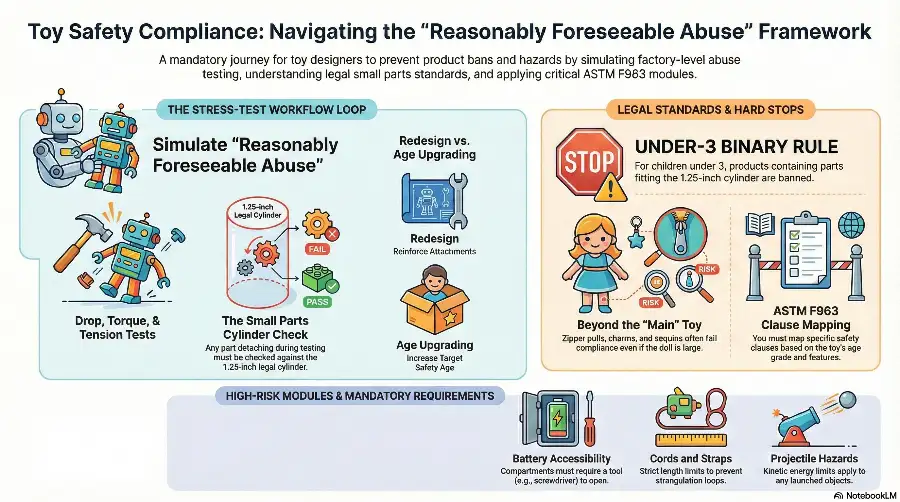
A common pitfall for designers is assuming the child will use the toy gently. The law requires you to test for "Reasonably Foreseeable Abuse." At LeelineToys, we see prototypes that look perfect on a shelf but disintegrate under the chaotic reality of a playroom.
We recommend a practical factory workflow to stress-test samples before paying for third-party lab certification:
- Drop Testing: Simulate falls from strollers, high chairs, or stairs. Rigid plastics often shatter into sharp shards (fails).
- Torque Testing: Twist every knob, limb, and wheel. If a child can twist a wooden toy component off, they will.
- Tension (Pull) Testing: This is critical for soft goods. Using a tension gauge, we pull on eyes, zipper pulls, and sewn-on accessories.
The Workflow Loop: If a part detaches during these tests, we immediately check it against the small parts cylinder. If it fits, you have two choices: redesign the attachment method (e.g., switch from glued eyes to embroidered eyes) or upgrade the Safety Age—if the appeal allows it.
Micro-CTA: If you want LeelineToys to run abuse checks (drop/torque/tension) on your PP sample before you pay for lab testing, contact us.
5. Small Parts Hazard: The "Hard Stop"
The definition of a "small part" is not subjective. It is a legal standard defined by 16 CFR 1501.
The compliance logic is binary:
- Is the toy intended for children under 3 years?
- Does it fit entirely within the test cylinder (approx. 1.25 inches in diameter)?
If the answer to both is YES, the product is banned. There is no "warning label" workaround for products intended for under-3s.
Common Competitor Gaps: Many brands overlook "secondary" small parts on soft goods and accessories. While the doll itself is large, the zipper pulls, decorative charms, toggle buttons, and sequin patches often detach during abuse testing. For custom dolls, we frequently recommend reinforcing these attachments or removing them entirely for the under-3 demographic.
6. ASTM F963 Standards: Clause Mapping
ASTM F963-23 is the current comprehensive standard for toy safety in the US. However, you do not test for every clause. You map the specific clauses to your toy's age grade and features.
High-Risk Modules Often Missed:
- Battery Accessibility: For younger grades, battery compartments must require a tool (screwdriver) to open to prevent access to coin cells.
- Cords and Straps: Strict length limits apply to prevent strangulation loops, particularly in crib toys and pull-along toys.
- Projectile Hazards: If it launches an object (even a soft one), kinetic energy limits apply.
- Stuffing Materials: Must be free of sharp contaminants.
⚙️ Under the Hood: While ASTM F963 is a "voluntary" standard in name, 16 CFR Part 1250 makes the majority of its sections mandatory under US federal law.
7. Marketing Age vs. Safety Age
This is where your internal teams may clash. Marketing wants the widest possible audience ("Ages 3+"), while Compliance needs to restrict the audience to ensure safety.
The Decision Table:
| Appeal Age (Visuals) | Safety Hazards Present | Required Action |
|---|---|---|
| Under 3 | Small Parts | REDESIGN. You cannot sell this. No warning label protects you here. |
| Under 3 | Safe (No Small Parts) | Test for Under 3. Label can say "Safe for all ages" or specific months (e.g., "18m+"). |
| 3 Years + | Small Parts | Label 3+. Must include the mandatory "Choking Hazard" warning on packaging. |
| 3 Years + | Safe (No Small Parts) | Label 3+. No choking warning required, but good practice to indicate age. |
Trust-Building Tip: If a toy appeals to 2-year-olds but has small parts, do not attempt to label it "3+" to bypass the ban. Regulators will assess the toy, not the sticker.
8. Global Alignment: CPSC vs. ISO/TR 8124-8
For brands selling into multiple markets (US, EU, GCC), creating separate products for each region is inefficient. Instead, use ISO/TR 8124-8 to harmonize your internal SOPs.
The "Lowest Age" Strategy:
- Build one internal "Lowest Age Rationale" document. If the EU standard is stricter on a specific chemical than the US, default to the stricter standard for all production.
- Create market-specific annexes for labeling. The safety of the toy remains constant, but the warnings on the box change (e.g., EN71 specific pictograms for Europe vs. text warnings for the US).
9. Output Artifacts
A compliant age grading process produces paper, not just products. Your compliance team should generate the following for every SKU:
- Age Grading Rationale Memo: A 1–2 page document citing the CPSC guidelines that justify your decision.
- Standards Matrix: A list of exactly which ASTM/EN71 clauses apply to this specific toy.
- Labeling Checklist: Verifying font size and placement of warnings.
- Pre-Production Sample Sign-off: Evidence that the "Golden Sample" passed internal abuse testing before mass production began.
Key Benefits: Transforming Compliance into Business Intelligence

Treating toy age grading guidelines as a strategic asset rather than a bureaucratic hurdle directly protects profit margins. When executed during the design phase, accurate grading serves as a preventative shield against expensive retooling and logistics paralysis.
Here is how precise age determination drives ROI.
Prevent "Under-3" Budget Explosions
The most expensive mistake in toy manufacturing is accidental scope creep into the 0–36 month age band. If regulators determine your product has "play value" for a toddler—despite your intention to market it to 5-year-olds—the compliance requirements expand instantly.
Moving a product from "3+" to "Under-3" triggers three cost drivers:
- Small Parts Testing: You become subject to the strict small parts regulation (16 CFR 1501), often forcing expensive mold retooling to eliminate choking hazards.
- Chemical Scope: Testing for phthalates and lead content becomes more rigorous, increasing lab fees by approximately 30–50% per SKU.
- Use-and-Abuse: The product must survive higher impact and torque forces without breaking.
Eliminate Market Takedowns and Enforcement Actions
Correct age grading is the foundation of lawful labeling. It dictates the mandatory warnings required on your packaging. If your age grade is wrong, your warnings are wrong, rendering the product "misbranded" under federal law.
- Marketplace Risk: Algorithms on platforms like Amazon cross-reference listed age grades against visual features. Mislabeled listings face immediate ASIN suppression.
- Border Risk: Customs inspectors prioritize shipments with conflicting age indicators (e.g., a "3+" label on a teether). This is true whether you import to the US or source via toy manufacturers in Australia, where AS/NZS ISO 8124 standards mirror global strictness.
According to the CPSC Business Guidance on Certification, a valid Children's Product Certificate (CPC) relies entirely on accurate age determination. Without it, inventory cannot legally enter the commerce stream.
Streamline Sourcing and Component Selection
Deciding on an age grade before sourcing materials functions as a hard filter for your Bill of Materials (BOM). It prevents the procurement of unusable inventory.
- 0–36 Months: You must use embroidered features or sonic-welded seams. Sourcing standard plastic safety eyes or button batteries is strictly prohibited.
- 3+ Years: You have wider access to complex mechanisms and small accessories.
Defining this early is critical for baby toy manufacturers, where safety margins are zero. It ensures engineers only select fasteners, paints, and battery doors that are legally permissible for the target demographic.
Unify Marketing and Compliance Teams
Internal friction between marketing (who desire broad appeal) and compliance (who require specific safety limits) delays product launches. A written "Safety Age Rationale" provides an objective, data-backed document that resolves these silos.
This alignment ensures marketing imagery matches the engineering reality. It prevents the costly error of designing a complex science kit but packaging it with "toddler-friendly" cartoons, which would flag the item as a high-risk choking hazard during retail audits.
📈 ROI Check: Redesigning a product after a failed lab test costs significantly more than initial engineering adjustments. Lock in your age grade before cutting steel for molds.
Need a pre-compliance review before placing a bulk PO? Talk to LeelineToys about materials, attachments, and age-grade risk. Contact us here.
Challenges & Limitations: The Reality of Age Grading
Accurate age grading is not a static administrative task; it is a dynamic legal definition that often conflicts with marketing goals and manufacturing realities. Even with good intentions, brands frequently encounter friction points where theoretical grades fail against regulatory enforcement or algorithmic audits.
Challenge 1: The "Appeal Age" Trap
A common failure occurs when a product's Safety Age conflicts with its Appeal Age. A toy may be labeled "3+" to avoid strict small parts regulations, but if its physical characteristics—soft textures, rounded edges, or themes like farm animals—implicitly signal it is for a toddler, regulators will reject the label.
CPSC staff and customs inspectors evaluate play value, not just box copy. If a product visually appeals to a child under 3, it is legally subjected to "Under 3" testing standards. If it fails the small parts test, the shipment can be seized regardless of the warning label.
Challenge 2: Foreseeable Abuse is Not Hypothetical
Age grading is indefensible if it assumes the child will use the toy strictly as intended. Safety standards require testing for "reasonably foreseeable abuse." Parts that survive normal play often fail under the chaos of a real playroom.
Common Breakage Pathways:
- Twisting: Limbs or knobs rotated 180 degrees.
- Tension: Pulling force applied to sewn-in eyes or zipper tabs.
- Impact: Repeated drops onto concrete surfaces.
⚠️ Critical Warning: Do not rely on a hand-assembled "Golden Sample." Factory-line units must undergo abuse testing, as variations in glue quality or sonic welding can alter the safety profile. If you want a factory-side stress test (drop/torque/tension) before paying for third-party lab submission, contact LeelineToys.
Challenge 3: Marketing vs. Safety Conflicts
Internal friction often arises between marketing teams seeking a wide audience and compliance officers seeking legal safety. Marketing may push for an "Age 4-8" band to capture siblings, while compliance identifies a hazard restricting the toy to "8+."
There is no middle ground: the strictest safety age dictates the labeling. Negotiating safety for market positioning creates a direct pathway to product recalls.
Challenge 4: Cross-Market Certification Gaps
Expanding globally introduces "certificate confusion." An EN71 test report (Europe) does not satisfy ASTM F963 (USA) requirements, and neither satisfies GCC standards automatically. While ISO/TR guidelines help harmonize the logic of age determination, they do not override local mandatory testing protocols. Relying on a single test report for multiple territories frequently leads to customs delays.
Challenge 5: Documentation & Marketplace Algorithms
Administrative failures can block sales as effectively as safety failures. E-commerce platforms, particularly Amazon, utilize automated enforcement bots that flag inconsistencies.
- Keyword Traps: Using keywords like "baby," "teether," or "infant" in a listing for a product labeled "3+" creates a contradiction. Algorithms will suppress the listing until you produce a test report confirming safety for infants.
- Missing Traceability: Brands often overlook CPSC requirements on tracking labels. A missing Children's Product Certificate (CPC) or untraceable batch codes will flag audits.
🛡️ Mitigation: Use the CPSC Regulatory Robot to identify exactly which requirements apply before listing. When you're unsure if your supplier can support this level of documentation, start with a rigorous supplier evaluation process.
The Verdict: Compliance is an Engineering Decision
Ultimately, age grading is not a marketing strategy used to widen your demographic; it is a rigid compliance decision that dictates the engineering constraints of your product. It determines your small parts acceptability, defines the severity of mechanical abuse testing, and mandates specific warning labels. Get this wrong, and you risk not just certification failure, but product recalls and customs seizures.
To move from subjective guessing to objective safety, follow this final decision framework before opening molds.
The 6-Point Age Grading Checklist
- Separate Appeal from Safety: Distinguish the Appeal Age (who wants it) from the Safety Age (who can safely handle it). If they conflict, Safety Age wins.
- Justify the Lowest Band: Use CPSC or ISO guidance to document a written rationale for the lowest age band your product targets.
- Stress-Test the Prototype: Run physical abuse checks (drop, torque, and tension tests) on pre-production samples to reveal parts that detach under force.
- Audit Detached Parts: Immediately check any component that falls off against the small parts cylinder (16 CFR 1501).
- Map the Standards: Correlate specific ASTM F963 clauses and CPSIA requirements to your final age grade—do not test for standards that don't apply.
- Lock the Messaging: Audit your packaging, Amazon listings, and labels to ensure they do not visually imply a younger age than your safety grade allows.
Further Resources
- For specific guidance on soft goods safety standards: Custom Plush Program
- If targeting the strict 0–36 month sector: Baby & Toddler Manufacturing
- To vet suppliers on their compliance capabilities: Factory Selection Guide
Want LeelineToys to review your design for foreseeable abuse + small parts risk before you commit to tooling or lab testing? Contact us here.