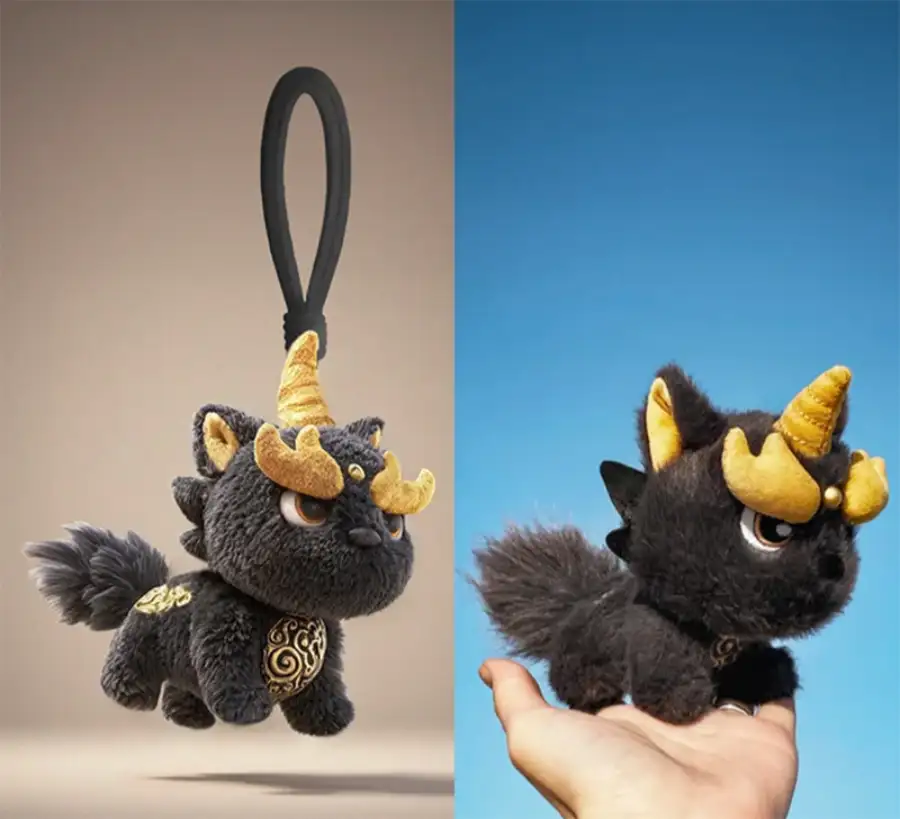

It depends, though pricing always splits into one-time setup ($1,200–$2,500 for patterns, prototypes, and testing) and per-unit production. For China plush OEM, expect $7–$12 at 500 units, dropping to $2.50–$4.50 at 10,000+ units. Public estimates are broad; accurate landed costs require a finalized spec pack. If you want a fast ballpark, use our MOQ explainer and send artwork for a quote.
Key Takeaways
- Complexity Drives Labor: More pattern pieces increase sewing minutes and unit cost. Control: Simplify limb shapes to reduce seam length and lower the Cost to Make Custom Plushies at scale.
- Materials Dictate Price: High-GSM fabrics and embroidery cost significantly more than prints. Control: Standardize fabrics across characters to bulk-buy raw materials.
- MOQ is Per SKU: Splitting 2,000 units into 4 designs equals 4 expensive short runs. Control: Consolidate variants to hit higher efficiency tiers.
- Prototyping is Sunk Cost: Expect 2–3 revision rounds ($100–$300/sample). Control: Submit detailed spec packs upfront to minimize iterations.
- Compliance Fees are Fixed: Lab tests (ASTM/EN71) cost ~$500–$1,500 per SKU regardless of volume. Control: Amortize costs over larger initial orders.
- Volume Kills Margins: Plushies trigger high volumetric shipping rates. Control: Require vacuum-compressed packaging to reduce carton size by 60%.
Golden Rule: Ignore "FOB price." Calculate Landed Cost (Production + Molds + Shipping + Duty). A low unit price is meaningless if logistics and setup fees drown your profit.
Detailed Breakdown: The Economics of Plush Manufacturing
Factory pricing is not a guess; it is a calculation of material consumption, labor minutes, and fixed setup fees amortized over volume. To accurately budget for the Cost to Make Custom Plushies , you must distinguish between the unit price (FOB) and the total capital required to land the goods at your warehouse.
1. The Pricing Model Factories Actually Use
Manufacturers determine the FOB (Free On Board) unit cost using a strict formula. This price covers the product up to the Chinese port, but excludes shipping to your door.
FOB Unit Cost ≈ (Materials + Labor Minutes + Factory Overhead + Packaging + Margin) / Total Units
However, the Total Project Cost—the actual capital required—includes "below the line" expenses:
Total Project Cost = Setup Fees (Design + Molds + Testing) + (FOB Unit Cost × Quantity) + Freight + Duties + Destination Handling
Worked Example: The "Standard 10-Inch Bear"
Fixed setup costs (roughly $1,500 for patterning, sampling, and safety testing) significantly skew the unit price at lower volumes.
| Scenario | Quantity | Setup Costs (Fixed) | Production Cost (Variable) | Real Cost Per Unit |
|---|---|---|---|---|
| Test Run | 500 units | $1,500 | $4,000 ($8.00/unit) | $11.00 |
| Growth | 2,000 units | $1,500 | $12,000 ($6.00/unit) | $6.75 |
| Scale | 10,000 units | $1,500 | $40,000 ($4.00/unit) | $4.15 |
(Analysis: Moving from 500 to 10,000 units reduces the effective cost per unit by over 60% because fixed setup fees are spread across a larger production run.)
2. Setup Costs (One-Time / Per SKU)
These fees validate the engineering and safety of the product before mass production begins.
A) Design Fees (Concept → Production-Ready)
If you do not provide a manufacturing-ready pattern, factories charge to translate 2D art into 3D geometry. This fee covers vector cleanup, Pantone mapping, and the creation of the Tech Pack—the technical blueprint used on the assembly line. Complex designs (multi-panel bodies, gussets, appliqué) require more engineering time than simple pillow shapes.
B) Prototype & Sample Fees
Sample fees ($100–$300) exist because they disrupt the production line. A single sample requires a senior technician to manually pattern, cut, sew, and stuff the prototype.
- Revisions: Includes 1–2 rounds of adjustments.
- Refund Policy: At LeelineToys, sample fees are deductible from the bulk deposit, effectively making the sample free if you proceed to production.
C) Compliance Testing & Safety Validation
Retail entry requires strict safety validation per material set.
- Internal Protocols: Before third-party lab submission, factories perform a Pull Test (ensuring eyes/noses withstand 20 lbs of tension) and a Small Parts Cylinder check to prevent choking hazards.
- Lab Fees: Official certification (ASTM F963 for US, EN71 for EU) is paid to accredited labs like SGS or Intertek.
- Resources:
3. Per-Unit Costs (The Variable Factors)
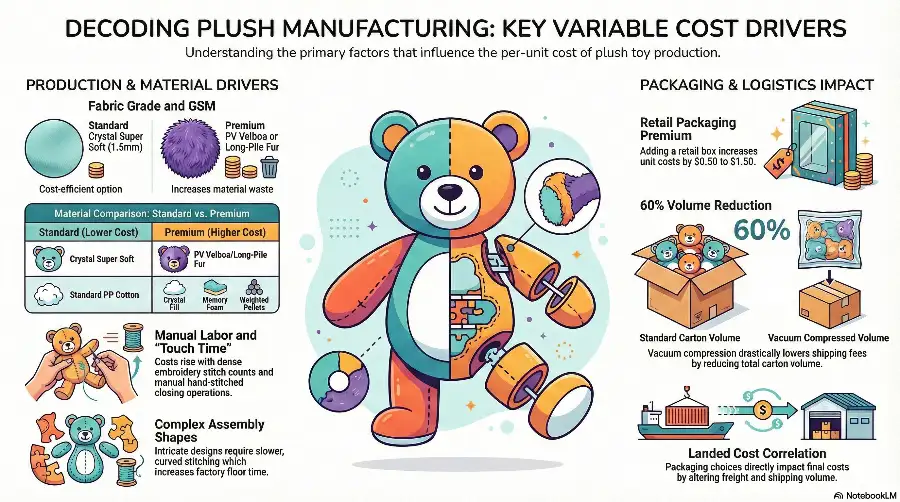
This is the variable cost most buyers compare.
A) Fabric and Filler Specs
Price correlates with GSM (Grams per Square Meter) and pile height.
- Standard: Crystal Super Soft (1.5mm pile) is the industry standard for cost-efficiency.
- Premium: PV Velboa or Long-Pile Fur increases costs due to higher GSM and directional cutting waste.
- Fillers: Standard PP cotton is the baseline. Adding memory foam, plastic pellets for weight, or wire armatures increases material cost.
B) Labor (The Factory Floor View)
Plush manufacturing relies on manual dexterity. Costs are driven by the number of sewing operations and "touch time."
- Embroidery: Dense stitch counts increase machine runtime.
- Assembly: Complex shapes require slower, curved stitching.
- Closing: The final "ladder stitch" is often done by hand.
- Grooming: Brushing seams to release trapped fur ensures a premium finish.
C) Packaging and Labeling
Packaging impacts the Landed Cost by altering shipping volume.
- Retail Box: Adds $0.50–$1.50/unit and increases freight volume.
- Vacuum Compression: Compressing plush toys reduces carton volume by up to 60%, drastically lowering shipping fees.
4. MOQ and Production Rates
Minimum Order Quantity (MOQ) dictates your leverage and unit price.
| Volume Tier | Price Trend | Lead Time | Logic |
|---|---|---|---|
| 500 Units | High | 15-20 Days | Uses stock market fabric colors only. |
| 2,000 Units | Moderate | 30-35 Days | Unlocks custom dyeing (Pantone matching). |
| 10,000+ Units | Lowest | 45+ Days | Unlocks custom molds and priority scheduling. |
Note: 2,000 units of one SKU is cheaper than 500 units of four colors. Each color change requires cleaning dye vats or re-threading machines, treating each color as a separate setup
5. Freight & Logistics: FOB vs. Landed Cost
A factory quote is usually FOB (Free on Board). You must calculate the landed cost based on your shipping method.
- FOB: The factory delivers to the port. You control the freight forwarder and assume risk from that point.
- DDP (Delivered Duty Paid): The forwarder handles shipping, customs, and duties, delivering directly to your door. This is recommended for e-commerce sellers seeking a fixed "all-in" price.
> The Science of Waste Reduction: Modern factories use Optitex software to visualize patterns in 3D. This allows for digital "nesting"—arranging pattern pieces on the fabric roll like a puzzle to maximize yield. Better nesting reduces fabric waste, directly lowering the material cost per unit.
Exceptions & Scenarios: When Standard Pricing Rules Don't Apply
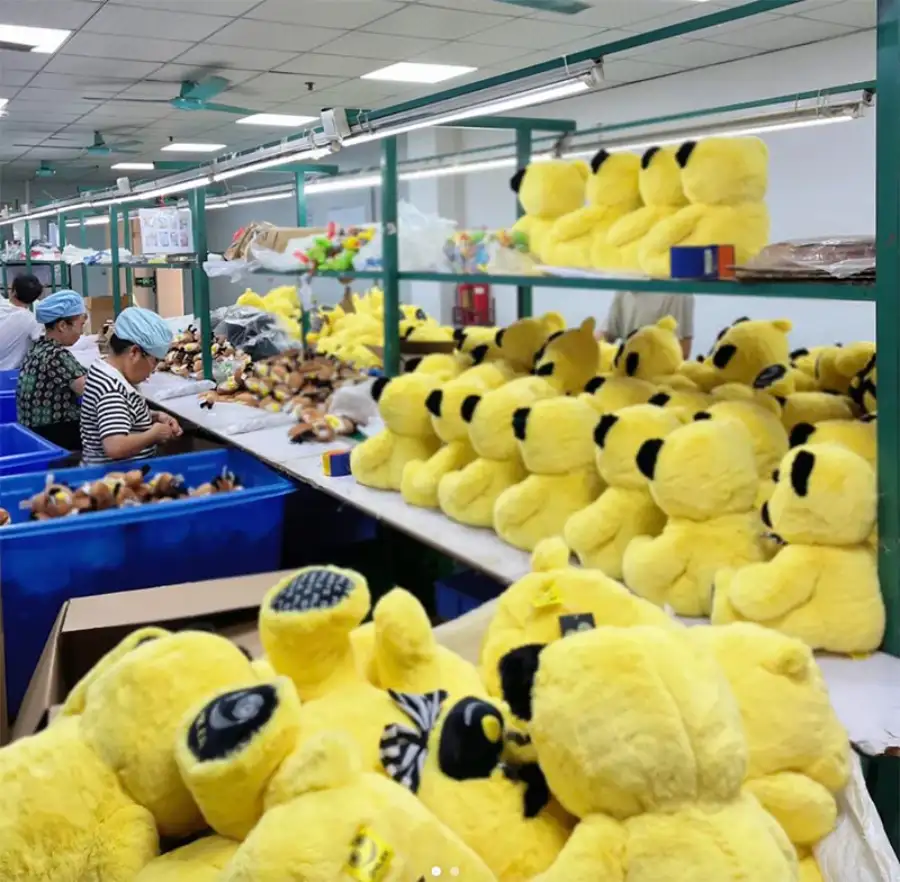
Standard pricing formulas work for generic retail, but specific business models and material choices introduce variables that break the math. Ignoring these constraints is the primary cause of budget overruns.
For Crowdfunding Creators (Kickstarter/Indiegogo)
The Deadline Trap: Campaigns often fail because creators budget for production (30 days) but ignore the "Unseen Weeks."
- Buffer Rule: Build a 45-day buffer into your promised delivery date. This accounts for sample approval rounds (2–4 weeks), safety testing (1 week), and port congestion.
- Milestone Payments: Never pay the full balance upfront. Structure terms as: Deposit → Sample Approval → Pre-Production Sample (PP) → Balance.
⚠️ Cashflow Warning: Freight rates fluctuate weekly. If you collect shipping funds in January but ship in September, a rate spike can wipe out your margin.
For Corporate Procurement Managers
The Compliance Trap: Unlike small runs, your primary risk is audit failure, not just unit cost.
- Documentation: Demand a full "Compliance Pack" before production begins: Bill of Materials (BOM), Material Safety Data Sheets (MSDS), and batch traceability codes on the sewn-in label.
- Retest Policy: Define who pays for failure. If a batch fails a third-party lab test (e.g., SGS or Intertek), the factory must cover the retest cost and material replacement.
First-Time Creators vs. Established Brands
- First-Time Creators: Simplify construction. A character with 20 pattern pieces and 4 fabric types requires high MOQs. Stick to standard pile lengths (1.5mm–5mm) and reduce limb complexity to lower entry costs.
- Established Brands: Consolidate components. If launching 5 SKUs, use the same base fabric color for all bodies. This aggregates the material order to hit volume discounts, reducing waste.
Regional Requirements (US vs. EU vs. AU)
Geography determines legal friction. A toy compliant in Texas may be illegal in Paris.
- United States: You must comply with CPSC requirements, specifically permanently affixed Tracking Labels identifying the date and location of production.
- European Union: Requires the CE Mark and stricter chemical limits under EN71 standards. Multi-language packaging is often mandatory.
- Verify your target market rules:
For Weighted Plush & Specialty Fill
Physics impacts your margins.
- Weighted Plush: Replacing cotton with weighted pellets increases shipping costs drastically. Freight is often charged by density/weight, meaning a small heavy bear costs more to ship than a large light one.
- Memory Foam: Unlike standard stuffing, memory foam requires expensive aluminum tooling (molds) rather than simple fabric cutting.
The Hidden Cost to Make Custom Plushies Checklist
Avoid "sticker shock" by asking if these line items are included or estimated.
| Cost Item | The "Gotcha" Detail |
|---|---|
| Sample Courier Fees | International express (FedEx/DHL) is rarely included in the sample fee. |
| Revision Rounds | 3rd+ revisions usually trigger new prototyping fees. |
| Lab Retests | If the product fails safety testing, who pays for round two? |
| Carton Drop Tests | Mandatory for major retailers (Walmart/Target); often an extra QC charge. |
| Peak Season Surcharges | Freight rates spike in Q3/Q4 (Pre-Christmas). |
| Destination Fees | Port handling, customs broker fees, and trucking to your door. |
| VAT & Duties | specifically for EU/UK imports (20%+) or US Tariffs. |
Strategic Instruction: Ask suppliers to quote FOB (for comparison) and DDP (for budgeting). Explicitly ask them to list what is excluded from the DDP price (e.g., lift-gate fees or residential delivery).
Need a landed-cost quote that accounts for compliance and logistics? Contact us directly for a project review.
People Also Ask About Cost to Make Custom Plushies
1. What's the cheapest way to make custom plushies?
Simplify your design. To lower costs, reduce the number of pattern pieces, use standard stock fabrics instead of custom-dyed colors, and minimize complex accessories like outfits or zippers. Increasing your Minimum Order Quantity (MOQ) also significantly lowers the unit price by amortizing setup fees across more toys.
2. How much does a plush toy prototype cost—and is it refundable?
Prototypes typically cost between $100 and $300 depending on complexity. This fee covers the technician's time to pattern, cut, and sew the initial sample. Yes, the sample fee is usually refundable (deducted from the final invoice) once you place a bulk production order meeting the factory's minimums.
3. What MOQ should I expect for a custom plush manufacturer in China?
Most factories require 500 to 1,000 units per SKU. While some plush toy manufacturers accept lower "test runs" (e.g., 100 units), the unit price will be significantly higher to cover fixed setup costs. Note that 1,000 units split across four different character designs counts as four separate small orders, not one bulk order.
4. What's included in a factory per-unit price (FOB) vs an all-in DDP quote?
FOB (Free On Board) only covers manufacturing and delivery to the Chinese export port; you are responsible for freight, insurance, and customs. DDP (Delivered Duty Paid) is an "all-in" price that includes production, sea freight, customs clearance, and delivery to your door. Always confirm if lift-gate or residential delivery fees are excluded.
5. How do safety eyes and small parts affect cost and compliance?
Hard plastic eyes (safety eyes) increase costs because they require reinforced washers and mandatory pull-testing to ensure they cannot be detached by a child. Embroidered eyes are often cheaper and inherently safer for infant products. For specific regulations, review: safety eyes for toys.
6. How long does bulk plush production take (sampling → mass production → shipping)?
A typical project takes 3 to 4 months from concept to delivery. Sampling and revisions take 2–4 weeks, mass production takes 30–45 days, and ocean freight adds another 30–40 days. Timelines extend during peak seasons (Q4) or if designs require multiple rounds of prototyping iterations.
7. How do I get an accurate quote (what should I send a factory)?
To avoid vague ranges, send a complete Tech Pack. This must include high-resolution artwork (front, side, and back views), specific dimensions, preferred materials (e.g., long-pile vs. short-pile), and your target quantity. See our guide on preparing files here: custom toy manufacturing.
Send your artwork + target MOQ + market (US/EU) for a factory-ready quote.