Finding the best toy manufacturers in Australia requires navigating a complex market. Most options here are a mix of niche producers, brand owners, and wholesale distributors.
You need a partner who meets strict AS/NZS ISO 8124 safety standards without destroying your margins. This shortlist breaks down verified suppliers by MOQ, private label potential, and lead times.
(Read our primer on how to find a toy manufacturer if you are just starting.)
List of Top 12 Toy Manufacturers in Australia
| Manufacturer | Location | Specialty | Notable Products | Key Highlights |
|---|---|---|---|---|
| Moose Toys | Cheltenham, Victoria (Melbourne area) | Innovative toys, collectibles, games | Shopkins, Num Noms, Magic Mixies, Squishmallows (distribution) | Australian-owned global powerhouse, founded 1985, award-winning designs |
| Geo Australia | Sunshine, Victoria | Educational & novelty toys | GeoSafari, various science kits | Focus on learning through play, STEM-inspired |
| Windmill Toys | Silverwater, New South Wales | Wooden & sustainable toys / Australiana plush | Classic wooden toys, puzzles, plush | Emphasizes eco-friendly, durable playthings; leader in Australiana plush |
| CA Australia | Brookvale, New South Wales | Children's toys & accessories | Various licensed & original lines | Known for quality Australian-market focus |
| Johnco Productions | Frenchs Forest, New South Wales | STEM, educational & art/craft toys | 4M, Avenir, Scratch Europe, Poly M | Award-winning wholesale distributor & brand, ignites imagination |
| Eleganter Australia | Slacks Creek / Brisbane, Queensland | Elegant & premium children's toys | Stylish dolls, playsets, wooden toys | High-quality, design-focused for kids; wholesale & importer |
| OB Designs | Ingleburn / South Murwillumbah area, New South Wales | Plush toys, baby & toddler gifts | Stuffed animals, muslin wraps, teethers | Family-owned since 2008, sustainable & beautiful designs |
| Village Toys | Gerringong, New South Wales | Australian-made toys & gifts | Locally crafted wooden & novelty items | Supports Aussie manufacturers, curated selection; family business |
| Stuffed With Plush Toys | Australia-wide (specific HQ not widely listed; plush-focused operations) | Plush toys & soft toys | Custom & classic stuffed animals | Specializes in cuddly, high-quality plush |
| Jasnor Australia | Various (Australasia distribution; main ops in Australia) | Quality toys & gifts | Plush, licensed products | Long-established distributor & manufacturer for Australasia |
| Banter Toys & Collectibles | Australia (emerging; specific location varies) | Collectibles & fun toys | Various novelty & collectible lines | Emerging player in Australian toy manufacturing |
| Australian Design Group | Australia (board games focus; ops across states) | Board games & strategy toys | Popular Australian board games | Focus on family & educational games |
Best 10 Toy Manufacturers in Australia
Discover the best Toy Manufacturers in Australia for quality and value – compare trusted brands, spot top deals, and find your next bestseller.
1. Moose Toys — Best for Licensed Brand Distribution
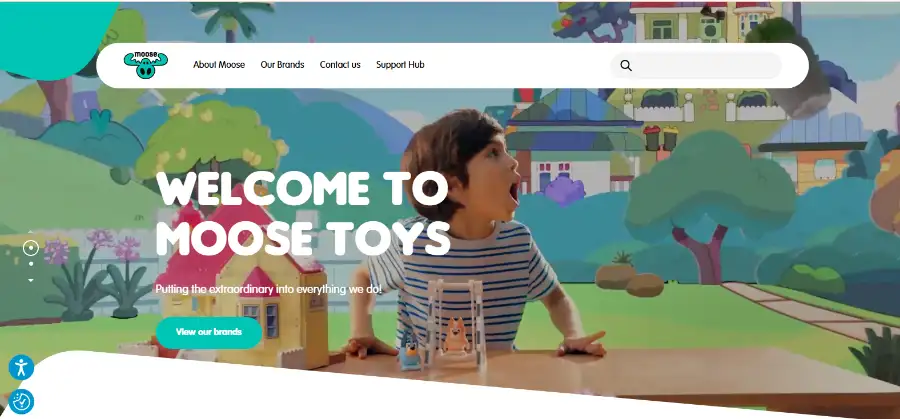
Moose Toys is not a contract factory for custom prototypes. They are a global brand powerhouse based in Melbourne, responsible for massive retail hits like Magic Mixies and Bluey. Choose this route if you need inventory that sells itself through established consumer demand rather than manufacturing your own designs.
What You Get: Access to wholesale portfolios of high-velocity licensed IP. You aren't buying production capacity; you are buying finished goods backed by global marketing campaigns.
Sourcing Logistics:
- Account Setup: Requires a valid business license and retail footprint. Apply directly or via major distributors.
- Allocations: Stock for "hot" Q4 lines is often allocated based on volume. Place orders 6–9 months in advance to secure inventory.
Compliance: Big brands still get flagged by e-commerce bots. Always request the Certificate of Conformity (CoC) and test reports against AS/NZS ISO 8124 safety standards. Verify specific labeling requirements via Product Safety Australia before sending stock to fulfillment centers.
Watch-outs: You have zero control over packaging or design. If you need custom tooling or private label production, view our guide to baby toy manufacturers in Australia for flexible alternatives.
⚡ Power Move: Don't rely solely on licensed IP. Use high-turnover Moose products to drive cash flow while developing higher-margin custom items to build your own asset value.
2. Geo Australia — Best for Australian‑Made Educational Plastic Toys (Injection Moulded)
For education tenders and government contracts, Australian Made certification is often a hard requirement. Geo Australia solves this by handling the entire production lifecycle—tooling, moulding, packing, and warehousing—directly from their Melbourne facility.
This local control offers supply chain security that importers cannot match. If you are sourcing wholesale educational toys Australia, their catalogue is the industry standard for math manipulatives, STEM connectors, and sorting counters.
Compliance & Safety: Since Geo controls the input materials, you get full transparency. You can request evidence of AS/NZS ISO 8124 safety compliance and verify the use of food-contact grade resins. This is critical for early learning centers where toys often end up in mouths.
Sourcing Logic
- The Model: This is a trade supply model. You buy existing catalogue configurations (like classroom packs) rather than custom OEM designs.
- The Limit: They specialize in rigid injection-moulded plastics. Skip this manufacturer for plush or soft goods.
If your procurement list requires natural materials instead of plastic, review our capabilities as a custom wood toy manufacturer.
🚀 Actionable Insight: Leverage their "Australian Made" status to win government school tenders. Explicitly list their Melbourne manufacturing address in your bid proposals to score higher on local procurement weightings.
3. Windmill Toys — Best for Quality Educational Toys and Learning Resources from Early Years to Primary
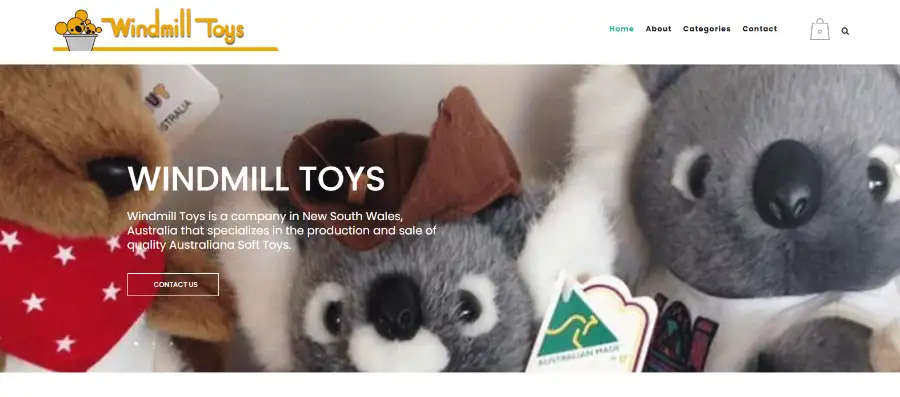
Best for: Souvenir shops, museum stores, and gift retailers.
Windmill Toys dominates the "Australiana" niche. They supply realistic kangaroos, koalas, and wombats that feel authentic rather than cheap. This is the standard inventory for high-traffic tourist destinations, such as airport gift shops.
How to Order. Their toy manufacturers in Australia use a traditional network of state-based agents. You cannot simply click and buy wholesale online. You must connect with a local rep to view the full catalogue and negotiate pricing. While online visibility is limited, this trade-focused approach ensures better support for large orders.
Compliance Checklist Plush toys face strict import and safety rules. Always request AS/NZS ISO 8124 test reports covering:
- Tension and Torque: Ensures eyes and noses won't detach (choking hazard).
- Flammability: Mandatory for soft toy materials.
- Seam Strength: Prevents access to fibrous filling.
The Limitation: Windmill sells existing stock designs. If you need fully bespoke characters or own the IP, this model won't fit. For custom manufacturing, read our guide for plush toy buyers exploring custom programs.
🚀 Actionable Insight: Ask about "custom tagging" on stock items. You can often attach your museum or shop branding to their existing animals. This offers a private-label look with much lower minimum order quantities (MOQs) than a full custom production run.
4. CA Australia — Best for Eco‑Positioned Plush and Display‑Ready Plush Programs
CA Australia bridges the gap between premium plush and verified sustainability. They function as a wholesale distributor, not a contract manufacturer.
This means you buy established lines with ready-made eco-narratives—specifically plush toys with 100% recycled PET filling—rather than designing from scratch. This is the fastest way for retailers to stock green inventory backed by professional merchandising displays.
Sustainability Due Diligence: Do not rely on green hangtags alone. To avoid "greenwashing" liability, your procurement process must validate the supply chain data.
- Verify Claims: Clarify exactly which parts are recycled. Often, "100% recycled" applies only to the inner fill, not the outer fabric.
- Request Proof: Demand Global Recycled Standard (GRS) transaction certificates to prove the material origin.
- Traceability: Ensure batch codes link the finished plush to the specific recycled material lot for ACCC compliance.
The Limitation: CA Australia distributes pre-designed brands. They do not manufacture custom characters. If you need to produce your own eco-friendly IP, you require an OEM partner. Review our guide on custom plush manufacturing for that specific workflow.
🚀 Actionable Insight: Request their "floor stand" merchandising packages immediately. High-visibility branded displays typically double sell-through rates compared to standard shelf stocking.
5. Johnco Productions — Best for STEM and Educational Toy Ranges (Wholesale Distribution)
Johnco is a wholesale distributor, not a factory. They are the fastest way to build a credible "Science & Tech" category. You get immediate access to award-winning robotics, coding, and DIY science brands without the long lead times of custom manufacturing.
Best For: STEM retailers, museum shops, and school suppliers needing instant catalogue breadth.
How to Buy: Register for a trade account. Once approved, leverage their "pack offers"—curated bundles of best-selling SKUs that fill shelves instantly without guesswork. Ask about drop-shipping options to further reduce your inventory risk.
Compliance Alert: STEM kits are high-risk due to included chemicals, magnets, and batteries. Request specific Safety Data Sheets (SDS) and test reports for every SKU. Ensure they meet Australian mandatory standards for age grading before stocking.
The Limitation: You cannot private-label these items. You are selling established brands, not building your own equity. If you want to create custom STEM products with your own logo, read our guide on how to find a toy manufacturer.
🚀 Retail Strategy: Use Johnco to test category demand with small volumes. Once you identify a winning niche (like "solar robotics"), switch to a direct manufacturing partner to produce your own higher-margin version.
6. Eleganter Australia — Best for Wooden Toys, Early Learning, and Retail‑Ready Gift Ranges (Wholesale)
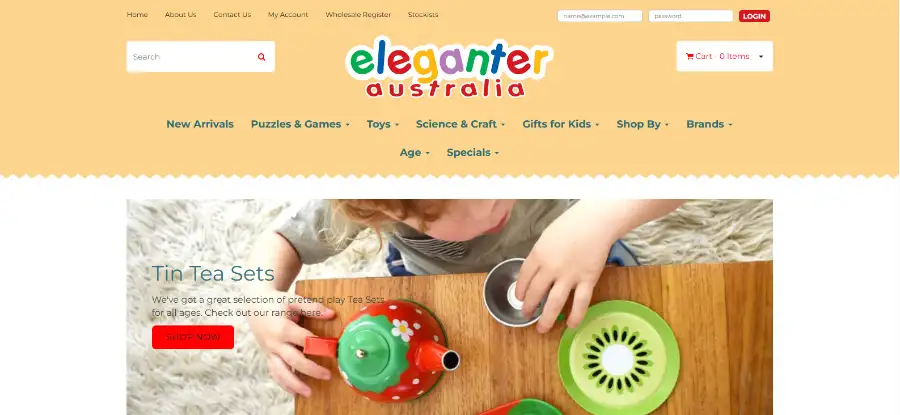
Eleganter solves the quality control headache often associated with wooden toy sourcing. They provide a curated, retail-ready wholesale catalog focusing on educational values, allowing shops to bypass manufacturing lead times.
Best For: Boutique gift shops and childcare suppliers seeking "Montessori-style" inventory.
What They Offer: They distribute trusted brands like Kaper Kidz. The range covers wooden puzzles, musical instruments, and educational arts & crafts. Note that this is a strict B2B model. You must register for a trade login and prove your business status (ABN) to view pricing or place orders.
Compliance & Safety: Wooden toys face strict chemical scrutiny. Paints and varnishes must be non-toxic. When sourcing here, always request documentation confirming compliance with AS/NZS 8124 (Safety of Toys), specifically regarding heavy metal migration in surface coatings.
The Watch-out: Eleganter is a distributor, not a factory. You are buying their brands, not making your own. You cannot alter the designs or packaging. If you need to produce unique wooden toys with your own branding, you need an OEM partner. See our capabilities as a custom wood toy manufacturer for that specific path.
🚀 Actionable Insight: Audit their "New Arrivals" section weekly. Popular wooden SKUs often sell out quickly, and because Eleganter relies on import cycles, the next replenishment shipment may take up to 12 weeks to arrive.
7. OB Designs — Best for Boutique Plush & Eco-Conscious Retailers
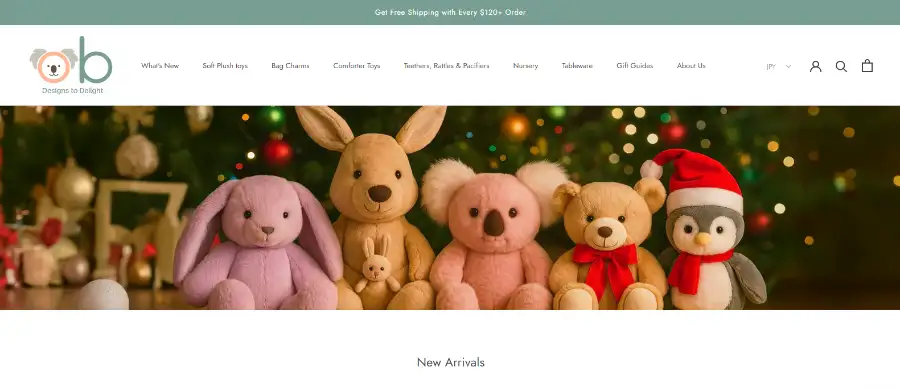
OB Designs delivers the soft-palette, "Instagram-ready" aesthetic essential for modern nursery boutiques. They are the go-to toy manufacturers in Australia option for retailers who need premium, shelf-ready plush without investing in design R&D.
The Sourcing Model: This is a stockist relationship, not manufacturing. You apply for a trade account to buy finished inventory. You cannot alter the designs or apply private labels; you are buying the brand story along with the product.
Due Diligence: Safety & Eco-Claims In the baby segment, safety documentation is more important than aesthetics. You must verify compliance with AS/NZS ISO 8124 Part 1 (Safety of toys). Explicitly request test reports confirming tension tests on small parts like eyes and buttons to prevent choking hazards, as mandated by Product Safety Australia.
Furthermore, validate "eco-friendly" marketing with hard data. Ask for the specific material breakdown—specifically if the plush fill is certified 100% recycled PET—and verify that dyes are formalide-free.
When to Switch: If you require custom branding or unique mechanisms, this wholesale path won't work. You need a manufacturing partner. Review our deep dives on custom teddy bear production and plush toy material types to understand the OEM process.
🚀 Retail Strategy: Use OB Designs to validate demand for eco-plush in your store. Once specific SKUs hit consistent volume (e.g., 500+ units/month), move those designs to an OEM manufacturer to double your net margin.
8. Ikon Collectables - Best for Licensed Pop Culture Merchandise and Collectible Toy Ranges
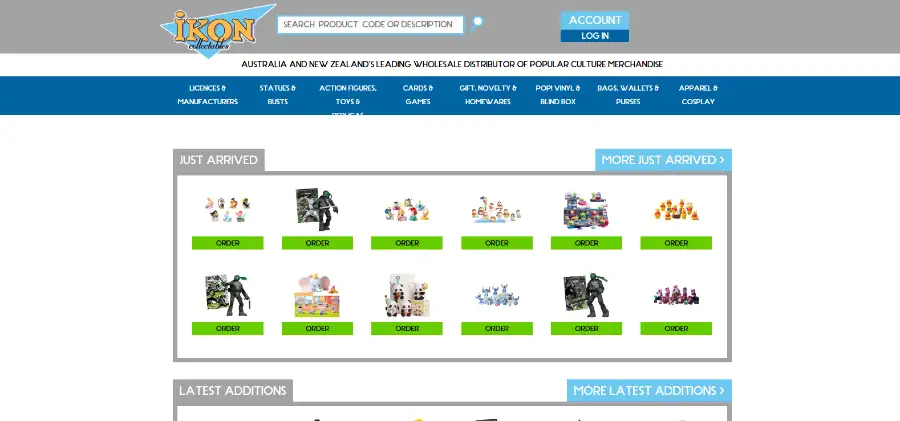
Best for: Comic book stores, hobby shops, and e-commerce sellers focused on the adult collector market.
Ikon acts as a wholesale distributor rather than toy manufacturers in Australia. They connect retailers with licensed pop-culture merchandise—from premium resin statues and prop replicas to blind-box figures. This provides immediate supply chain access to franchises like DC Comics, Harry Potter, and major anime hits without the headache of negotiating individual licensing deals yourself.
The commercial model: Success here relies on the "pre-order" cycle. Ikon lists items months before release. Smart retailers presell this inventory to their own customers, often using end-consumer deposits to fund the wholesale purchase. This model drastically reduces the cash flow risk typical of holding static inventory.
Compliance is mandatory: Do not assume "adult collectibles" are exempt from safety laws. If a product has "play value" for children, ACCC product safety guidelines still apply. You must request AS/NZS ISO 8124 documentation for any item that crosses the line between display piece and toy.
The limitation: You cannot private-label licensed goods. If you want to build asset value by creating your own character IP, you need an OEM partner. See our guide on custom anime plush manufacturing to start your own line.
⚡ Power Move: Sync your store with Ikon's release calendar. Launch pre-orders 48 hours before the wholesale cutoff to gauge exact demand without committing your own capital to excess stock.
9. Village Toys - Best for Wooden, European‑Style and Steiner‑Inspired Toys
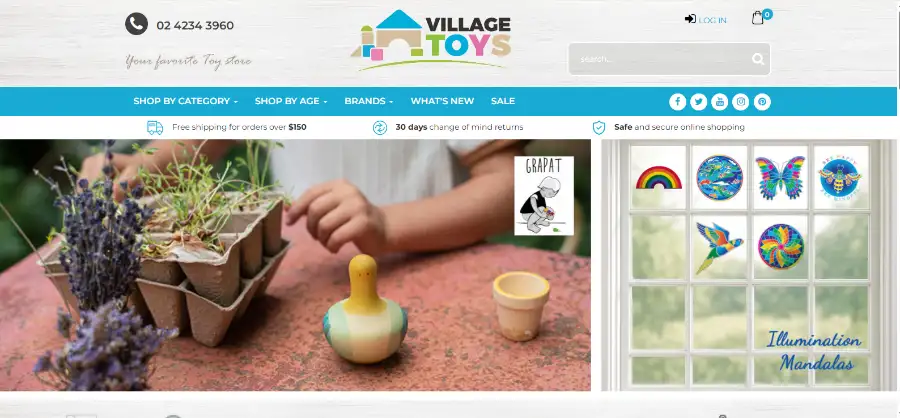
Village Toys isn't a manufacturer. They are a premier specialty retailer. Smart buyers use their catalog as a market research tool to benchmark quality standards before sourcing elsewhere.
Best For: Benchmarking high-demand categories in the specialty educational market.
How to Use This for Sourcing: Treat their inventory as a cheat sheet. They strictly curate Steiner-style and wooden toys, filtering out cheap plastics. Analyze their "open-ended play" categories to identify proven sellers. Use their retail prices to reverse-engineer the unit costs you need to hit for a healthy margin.
Compliance Reality Check: Retail marketing text is not legal documentation. A website claiming "non-toxic" protects the consumer, not the reseller. You must secure valid AS/NZS ISO 8124 safety reports and ensure alignment with ACCC mandatory standards directly from the supply source.
The Watch-out: This is a B2C storefront. To get wholesale pricing, you must identify the specific brands they stock and open trade accounts with the underlying distributors.
10. Stuffed With Plush Toys — Best for In‑Stock Plush Inventory
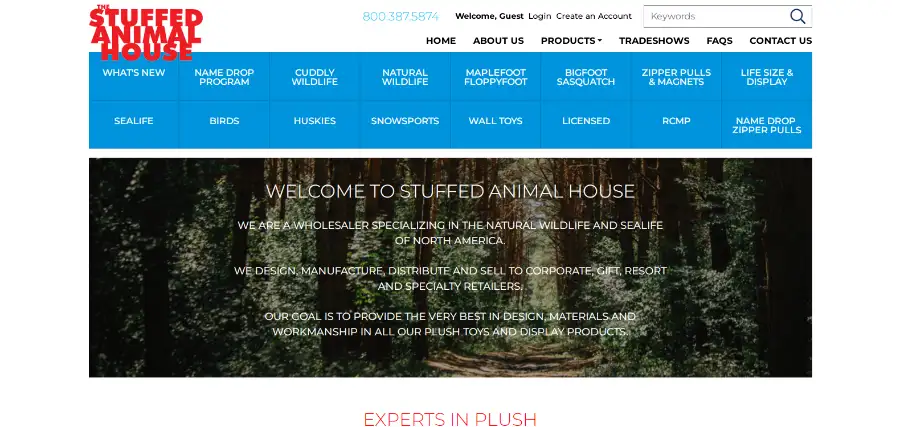
Stuffed With Plush Toys is a wholesale distributor, not a manufacturer. This makes them the ideal partner for gap-filling inventory or testing new niches without the 60-day wait of ocean freight.
Best for: Validating demand. Buy small bulk quantities to test specific categories before investing in private-label tooling.
What to evaluate: In-stock claims and shipping cut-offs. You pay local wholesale premiums for speed, so verify they can ship immediately via their wholesale enquiry process.
Compliance: Request supplier documentation for the specific SKU. Never rely on general storefront copy. You need test reports that comply with Australian product safety laws to satisfy marketplace audits.
When to move on: You cannot add custom branding, hang tags, or unique packaging here. Once you need to build asset value with proprietary designs, you must switch to an OEM.
Read our guide on custom plush manufacturing when you are ready to scale. You should also compare global sourcing options in our China plush guide and Malaysia manufacturer comparison.
🚀 Actionable Insight: Buy 50 units of a specific animal type here to prove the concept. If they sell out in a week, use that sales velocity data to negotiate lower MOQs with a custom manufacturer for your own branded version.
6 Steps to Build Your Australian Toy Procurement Workflow
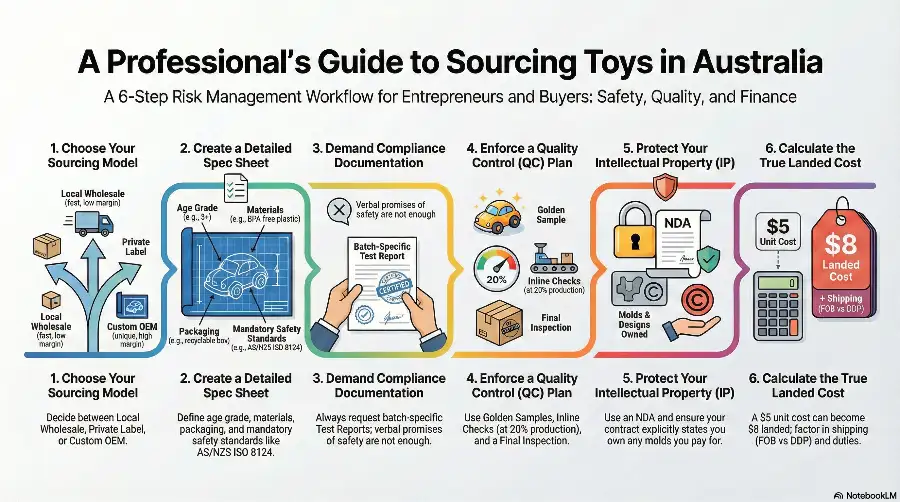
Sourcing is not shopping. It is a technical process of risk management. Use this workflow to move from a concept to a delivered product in Sydney or Melbourne.
Step 1: Decide Your Sourcing Model
Choose the path that fits your timeline and margin goals.
- (A) Local Wholesale. Buy existing stock from Australian distributors. You get fast delivery, but margins are low and differentiation is zero.
- (B) Private Label. Brand a factory's existing design. This is faster than custom work, but you do not own the intellectual property (IP).
- (C) Custom OEM/ODM. Create new tooling for a unique design. This requires higher upfront costs, but it maximizes profit margins and creates a competitive "moat."
Step 2: Build a One-Page Spec Sheet
Never approach a manufacturer with just a photo. Quotes are calculated based on specifics. Your spec sheet must define:
- Age Grade: 0–3 years (requires strictest testing) vs 3+.
- Materials: Specify details like Recycled PET, beech wood, or virgin plush.
- Packaging: Polybag (lowest cost) vs Window Box (retail ready).
- Standards: Explicitly list AS/NZS ISO 8124 requirements.
Step 3: Demand Concrete Compliance Documentation
Do not ask "Is this safe?" Ask for the Test Report per Batch. You need a paper trail to satisfy marketplace audits. Request material declarations and labeling proofs (including mandatory small parts warnings) before mass production begins.
Step 4: Enforce a QC Plan
Stop relying on promises. Implement a standard quality control workflow:
- Pre-production. Approve a "Golden Sample" that serves as the manufacturing standard.
- Inline Inspection. Check quality via video or third-party inspection when 20% of goods are produced.
- Final Inspection. Use ISO 2859-1 (AQL standards) to check a random sample before the container locks.
Step 5: Protect Your IP
Secure your assets for private label or custom projects. Sign an NDA before sharing CAD files.
Crucially, clarify Mold Ownership. If you pay for the tooling, the contract must state that only you can use those molds.
Step 6: Calculate the Real Landed Cost
A $5 unit cost often becomes $8 in Sydney after freight and duties. Compare importing via FOB (Free on Board) vs DDP (Delivered Duty Paid) using official Incoterms definitions. Bulky items like plush toys consume margin in shipping, so factor volume into your math.
Where LeelineToys Fits
We operate as your "Maker-Partner" for Option C. We replace the distributor.
This gives you direct engineer access for custom plush manufacturing and custom wood toys. This direct model improves margins for Australian baby toy brands and plush retailers ready to own their supply chain.
Ready to secure factory-direct pricing? Request a quote and spec review from our engineering team today.
People Also Ask About Toy Manufacturers in Australia
1. Are Australian wholesalers guaranteed to be AS/NZS ISO 8124 compliant?
No, you cannot assume compliance based on location alone. While Australian law mandates safety standards, inventory lapses happen.
Never rely on a verbal claim. For every batch, you must request a valid Test Report that specifically cites AS/NZS ISO 8124 Part 1, 2, and 3. If a supplier offers a "General Certificate of Conformity" without the underlying lab data, do not buy it.
2. What is the difference between a manufacturer, a distributor, and a sourcing agent?
A Manufacturer (OEM) owns the factory and machines. They build products from scratch based on your design.
This is the only path for custom IP. A Distributor warehouses finished goods from other brands.
You buy what they have in stock. A Sourcing Agent is a middleman who finds a factory for you, usually for a commission. If you need to know which partner fits your business stage, read our guide on how to find a toy manufacturer.
3. What Minimum Order Quantity (MOQ) should I expect for private-label toys?
MOQs depend on the material and tooling required.· Plush Toys: Flexible factories often start at 500 units per design. Complex types of plush toys with electronic mechanisms may require 1,000+ units.· Plastic Toys: You face higher barriers due to mold costs. Expect MOQs of 3,000 to 5,000 units to amortize the steel tooling investment.· Wood: Simple shapes can start as low as 500 units if using standard stock timber.
4. Is it cheaper to manufacture in Australia or import from overseas?
Importing is almost always cheaper for volume production. Manufacturing in Australia avoids freight costs and duties, but labor and raw material costs are significantly higher.· Local Manufacturing: Best for small batches (under 100 units) or rapid prototyping where speed outweighs margin.· Importing (China): Best for commercial scale. Even with freight and import duties added, the unit cost is typically 40–60% lower than local production. (See how this compares to other high-cost labor markets in our review of stuffed animal manufacturers in Canada.)
5. What should be in a private label contract to protect my IP?
A standard invoice offers zero protection. Your manufacturing agreement must include:· Tooling Ownership: Explicitly state that you own the molds once paid for. This prevents the factory from using your molds for other clients.· NDA (Non-Disclosure Agreement): Prevents the factory from sharing your CAD files or artwork.· Quality Tolerances: Define exactly what counts as a "defect" (e.g., color variance, seam strength) to enforce QC standards.